








 Web Trader MT5











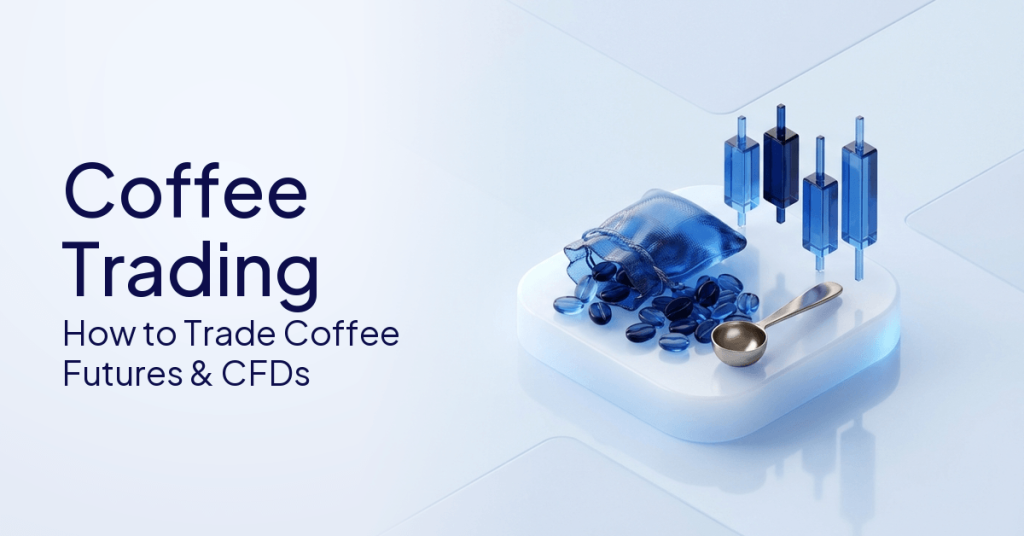
You can gain exposure to one of the world’s largest agricultural commodity markets by trading coffee futures, CFDs, ETFs and related stocks.
Ever wonder what your morning cup of coffee is worth in relation to the billions of dollars that change hands in the world’s financial markets each day?
Coffee is one of the most widely drunk beverages in the world and is a huge, very liquid market. If you start to investigate coffee trading, you will soon come across the two main varieties of coffee that are traded internationally: Arabica and Robusta. Each has its own market, supply chain and price drivers.
It has a diverse mix of participants that keeps these markets alive. Producers and exporters trade to make money. Roasters trade to lock in the cost of supply. Institutions, speculators, and retail traders get involved to profit from price volatility.
This complete guide explains the coffee market in detail. We will look at the main drivers of price, the main instruments you can trade, how to trade CFDs, common strategies, options for longer-term investing, the risks involved and common mistakes that beginners should avoid.
Quick Answer
Coffee trading refers to the buying and selling of coffee as a commodity, whether through futures, CFDs, ETFs or coffee-related stocks.
Prices are highly influenced by weather, world supply and demand, timing of harvests and currency fluctuations. Coffee is a volatile agricultural commodity and there is always a risk to capital. Coffee traders need clear disciplined risk management when learning to trade.
What Is Coffee Trading?
Coffee trading refers to the buying and selling of coffee as a commodity on financial markets, rather than buying through retail coffee purchases.
Coffee Trading Meaning In Simple Terms
Coffee trading is the buying and selling of coffee over time for price. Traders in the financial markets typically don’t buy bags of actual coffee beans to store in a warehouse. Instead, they use derivatives market instruments like futures contracts, CFDs (Contracts for Difference), exchange-traded funds (ETFs) or coffee-related stocks.
Such financial instruments allow traders to attempt to profit from price movements, whether the market is going up or down. If a trader thinks a bad harvest will drive prices higher then they can go long. If they think there is too much supply and prices will fall, they can go short.
Coffee As An Agricultural Commodity
Coffee is an agricultural commodity, also referred to as a “soft commodity”. These are farm products, not mineral or oil products. Other examples are sugar, cotton and wheat. Coffee is a crop and its market pricing is very sensitive to external natural factors.
Crop conditions, global consumer demand, international export flows, changing weather patterns, currency exchange rates and natural production cycles are all hugely influential on the daily price of coffee commodity trading.
Who Participates In Coffee Trading?
The coffee market requires a variety of participants to function efficiently. Producers and farmers participate to lock in prices for their future crops. Exporters and importers use the market to hedge against currency and shipping cost fluctuations.
Major roasters and commercial buyers hedge to stabilize the cost of their supplies. Apart from these commercial players there are commodity firms, institutional traders, hedge funds, retail investors and independent speculators who all provide liquidity to the market and who are looking to make a profit from changes in prices.
Where Coffee Is Traded
Coffee prices are set on major international commodity exchanges and serve as benchmark. Arabica coffee is primarily traded on the ICE Futures US, Intercontinental Exchange, which sets the global benchmark price for premium coffee.
Robusta coffee, on the other hand, is mostly traded on markets based in London, especially on the ICE Futures Europe exchange.
These exchanges do not require membership from retail traders. With online brokers you can simply access the coffee markets and trade CFDs, ETFs, managed commodity funds and even equity stocks.
Green Coffee Trading
Green coffee trading is the buying and selling of raw, unroasted coffee beans in the physical and wholesale supply chain. Commercial roasters and importers buy the green coffee in large shipping containers depending on physical grading and quality of origin.
Green coffee is seldom dealt in by retail traders and financial speculators. Instead, they are exposed to coffee prices via digital financial instruments, while the physical logistics of green coffee are controlled by the commercial industry.
What Are The Main Types Of Coffee?
The two main types of coffee that are traded are Arabica and Robusta, which differ in characteristics regarding price, use and market behaviour.
Arabica Coffee
Arabica is generally considered the premium type of coffee by the industry and consumers. It is sweeter, smoother to the taste and accounts for most of the world’s coffee consumption.
Arabica is a commodity traded on the financial markets on the ICE Futures US exchange. The most common reference is to its ticker symbol KC.
Most of the world’s Arabica supply comes from high-altitude regions in South America, especially Brazil, so Arabica prices are highly sensitive to regional weather conditions. One frost warning in Brazil can get the KC ticker flying in minutes.
Robusta Coffee
Robusta is typically cheaper and is known to be a hardier plant that has a stronger, more bitter taste and significantly higher caffeine content. It is widely used by commercial producers for espresso blends and instant coffee.
The variety is traded on London markets under the ticker symbol RC. Vietnam is the world’s biggest Robusta producer. Thus, the prices of Robusta are largely determined by supply chains in Southeast Asia, regional droughts and the export policies of the countries involved.
Arabica Vs Robusta Price Behaviour
Arabica and Robusta prices can and often do move independently of each other. The reason for the different price behavior stems from different quality grades, different supply chains, different growing regions and different demand profiles.
For example, if consumers are hit by economic hardship, demand for premium Arabica cafe drinks may switch to cheaper Robusta instant coffee at home. Arabica, however, is very sensitive to frost, while Robusta is more resistant to weather changes, but very sensitive to long-term droughts.
Arabica accounts for 58% of the global coffee bean trade by volume, commanding a significant price premium over Robusta due to its superior flavor profile and specialty positioning.
Arabica Vs Robusta Table
| Type | Exchange | Ticker | Key Use | Price Characteristics |
| Arabica | ICE Futures US | KC | Premium coffee, specialty blends | Often higher priced and heavily weather sensitive |
| Robusta | London Market | RC or Broker Specific | Instant coffee and commercial blends | Often lower priced but can be highly supply sensitive |
| Green Coffee | Physical Commodity Market | Varies | Unroasted physical coffee beans | Driven by physical grade, origin, and delivery terms |
What Drives Coffee Prices?
Coffee prices are significantly influenced by weather, crop conditions, supply and demand, currency movements, transport costs and global risk sentiment.
Weather And Climate Events
Weather in key producing countries such as Brazil, Vietnam and Colombia is the main drivers of supply shocks. Coffee plants are highly sensitive to temperature changes.
Drought can destroy beans, too much rain can ruin the harvest, and a hard frost can kill the coffee tree. If climate stress alters the expected size of the harvest, traders react instantly, sending prices soaring and plunging sharply on the world’s exchanges.
Supply And Harvest Cycles
Planting conditions and harvest forecasts always affect coffee prices. Coffee trees are naturally biennial, so a year of big production is often followed by a year of smaller production as the trees recover.
Traders look at world inventories, warehouse stock reports, national export data and official crop forecasts. Any indication that demand is outstripping supply tends to push prices up, while indications of excess supply tend to drive them down.
Currency Movements
As with most major commodities, international coffee contracts are usually quoted in US Dollars (USD). So the overall strength or weakness of the USD directly affects how commodities are priced internationally.
A strong dollar makes coffee more costly for buyers using other currencies, which could curb demand and weigh on prices globally. Local currencies in producing countries, such as the Brazilian Real, also have a strong impact on producers’ selling behavior.
As the Real weakens against the dollar, Brazilian farmers earn more local currency per bag, prompting them to sell more aggressively and flood the market with supply.
Global Demand Trends
The baseline price of coffee is largely determined by global consumption patterns. Demand is changing all the time with economic stability, the rise of the cafe culture and the continued demand for instant coffee.
The International Coffee Organization (ICO) reports indicate that demand in emerging markets is growing as disposable incomes rise in tea-drinking countries. Arabica beans in particular remain in demand as consumer tastes shift towards premium specialty coffee.
Logistics And Production Costs
The journey from a rural farm to a retail cup is long and complex. Shipping costs, global labor shortages, changing fertilizer prices and port storage constraints all play a big role in the final price in the market.
When supply chains are disrupted, such as with freight delays or blockages of shipping lanes, physical coffee cannot efficiently reach global buyers. The bottleneck means that supply cannot be increased immediately and can push prices up dramatically in the short term.
Price Driver Table
| Factor | How It Affects Coffee Price |
| Weather in Brazil & Vietnam | Can drastically reduce or improve the expected physical supply. |
| Harvest Forecasts | Strong harvests may pressure prices downward; weak harvests may support upward prices. |
| USD Strength | Can alter global commodity affordability and shift export behavior. |
| Global Demand | Rising consumption trends can support higher baseline demand expectations. |
| Inventories | Low warehouse stocks may sharply increase supply deficit concerns. |
| Transport Costs | Higher global shipping costs can affect physical coffee flows and final pricing. |
| Crop Disease | Outbreaks (like coffee leaf rust) can reduce output and degrade bean quality. |
| Producer Currency Moves | Can directly influence farmers’ daily export selling decisions. |
How To Trade Coffee: Futures, CFDs, ETFs, And Stocks
Coffee is tradable through futures contracts, CFDs, ETFs, commodity funds, options, and the stocks of companies involved in coffee.
Coffee Futures
Coffee futures are standardized contracts traded on exchanges. The buyer has to purchase and the seller has to supply a certain amount of coffee at a certain price on a certain date in the future. That is the most direct way to trade coffee in the world market.
Coffee futures trading is broad-based, with commercial hedgers locking in supply costs and experienced speculators trading on margin. Futures however have hard expiry dates, large standard contract sizes and complex rollover mechanics that make them less accessible to the casual retail trader.
Coffee CFDs
Coffee CFDs (Contracts for Difference) allow traders to speculate on the price of coffee, without actually taking delivery of the beans. It’s just the difference in price between when you opened and closed your contract.
This instrument is very popular among retail participants as it allows flexible position sizing. However, CFDs are leveraged products and can cause the loss of all your invested capital. Never invest money you can’t afford to lose.
Coffee ETFs And Commodity Funds
Depending on the availability of local markets, some investors prefer to get exposure to coffee through Exchange-Traded Funds (ETFs), exchange-traded products or diversified commodity funds.
These funds track either an index of coffee futures or a basket of agricultural commodities. The approach is much more hands-off, with investors able to buy shares of the fund through a regular brokerage account without worrying about futures expiries or CFD margin requirements.
Coffee Company Stocks
Investors may also invest in coffee indirectly through listed companies with large coffee operations. This could be large retail chains such as Starbucks, large-scale roasting companies, distribution networks or related agricultural supply chains.
These stocks give you exposure to coffee demand but are also affected by company-specific factors. Even if the commodity price of coffee is skyrocketing, a coffee retailer could have bad management or bad earnings reports and its stock price could drop too.
You can explore different asset classes to find other ways to invest in coffee.
Coffee Options Trading
Trading in coffee options involves derivative contracts that are based on the underlying coffee futures. An option gives the buyer the right, but not the obligation, to buy (a call) or sell (a put) coffee at a particular strike price before a particular date.
Traders can use options to hedge existing positions or to speculate with defined risk (limited to the premium paid). But there are complex variables like time decay and implied volatility that go into pricing options. They are considered complex instruments and are generally not suitable for complete beginners.
Instrument Comparison Table
| Instrument | How It Works | Who It Suits | Key Consideration |
| Coffee Futures | Standardized physical contracts traded on public exchanges. | Experienced commodity traders and commercial hedgers. | Strict expiry dates, large contract sizes, high margin. |
| Coffee CFDs | Speculate on price movement without underlying delivery. | Retail traders who fully understand leverage mechanics. | CFD leverage risk, margin maintenance, and overnight swap costs. |
| Coffee ETFs or Funds | Fund-based, pooled agricultural commodity exposure. | Investors seeking an easier, hands-off market access route. | Management fees, tracking errors, and specific product availability. |
| Coffee Stocks | Shares of publicly traded coffee-related businesses. | Investors seeking indirect, equity-based exposure. | Company-specific risk and broader stock market volatility. |
| Coffee Options | Derivative contracts linked directly to coffee futures. | Advanced, highly experienced traders. | Expiry dates, strike price selection, volatility, and deep complexity. |
How To Trade Coffee Using CFDs
Traders can speculate on long or short positions on the price of coffee through coffee CFDs without physically owning or storing the commodity.
What A Coffee CFD Is
A coffee CFD is a financial contract for difference that tracks the live prices of coffee futures. In a coffee CFD trade the trader does not own, store or take delivery of any physical coffee.
The profit or loss of the trade is the difference in prices between the opening and closing of the position, minus any costs to the broker. This allows traders to profit from both bullish and bearish market conditions.
Step 1: Choose A Coffee Trading Platform
Traders need a trusted coffee trading platform with secure access to get going. The platform should feature coffee CFDs, professional charting tools, a variety of order types and tight risk controls.
Traders looking to choose trading platforms should also look at the speed of execution, regulation, customer support and transparency around trading spreads and overnight fees.
Step 2: Open The Coffee Trading Chart
Traders logging into the platform can open the coffee trading chart to analyze the current market conditions.
Traders can choose their own time frame, from one-minute charts for short-term trading to daily charts for a more comprehensive view. They can pinpoint key support and resistance zones, employ technical indicators and review recent price action history to find potential entry points.
Step 3: Choose Trade Direction
CFDs also give traders directional flexibility and traders need to decide which way they think the market will move.
If their analysis indicates a poor harvest in Brazil, which will send coffee prices higher, they will take a ‘long’ (buy) position. Or, if they anticipate a big surplus that will swamp the market with excess supplies and push prices down, they will take a “short” (sell) position.
Step 4: Set Position Size And Risk Controls
This is the most important step. The size of the position of the traders depends on the capital they have in their accounts. They need to check the required margin requirement and how leverage is impacting their trade.
A maximum risk per trade is highly recommended. A strict “stop loss” order is set to protect from severe downside, while a “take profit” order is set to automatically realize gains at a certain target price.
Step 5: Monitor The Trade
The job of a trader doesn’t end when the position is live. Traders should watch the price action in real time. Keep an eye on the available margin level so that you do not get the margin call. Watch out for spreads that widen.
Equally important is to keep an eye on international news, abrupt climate news from the producing areas and general economic news which can cause unexpected market fluctuations. To know the mechanics in detail, read this guide on how to trade Coffee CFDs.
CFD Trading Steps Table
| Step | Action | Notes |
| 1 | Choose Platform | Confirm direct coffee CFD access, transparent costs, and strong regulation. |
| 2 | Open Chart | Review the current trend, support, resistance, and market volatility. |
| 3 | Select Direction | Choose to go long (buy) or short (sell) based on thorough analysis. |
| 4 | Set Trade Size | Double-check required margin and overall account exposure. |
| 5 | Add Risk Controls | Always use stop loss and take profit orders if appropriate to manage risk. |
| 6 | Monitor Position | Track real-time weather news, physical supply reports, and margin usage. |
Note: CFD trading involves significant risk, including the potential for rapid leverage losses. This article is purely educational and is not investment or trading advice
What Coffee Trading Strategies Do Traders Use?
Coffee traders can trade the market using trend following, seasonal analysis, spread trading, technical chart analysis or news-based methods.
Trend Following
The trend following trading strategy is the basic coffee trading strategy. It is a trading strategy that goes with the established price trend. Trend followers wait for a clear direction up or down to develop rather than trying to anticipate market reversals.
Tools such as moving averages can help traders smooth price data, create definitive trendlines to find the direction of the market and use momentum indicators to confirm the strength of the move.
Seasonal Trading
Seasonal trading is also quite relevant, as agricultural commodities are subject to inflexible natural schedules. Seasonal trading involves studying the annual harvest cycles, fixed planting dates, seasonal weather hazards and recurring supply patterns in the leading coffee-producing regions.
For example, traders are aware that the Brazilian winter (June–August) is the highest risk period for frost damage to crops. This enables traders to position themselves before any potential volatility hits the market by anticipating this seasonal risk.
Arabica Robusta Spread Trading
When you spread trade, you are watching the price difference between Arabica and Robusta contracts at the same time. Their uses and supply chains are different, so sometimes their price relationship breaks down.
The strategy provides a way for traders to view relative value, speculating that one type of coffee will outperform another, regardless of what the overall market is doing. This is a very nuanced approach and it requires an advanced, in-depth knowledge of the individual supply chains.
News-Based Trading
News-based traders are only looking at fundamental catalysts and macro data and tend to ignore long-term charts. They follow daily weather forecasts from South America and Southeast Asia, official crop reports, national export numbers, port inventory data and global supply disruptions.
News traders will jump on a big news event, like a surprise drought warning in Vietnam, to take advantage of a sudden, violent price spike or drop.
Technical Chart Trading
Trading based on technical charts is based on the assumption that the past price action can be used to forecast the future market activity. Traders of this sort may use fundamental support and resistance zones, moving averages, the Relative Strength Index (RSI), the MACD indicator and different candlestick patterns.
They look for specific coffee trading chart setups that repeat over and over again to know when to enter or exit a trade. But it’s important to remember that technical chart signals are mathematical probabilities and don’t guarantee winning outcomes.
You can expand your knowledge with specific coffee trading strategies.
Strategy Table
| Strategy | How It Works | Best For |
| Trend Following | Trades exclusively with the main established price direction. | Traders who prefer clearer, sustained directional markets. |
| Seasonal Trading | Studies predictable annual harvest and weather cycles. | Traders who heavily follow agricultural fundamentals. |
| Spread Trading | Compares the relative Arabica and Robusta price movements. | Experienced, advanced commodity traders. |
| News Based Trading | Reacts aggressively to live weather and physical supply reports. | Traders who monitor real-time market news closely. |
| Technical Chart Trading | Uses mathematical indicators and historical price patterns. | Traders focused entirely on price action and chart setups. |
How To Invest In Coffee
Longer-term investors usually get their coffee exposure either through commodity ETFs, broad agricultural funds or stock in coffee-related companies.
Coffee ETFs And Commodity Funds
Coffee ETFs and other commodity funds are a more passive way to invest in coffee (as opposed to buying and selling coffee on a daily basis). They pool investors’ money and buy a basket of coffee futures contracts or a mix of agricultural assets.
That gives you direct exposure to the moves in global coffee prices without the hassle of managing daily CFD margins or the complexities of rolling over single futures contracts.
Coffee Company Stocks
Long-term investors also have a major avenue in buying shares of coffee companies. Investors can indirectly play on the profitability of the coffee industry by buying shares in huge global companies like Starbucks, JDE Peet’s or various agricultural logistics companies.
Remember, investing in equities means being exposed to the ups and downs of the stock market. A company’s stock price is based on its earnings, its management decisions and its retail expansion strategies, not the raw cost of coffee beans.
A Note On Physical Coffee
You can technically buy gold bars or silver coins and keep them as physical investments. Retail investors should not consider physical coffee a viable proposition. Coffee is a perishable agricultural product.
It’s a product that ages and loses its flavor profile, and requires very specific climate-controlled warehouse storage to prevent mold and rot. So note this clearly: physical holdings of green coffee are only a commercial logistics operation. It is not a viable financial investment strategy for retail market participants.
What Are The Key Risks Of Coffee Trading?
Coffee is traded with extreme price volatility and high leverage risks, as well as exposure to currency and potential liquidity issues during times of low market activity.
Price Volatility Due To Weather And Supply
Agricultural markets are known for their volatility. Coffee prices can jump wildly and without warning over the course of a weekend if a sudden weather event hits a major producing region, such as an unseasonal frost or a severe drought. Such price swings can quickly disrupt setups and lead to large losses if positions are not carefully managed.
Leverage Risk In CFD And Futures Trading
Both futures and CFDs use margin and leverage. Leverage enables the trader to control a large position for a relatively small amount of initial capital.
This can increase potential gains, but it also increases potential losses. In a highly leveraged coffee trade, even a small adverse price move can wipe out a trader’s account balance and result in a forced margin closeout.
Currency Risk
Standard coffee contracts are priced in US Dollars, which can expose non-US traders to currency risk. Even if your analysis of the coffee market is correct, negative changes in the exchange rate between your local account currency and the USD can diminish your trading profits or increase your losses.
Liquidity Risks
Typically, coffee is a very liquid market but there can be times when liquidity risk can develop. Market liquidity can dry up if you trade less active months for futures contracts or trade during off-peak exchange hours. That means wider bid-ask spreads, which means it costs more to get in and out of trades, and an increased risk of slippage on your stop-loss orders.
Risk Table
| Risk Type | What It Means | How to Manage It |
| Price Volatility | Sudden, aggressive price swings due to unpredictable weather or supply shocks. | Use strict stop-loss orders and reduce position sizes during volatile seasons. |
| Leverage Risk | Magnified losses from controlling large positions with minimal upfront margin. | Lower your effective leverage and never risk too much capital on a single trade. |
| Currency Risk | Fluctuations in the US Dollar negatively impacting your non-USD account balance. | Monitor major macroeconomic USD trends alongside coffee market analysis. |
| Liquidity Risk | Difficulty executing trades at desired prices due to thin market volume. | Stick to trading the most active, high-volume contract months and peak market hours. |
Legal Disclaimer: This guide is strictly for educational purposes and does not constitute investment advice. Trading commodity CFDs carries a significant risk of rapid financial loss.
What Common Mistakes Should Beginners Avoid In Coffee Trading?
Beginner mistakes include ignoring the market information, over-leveraging, thinking coffee is safe and not knowing the details of the contracts.
Ignoring Weather News And Supply Reports
Many beginners focus on technical indicators and completely overlook the fundamental reality of agricultural commodities. Traders who don’t check on the weather forecasts in Brazil or who ignore the ICO supply reports are trading blind. An unseasonable frost will take a big bite out of the world crop and therefore, a perfect technical chart set-up will fail immediately.
Overleveraging Positions In Volatile Markets
The platforms allow for high leverage so beginners often use the maximum allowed to try to make big profits fast. That’s a fatal mistake in a volatile market like coffee. If an account is over-leveraged, then small, normal movements in the market can wipe it out and trigger margin calls before the larger trend in price has even started to develop.
Treating Coffee As A Low-Risk Market
Some newer traders have the misconception that because coffee is a consumer staple that it must be a slow moving, stable market. Coffee is in fact highly sensitive to global macro economic shocks, shipping crises and climate events and is therefore a high risk high reward trading environment.
Not Understanding Contract Specifications
If you are new to trading coffee futures or futures based CFDs, not knowing the contract specifications will cost you dearly. Most newbies are not aware of the contract expiry date and are surprised by broker rollovers, settlement fees or forced liquidations. You should know exactly what you are trading in the instrument terms.
Mistake Table
| Mistake | Why It Happens | What to Do Instead |
| Ignoring Weather Data | Relying exclusively on technical chart patterns. | Check agricultural news and weather forecasts daily before trading. |
| Overleveraging | Attempting to force large profits from small account balances. | Use conservative position sizing and maintain ample free margin. |
| Assuming Low Risk | Confusing consumer familiarity with market stability. | Treat coffee with the strict risk management required for volatile commodities. |
| Ignoring Expiries | Lack of research into how derivative contracts function. | Always verify the underlying contract expiry dates and rollover rules. |
FAQs
Coffee trading is the buying and selling of coffee as a financial commodity, in order to speculate on price movements. Instead of buying the physical beans, traders play the market with instruments such as futures and CFDs. It offers people and institutions opportunities to profit from shifts in global coffee supply and demand.
Trading in coffee futures refers to standardized contracts that trade on major exchanges. These contracts are agreements to buy or sell a certain amount of coffee at a fixed price on a specified date in the future. Most Arabica trading is on ICE Futures US, and most retail traders and speculators close out their futures positions before expiry to avoid taking delivery of the physical commodity.
Arabica is a premium bean, more expensive, higher quality and highly weather sensitive, traded on the ICE Futures US exchange. Robusta is a hardier, stronger, cheaper bean, used in instant coffee and traded mainly on the London markets. They have different tickers and report to different regional supply chains.
Yes, coffee CFDs allow retail traders to speculate on the price of coffee without ever taking delivery of the commodity. CFDs allow traders to buy and sell on margin. However, you should also be aware that CFD trading involves a high level of risk, as leverage can increase both potential profit and overall loss.
The biggest driver of coffee prices is the weather in major coffee-producing countries like Brazil and Vietnam. Other important drivers include annual supply and harvest cycles, strength of the US Dollar, changing global consumer demand and logistical shipping costs. The threats to the size of the future harvest tend to drive prices up.
Conclusion
Trading coffee provides a hands-on exposure to one of the most important agricultural commodity markets in the world.
No matter how you decide to trade the markets, whether it’s through direct futures contracts, flexible CFDs or longer-term equity investments, it’s important to understand the key drivers of coffee. All the time, prices go up and down because of the world’s weather, changing harvest cycles and changing consumer demand.
There are lots of opportunities in the market to take advantage of trends but with commodity prices being hyper-volatile, traders need to be disciplined and manage their risks in a balanced manner at all times.
If you want to take your knowledge to the next level, spend some time to explore coffee trading strategies and how technical and fundamental analysis can help you refine your approach to the market.
This content is provided for educational and informational purposes only. It does not constitute investment advice, financial guidance, or a recommendation to trade any financial instrument.
Tags


Open Live Account
 Email Address
 Phone Number
Important Notice
STARTRADER does not accept any applications from Australian residents.
To comply with regulatory requirements, clicking the button will redirect you to the STARTRADER website operated by STARTRADER PRIME GLOBAL PTY LTD (ABN 65 156 005 668), an authorized Australian Financial Services Licence holder (AFSL no. 421210) regulated by the Australian Securities and Investments Commission.
Important Notice for Residents of the United Arab Emirates
In alignment with local regulatory requirements, individuals residing in the United Arab Emirates are requested to proceed via our dedicated regional platform at startrader.ae, which is operated by STARTRADER Global Financial Consultation & Financial Analysis L.L.C.. This entity is licensed by the UAE Capital Market Authority (CMA) under License No. 20200000241, and is authorised to introduce financial services and promote financial products in the UAE.
Please click the "Continue" button below to be redirected.


