








 Web Trader MT5









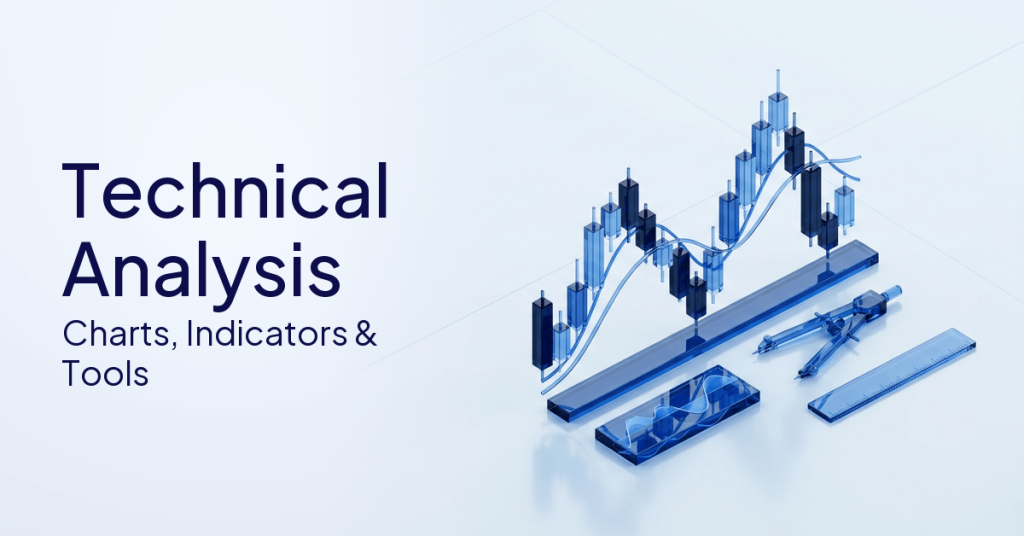
Every time a trader looks at a price chart and says, “Where is this market probably going next?”, they’re working with technical analysis – whether they realize it or not. It’s one of the most widely used frameworks in trading, used daily by millions of traders across forex, stocks, commodities, and indices.
Technical analysis is the study of past price data, chart patterns, and trading volume to predict future price changes. One of the fundamental principles of technical analysis is that all information is reflected in the price. This contrasts with fundamental analysis, which considers value, company earnings, and economic statistics. If this is the case, then examining the trajectory of prices over time will provide a significant indication of their future direction.
This guide is for beginner to intermediate traders who want to learn about the practical tools of technical analysis: how to read charts, what the most common indicators measure, how Fibonacci retracement works, what pivot points are, and how to bring these tools together in a trading context.
Quick Answer
Technical analysis is the study of past prices, chart patterns, and trading volume to forecast future price movements. Traders may employ charts, indicators, and pattern recognition to find suitable entry and exit positions. The basic idea is that the prices consider all existing facts. It is used for FX, stocks, commodities, and indexes. It doesn’t guarantee profits.
What Is Technical Analysis?
Technical analysis is a technique developed to forecast price movement using price charts, volume, and previous price action, and the principle that “all important information is contained in the price itself.”
The central concept, called the efficient markets assumption, is that prices reflect all discounts. The price changes in response to supply and demand, news, economic data, market sentiment – it’s all in the price at all times. That is, traders can hypothesize about future price behavior based on previous price action.
But that doesn’t mean technical analysis can predict the future with certainty. There’s no analytical way to achieve this. It provides you with a structure for identifying trends, a way to measure momentum, a way to gauge where buyers and sellers have typically traded, and a way to define levels at which buying and selling pressure is expected to shift.
Day traders use technical analysis to identify intraday entry points, and swing traders hold a trade for several days or weeks. Forex traders also use technical analysis to make decisions based on short-term price signals, and commodity traders use it to track trend continuation.
The instruments across all markets are the same; only the application varies by time period and instrument.
Technical Analysis vs Fundamental Analysis
Technical analysis relies on price charts and indicators, while fundamental analysis is based on the intrinsic worth of the asset. Numerous traders use both of these.
You need to know the role of technical analysis in the bigger picture so you can know what it can and cannot tell you.
| Feature | Technical Analysis | Fundamental Analysis |
| Focus | Price charts, volume, patterns, indicators | Company financials, economic data, and valuation |
| Tools used | Charts, moving averages, RSI, Fibonacci, patterns | Earnings reports, P/E ratio, GDP data, and interest rates |
| Time horizon | Short to medium term (intraday to weeks) | Medium to long term (months to years) |
| Core assumption | Price reflects all known information | Price eventually reflects intrinsic value |
| Typical users | Day traders, swing traders, forex traders | Investors, portfolio managers, equity analysts |
| Market application | Forex, stocks, commodities, indices | Stocks, bonds, macroeconomic strategy |
Some traders rely only on technical analysis. Others use fundamental analysis to determine which trades to take and technical analysis to determine when to enter. Neither of the two approaches is better than the other. The combination depends on the trader’s trading style, timeframe, and the markets they trade.
Types of Price Charts
The price chart is the basis of all technical analysis. There are 3 basic types of charts: line charts, bar charts, and candlestick charts.
Understanding how each chart type presents price information helps traders choose the appropriate visual format for their analysis style.
Line chart: The simplest of all chart types. It plots one price (usually the closing price) for each period of time and connects the points with a line. Line charts give you a fair idea of the overall price direction, but don’t show how much prices moved in each period. These are useful for a general overview but not very detailed for short-term analysis.
Bar chart: Also called an OHLC chart (open, high, low, close). Each vertical bar is a period of time. The highest price it made is the top of the bar. The lowest is at the bottom. Opening and closing prices are shown by little horizontal lines on the left and right. Bar charts offer more detail than line charts and are typically used by traders who want to see the price range for each trading session clearly.
Candlestick chart: The most popular chart type in modern trading. Candlesticks display a period’s open, high, low, and close like bar charts, but are easier to interpret visually. The thick rectangle is the body of the candle, and represents the difference between the open and the close. Above and below the body are thin lines (wicks) indicating the highs and lows. If the candle is green or white, the close is higher than the open (a bullish period). If the candle is red or black, it means that the closing price is lower (bearish phase).
Candlestick patterns such as the hammer, engulfing, and doji are used to identify potential reversals and continuations. Most traders use candlestick charts for their clearer, simpler appearance and the ability to be understood quickly and easily compared to bar charts.
Understanding all the types of trading charts helps you make more informed decisions with minimal mistakes.
Key Concepts: Support, Resistance, and Trend
Before traders can begin using indicators, they must master the basics of all technical analysis: support, resistance, and trend.
| Concept | Definition | How Traders Use It |
| Support | A price that historically has been strong enough to stop sellers from selling out of that price | Possible entry point for long trades; stop-loss below support |
| Resistance | A price level that has previously proved sufficient to halt further upward movement in price | Potential exit zone or entry for short positions; stop-loss placement above resistance |
| Uptrend | A series of higher highs and higher lows | Traders look to buy pullbacks toward support |
| Downtrend | A series of lower highs and lower lows | Traders look to sell rallies toward resistance |
| Sideways/ranging | Price is moving horizontally between support and resistance | Traders buy at support and sell at resistance |
Support is a price level that buyers have historically jumped into. As the price approaches a support level, a trader is likely to expect buying interest that will stop or reverse the price decline. Support does not always hold, but it is a significant period of buying activity that has been noted in the past, and the market has reacted accordingly.
Resistance is the mirror image. A price level at which sellers have been around enough not to allow it to shoot higher. If the price approaches resistance, traders will anticipate a resumption of selling pressure. Like support, resistance does not necessarily hold — it is a level the market has respected time and time again.
Trend is the direction of price movement over a given time frame. In an uptrend, price highs and lows occur at higher levels than in the previous price action. If lows are lower than lows and highs are lower than highs, it is a downtrend. A sideways market (also known as a range market) is a market in which prices trade within a specific range, or band, over a given time period.
Trend lines are formed by a series of higher lows in an uptrend and lower highs in a downtrend. They provide traders with some dynamism and can help them pinpoint trend exhaustion or reversals. A downward movement within an uptrend is often seen as a sign that the uptrend may be losing momentum.
Popular Technical Indicators
Technical indicators are mathematical formulas derived from price data that traders use to gauge momentum, identify trends, assess volatility, and pinpoint potential reversal points.
Knowing what each indicator measures — and its shortcomings — helps the beginner avoid the pitfall of trading solely on an indicator without understanding what it is saying. Indicators are signals, not certainties. They perform well under certain market conditions, and when used alongside chart analysis and support and resistance levels, they provide more context than any single indicator.
| Indicator | What It Measures | Typical Use Case |
| Moving Average (MA/EMA) | Average price over a defined period | Identifying trend direction and crossover signals |
| RSI (Relative Strength Index) | Momentum and speed of price movement | Identifying overbought (above 70) or oversold (below 30) conditions |
| MACD | Trend direction and momentum | Identifying trend changes and momentum shifts via crossovers |
| CCI (Commodity Channel Index) | Deviation from the average price | Identifying cyclical turning points and overbought/oversold conditions |
| Bollinger Bands | Price volatility around a moving average | Identifying periods of high/low volatility and potential breakouts |
Moving Averages smooth out price data to determine the direction of the price trend. A simple moving average (MA) is the average of the closing prices over a given number of periods. An exponential moving average (EMA) places more emphasis on the most recent price and is therefore more sensitive to the present situation. One of the most common signals used in trend-following strategies is the crossover between two moving averages, with one MA having a longer period than the other.
RSI (Relative Strength Index) is a measure of the velocity and intensity of price movements in the recent past, ranging from 0 to 100. If the price is above 70, it indicates the stock may be overbought, meaning the recent price increase may have been too strong, and a pullback may be possible. Readings below 30 indicate oversold conditions. RSI is a momentum indicator best used in conjunction with trend-direction analysis in trending markets.
Moving Average Convergence Divergence (MACD) is a combination of two moving averages used to indicate trend direction and strength. When the MACD line crosses above the signal line, it’s often interpreted as a bullish signal—a bearish signal when it crosses below. A divergence between MACD and price (when the indicator moves in the opposite direction to price) can be a sign of a weakening trend.
Bollinger Bands rely on two outer bands that are a specified number of standard deviations above and below a moving average, and a middle band that is the moving average. If the bands get close together (volatility contracts), it sets up for a big price swing. The bands are used to signal overbought or oversold price conditions; however, when the price approaches or crosses the outer bands, it may mean that the price is “walking the band,” which can signal a strongly trending market for long periods.
CCI (Commodity Channel Index) is a technical indicator that measures the deviation of price from the average price trend over a given time frame. High positive readings indicate the price is trading above average (overbought). Low negative readings indicate it is significantly below (oversold). You can read a comprehensive explanation of how you can use the CCI indicator in practice, where you will learn how you can identify the cyclical turns and the divergence signals.
For traders interested in forex, the forex indicators guide for beginners and the technical indicators in forex guide are must-reads. They both cover how to apply technical indicators in the currency market, as well as the rules and considerations traders should use for each currency pair and time frame.
Fibonacci Retracement and Levels Explained
Fibonacci retracement is one of the most commonly used tools in technical analysis: it identifies potential support and resistance levels based on the Fibonacci sequence.
The Fibonacci sequence is a series of numbers that follows the pattern: 0, 1, 1, 2, 3, 5, 8, 13, 21, and so on; that is, each number is the sum of the two preceding numbers. These numbers are ratios to one another, especially 23.6%, 38.2%, 50%, and 61.8%, which are frequently found in natural patterns and have been used as price correction and price reversal points in financial markets.
In trading, Fibonacci retracement works by identifying a clear price swing (from a swing low to a swing high in an uptrend, or from a swing high to a swing low in a downtrend) and plotting price levels against the key retracement levels. The resulting horizontal lines can be used to find potential support and resistance levels on the market during a pullback.
| Fibonacci Level | Significance | Trader Interpretation |
| 23.6% | Shallow retracement | Common in strongly trending markets; price doesn’t pull back far |
| 38.2% | Moderate retracement | First major level; often watched in trending markets |
| 50% | Midpoint | Not a Fibonacci ratio technically, but widely watched as a psychological level |
| 61.8% | The “golden ratio.” | Most closely watched Fibonacci level; considered the key retracement zone |
| 78.6% | Deep retracement | Often, the last zone before the original move is considered invalid |
The most notable level is 61.8%, known as the “golden ratio”. In a bull run, many traders look for price action to reach this level and then hold there, seeing it as a potential buying signal, assuming the upward trend will resume. This level is also a bit self-rewarding, as so many traders watch it; it is a self-fulfilling trade in many markets.
Fibonacci extensions show probable price levels after the initial price move. Where retracement levels identify where a correction may pause, extension levels (e.g., 127.2%, 161.8%, 261.8%) identify where the next leg of the trend may reach. The two tools often work together.
Learning how to use Fibonacci retracement helps you illustrate how to use the tool on a chart. Also, learning the Fibonacci levels in trading helps you understand their role across various market conditions and time periods.
Example: A forex trader sees a clear, smooth bottoming trend in a currency pair that has rotated from a low to a new high. Instead of looking at the move at the top, they employ a Fibonacci retracement grid and know that the 61.8% retracement area would make a good entry point on the pullback. Price comes back down, hits the 61.8% level, then turns back up. The trader has a clear stop-loss level below the swing low, unlike a random level they could have picked. That’s how Fibonacci retracement works in reality: as a blueprint for locating a structured entry point from a defined risk level during trend reversals.
Pivot Points Explained
A pivot point is a price level calculated using the highest, lowest, and closing prices of a previous time frame, which can serve as potential support and resistance levels for a given trading session.
The standard pivot point formula is quite simple:
Pivot Point = (Previous High + Previous Low + Previous Close) / 3
From this pivot point, additional support and resistance levels are derived above and below. Generally, these levels are referred to as S1, S2 (support), and R1, R2 (resistance), and they provide traders with a defined price range to expect throughout the trading session.
Pivot points are especially favored in forex and index trading, where they provide clear, calculated levels without the need for subjective drawing. Pivot points are mathematically based and usually the same for all traders, unlike chart-pattern support and resistance levels, which traders can plot in various ways.
There are several ways to calculate pivot points. Standard (classic) pivot points are the most popular ones. Camarilla pivot points also add more weight to the calculation, and for some intraday traders, this system is preferred for tighter, more accurate levels. Woodie’s pivot points are slightly more sensitive to the latest price action because they assign greater weight to the end-of-day price.
If the price is above the central pivot point, the overall interpretation is that of a bull market action. However, trading below indicates a bearish interpretation. These are S1, S2, R1, and R2, which are used as entry, exit, and stop-loss levels throughout the session.
The details of the calculation method and practical examples are explained in the pivot point in the trading guide.
How to Use Technical Analysis in Forex Trading
Technical analysis is a critical aspect of forex trading because the foreign exchange markets are highly dominated by day-to-day trading activity, and chart patterns and indicators may offer more actionable signals than fundamental data.
Fundamental analysis is more important in equity markets for long-term valuation. It’s worth noting that in the world of Forex, macro factors do have an impact, but because so much trading occurs within a day, price behavior tends to be more consistent when technical patterns are followed. Forex is an ideal market for technical analysis.
Shapes and patterns with indicators are more informative than indicators alone. The combination of the price approaching a key resistance level and the RSI being near buy-over conditions is a more structured combination than either indicator alone. If several technical tools converge, they are more likely to be viewed as a stronger signal by many traders.
The use of support and resistance and Fibonacci levels offers a practical approach to finding entry and exit areas. If a Fibonacci level meets a previous price support area, then this is where many traders come up with the designation of a “confluence zone” — a price area in which more than one independent technical signal is pointing to the same potential turning point.
Also, the choice of time frame is very important. Swing traders on the daily chart on the same currency pair will see something different than intraday traders looking at 15-minute or 1-hour charts. One good technique is to confirm the overall trend from the higher time frame, then time the entry using the lower time frame. This is a top-down approach in which the shorter-term trades are executed in line with the overall direction.
In the short term, economic events such as interest rate decisions, inflation data, and employment data can and do trump technical signals. A technically perfect setup can be ruined by a big news release and end immediately. Many of the more advanced forex traders know what to expect when certain economic events are released and adjust their trading accordingly, either by not trading during the high volatility that often accompanies these releases or by waiting for the initial volatility to die down before using technical analysis again.
There is no certainty that profitable trades will come through with technical analysis. Trading is a risky business, and what has happened in the past is not necessarily what will happen in the future.
The foreign exchange market is the largest and most liquid financial market in the world, with daily trading exceeding several trillion dollars, according to the Bank for International Settlements. This liquidity is one of the most significant factors that make technical analysis so important in Forex: If several traders are watching a particular price level, Fibonacci zone, or indicator signal at the same time, many traders are likely to believe the price will respect that level.
Tips for Beginners Using Technical Analysis
While it is true that starting with technical analysis may seem daunting, it is possible when tackled in the right order: first the foundations, then the indicators, and finally, the fewer the tools, the better.
A few practical principles help beginners develop their technical analysis skills more efficiently:
Start with chart reading before indicators. If you are looking to add indicators to your charts, take the time to learn to read price action first. Find support and resistance, learn to recognize trend lines and uptrends and downtrends, and practice drawing trend lines. The key to making indicators more meaningful is to be able to read a clean price chart.
Use two to three indicators maximum to start. One of the most common errors beginners make is adding more indicators to a chart than they should. If there are 5 or 6 indicators on the screen at the same time, they tend to clash and may cause confusion rather than clarity. A moving average and an RSI give most beginners enough information to start understanding how indicators work in practice without overwhelming the analysis.
Understand what each indicator measures before using it. As with instructions in an unknown language, it is not possible to use an indicator you don’t understand. Always find out what the tool measures, what the signals indicate, and when the tool is most effective before adding an indicator to your chart.
Backtest your approach on historical charts. Before using any technical setup with real capital, test it on historical price data. Look at past examples of the same setup on the same instrument and assess how often it worked and how often it failed. This builds realistic expectations and prevents the error of assuming a technique is foolproof because the first few examples looked good.
Recognize that indicators lag. Most indicators are derived from historical price data, so they react to what has already happened rather than predict what will happen next. This lag is inherent in the tool. Understanding it prevents the frustration of entering a trade based on an indicator signal that appears just as the move is ending.
Combine technical analysis with risk management. The best technical setup in the world is undermined by poor position sizing or the absence of a stop-loss. Technical analysis tells you where to enter and where your thesis is likely wrong. Risk management determines how much you lose if you’re wrong. Both are required for sustainable trading.
Frequently Asked Questions
Technical analysis involves analyzing price action, chart patterns, and trading volume to predict future price movements. The basic principle is that price action reflects all known information; therefore, a study of price behavior can indicate future price action. It is used by traders interested in short- to medium-term opportunities across all asset classes, including forex, stocks, commodities, and indices.
There are three types of charts: line charts display closing prices over time; bar charts show OHLC data over time; and candlestick charts, the most popular, visually show the same OHLC data with color-coded bodies and wicks. The most popular traders use candlestick charts because they are more visible and helpful for spotting patterns.
Fibonacci retracement maps key price levels — 23.6%, 38.2%, 50%, 61.8%, and 78.6% — across a significant price move. These levels are used to identify areas of price correction that typically stall or reverse. Often, traders rely on them to identify potential pullback areas, such as the 61.8 level, known as the golden ratio.
CCI (Commodity Channel Index) is an indicator that measures price movement relative to the average price over a given time frame. High positive readings indicate that the price is well above average (overbought), and high negative readings indicate it’s well below average (oversold). Traders use it to identify turning points and divergence between the indicator and the price chart.
A moving average and RSI are the most practical starting combination for beginners. The moving average shows trend direction; the RSI shows momentum and potential overbought/oversold conditions. Starting with two indicators reduces the risk of conflicting signals and “analysis paralysis.” Once comfortable with these, additional tools can be added gradually.
A pivot point is a calculated price level made from the highest, lowest, and closing prices of the previous time period. The central pivot and its support levels provide a range of price levels that traders can use during the session. In forex trading, index trading, and other forms of trading, pivot points are used as objective, mathematical reference levels.
Forex traders rely heavily on technical analysis because currency markets involve large volumes of short-term trading activity where price patterns are often consistent and chart-derived signals are widely followed. Common approaches include combining trend indicators with momentum oscillators, using Fibonacci levels to identify entry zones, and aligning trades with the direction shown on higher timeframes. Economic data releases can override technical signals and should be factored into trade planning.
Conclusion
Technical analysis provides a structured framework for traders to understand price, identify chart patterns, measure momentum, and determine entry and exit points. Those tools include charts, indicators, Fibonacci tools, and pivot points, each of which examines a different aspect of that framework and is best used in conjunction with the others.
The first and most crucial principle to grasp is that technical analysis provides information for decision-making. It doesn’t make them. What has worked in the past may not work in the future. Indicators that signal a trade can be wrong. Also, risk management — knowing how much to risk on any single setup and having a clear plan if the trade moves against you — is as important as the analysis itself.
The practical next step is to learn more about the particular tools that you’re most interested in. Learning how to use Fibonacci retracement is a logical starting point for traders who want to apply one of the most widely used technical tools in a structured, practical way.
Note: This content is for informational purposes only and doesn’t constitute investment advice. Trading involves risk, and historical performance is not necessarily indicative of future performance.
Ready to go deeper? Look into the Fibonacci retracement guide and the technical indicators overview to further develop your understanding of the tools mentioned in this article.
Tags


Open Live Account
 Email Address
 Phone Number
Important Notice
STARTRADER does not accept any applications from Australian residents.
To comply with regulatory requirements, clicking the button will redirect you to the STARTRADER website operated by STARTRADER PRIME GLOBAL PTY LTD (ABN 65 156 005 668), an authorized Australian Financial Services Licence holder (AFSL no. 421210) regulated by the Australian Securities and Investments Commission.
Important Notice for Residents of the United Arab Emirates
In alignment with local regulatory requirements, individuals residing in the United Arab Emirates are requested to proceed via our dedicated regional platform at startrader.ae, which is operated by STARTRADER Global Financial Consultation & Financial Analysis L.L.C.. This entity is licensed by the UAE Capital Market Authority (CMA) under License No. 20200000241, and is authorised to introduce financial services and promote financial products in the UAE.
Please click the "Continue" button below to be redirected.


