








 Web Trader MT5










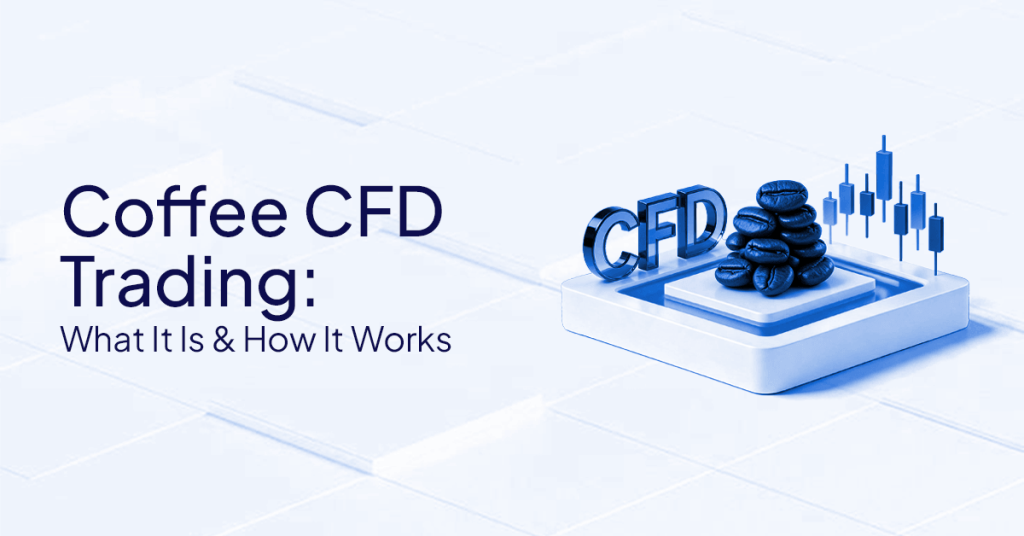
A coffee CFD is a financial agreement that enables traders to speculate on the price movement of coffee beans without owning, storing, or delivering the actual commodity.
Does the cost of your morning coffee change due to a Brazilian frost or the Vietnamese shipping time-out?
Although most individuals remain aware of the final price in a cafe, the coffee market is highly dynamic, with prices constantly changing.
This coffee trading guide will discuss coffee CFD trading, its mechanics, the critical role of leverage, and its risks.
Note: CFDs (Contracts for Difference) are complex instruments, and they are at a high risk of incurring a significant loss in a short time as a result of leverage. Some jurisdictions place limits on them, the United States being the most notable. This article is purely educational and does not amount to investment advice.
Quick Answer
Coffee CFDs are derivative products which follow the live price of coffee futures, where participants can trade on the rising and falling markets. Unlike physical buying of beans, you are trading on the difference between the opening and closing of a position, often with leverage to increase exposure, which increases both the potential return and the risks.
What Is a Coffee CFD?
This is a derivative financial instrument that tracks the price of coffee, allowing traders to speculate on the market’s direction without physically holding the commodity.
Coffee CFD Meaning
The coffee CFD meaning is based on an agreement between a trader and a provider to trade the difference between the value of coffee, and it applies when a trade is opened and closed.
Whenever you think the price is going to increase, you buy (go long); whenever you feel it is going to decrease, you sell (go short).
It is a derivative, and therefore, no physical delivery of sacks of coffee ever occurs. The outcome of the trade is an entirely cash settlement based on price movement.
Is Coffee a Commodity or a Currency-Style Market?
Coffee is a soft commodity; it is not mined but grown, and it can be traded in a very different way compared to currency pairs.
Whereas interest rates and a country’s political stability influence currencies, physical supply and demand factors influence soft commodities, such as weather and harvest periods.
In most cases, CFD coffee products are based on the prices of two widely traded varieties of beans.
That is Arabica (which is usually deemed to be of a higher quality) and Robusta (instant coffee). These are typically compared with key contracts of the futures exchange.
How Does Coffee CFD Trading Work?
Coffee CFD trading works by allowing you to take a position based on where you think prices will move in the future, and trade on margin so that you can control a larger position than your deposit.
Long vs Short on Coffee
Buying a CFD in the hope that coffee prices will rise is referred to as going long, whereas selling a CFD in the hope that prices will fall is referred to as going short.
- Bullish Scenario (Long): A trader expects that a drought will occur in a large producing area, which will hurt supply. They open a “buy” position. In the case of a price increase, they shut the trade at a profit (after charges).
- Bearish Scenario (Short): A trader thinks that there will be a bumper crop in the market. They open a “sell” position. They get the difference in case of a price decline.
Margin and Leverage
Margin is the small percentage of the total value of the trade you have to deposit to establish a position. In contrast, leverage is the tool that enables you to manage that large position.
For example, if a broker offers 1:10 leverage, you could control only $1000 worth of coffee contracts with just $100.
Although this reduces the entry barrier, it is essential to note that leverage increases the gains and losses. When the market works against you, you can run out of the money that you had deposited.
- Risk Note: Soft commodities are highly volatile and leveraged, and without careful risk management, they can be liquidated quickly.
Coffee CFD Contract Specs You Must Understand
Each CFD is subject to a set of rules known as CFD specifications, which determine the calculation and execution of the trade.
Underlying Reference
The majority of coffee CFDs are based on futures contracts listed on major international marketplaces, including the Intercontinental Exchange (ICE).
This makes the price which you would see on your computer screen equate to the actual global market price of coffee.
Nevertheless, CFD providers usually update their prices to reflect the change between the current and upcoming futures contracts as a future contract approaches expiration.
Lot Size, Tick Value, Trading Hours, Rollover
Such technicalities define the minimum amount of business, or the value of individual price movements and the timing of business.
- Lot Size: The amount of coffee in one contract that is standardized.
- Tick Value: The cash value of the least amount of movement of the price.
- Trading Hours: Coffee markets do not operate 24/7 as forex; they have definite break times.
- Rollover: When you are in a position at the end of the underlying futures contract, you may roll that position to the next month, which may carry an adjustment fee.
What Moves the Coffee Market?
The supply-side shocks that have a key influence on the price of coffee include weather-related, geopolitical logistics, and the economy of the key exporting countries.
Weather Shocks and Crop Conditions
An extreme weather event is defined as an immediate, short-term occurrence of an unusual weather condition in relation to the average weather conditions of a particular region in a specific time.
The most significant contributors to price volatility are extreme weather events, which can be frost or drought in the major growing areas, including Brazil or Vietnam.
Coffee trees are sensitive, and therefore, a sudden drop in temperature can ruin a season of crop production, leading to an increase in the world prices.
On the other hand, the optimal conditions for growth may cause oversupply, which pushes the prices downwards.
Major Producers and Supply Chain
The global market is highly concentrated, with a large share of coffee produced in Brazil and Vietnam.
Any unrest in such nations, such as a labor market strike, political unrest, or a port logjam, can affect the supply of beans to the market. The International Coffee Organization (ICO) also publishes monthly reports on authoritative data on production.
Currency Impact and Global Demand
The US dollar and the exchange rates of producing countries (such as the Brazilian Real) have a significant effect on export prices in the country.
When the Brazilian Real is low against the Dollar, farmers tend to sell more coffee for export, generating more currency, which may raise global supply and reduce prices.
Costs and Risks in Coffee CFDs
The costs of trading, in the form of spreads and swaps, consume potential returns, whereas leverage creates the uncertainty that you may end up making a loss larger than you anticipated.
Spreads, Overnight Financing, Slippage, and Gaps
The spread is the cost of opening the trade, and overnight financing (swaps) is the cost of maintaining a leveraged position after the end-of-day cut-off.
- Spread: The difference between the bid and ask prices.
- Swaps: Daily interest readjustment. These costs may accumulate with long-term strategies.
- Gaps: Because coffee markets are not open all day, news may be announced when the market is not accessible. The price may reopen much higher or much lower than the closing price, thereby bypassing stop-loss orders.
Volatility Risk Amplified by Leverage
Coffee volatility is well known, and leverage combined with regular market movements can lead to significant account losses.
As statistics from sources such as the Commodity Futures Trading Commission (CFTC) have shown, commodities markets are fraught with hazards stemming from physical delivery limitations and indirect speculative restrictions that influence the pricing patterns of CFDs.
Beginners do not realize that a small weather phenomenon can shift the market very quickly.
How to Trade Coffee CFDs Step by Step
A practical approach to trading coffee CFDs is to adopt a systematic procedure that focuses on risk management rather than on profit accumulation.
Pre-Trade Checklist
You need to revise the market environment and your own risk parameters before you trade coffee CFD products.
- News Check: Is there a weather warning in Brazil?
- Check Chart: What is the trend in the long run?
- Check Calendar: Does it have any crucial economic reporting?
- Platform Check: This is an assurance that you are on the right platform. (See instruments available on the commodities page of STARTRADER).
Position Sizing and Stop-Loss Rules
Never get into a trade without first determining the particular amount of money you are prepared to lose and an automatic exit point.
- Position Sizing: It is essential to decide the size of your trade depending on the money in your account rather than the confidence you have.
- Stop-Loss: It should be a stop-loss order. It is a teach-back order that automatically closes the trade when the price moves against you by a predetermined amount, limiting potential losses.
Common Mistakes Beginners Make
The new traders fail most of the time because they treat coffee trading as gambling rather than a strategic financial activity.
- Over-leveraging: With the highest leverage, there is no opportunity for normal market breathing.
- Chasing the Market: Buying a trade simply because of the fast change in price, which typically leads to its purchase at the peak.
- Neglecting Swaps: Being in positions and holding for weeks without realizing that the overnight charges are eating into the account.
- Lack of Education: the inability to comprehend the distinction between the Arabica and Robusta markets. To gain more profound knowledge, consult sources such as the education center at STARTRADER.
Key Risk Factors at a Glance
| Factor | Impact on Trading |
| Leverage | Magnifies both profits and losses. |
| Market Gaps | Prices may jump significantly between trading sessions. |
| Volatility | Weather news can cause sudden, sharp price movements. |
| Liquidity | Some trading hours may have lower activity, widening spreads. |
FAQs
A coffee CFD is a contract, according to which you can trade on coffee price fluctuations without having the physical product of coffee.
A coffee CFD means Contract for Difference, which is used on the coffee prices. It is an agreement to exchange the difference in the asset’s value between the time the contract was opened and the time it is closed.
It works by monitoring the coffee futures price. A leveraged position is opened by traders depositing margin and making profits when the market price moves in the direction they expect and losses when it moves in the opposite direction.
Yes, it is high-risk. A combination of the inherent volatility of coffee prices (weather and supply chains) and leverage in CFDs can result in losses within a short period of time
Conclusion
Coffee CFD trading will give you the freedom to choose how to trade one of the most popular soft commodities in the world. However, it will require a sense of respect for volatility and risk management.
By understanding how the market works, how weather affects the market in South America, and the technicalities of leverage and margin, you can gain a much clearer view of trading.
It is important to remember that the coffee market offers high opportunities but also high risks.
Tags


Open Live Account
 Email Address
 Phone Number
Important Notice
STARTRADER does not accept any applications from Australian residents.
To comply with regulatory requirements, clicking the button will redirect you to the STARTRADER website operated by STARTRADER PRIME GLOBAL PTY LTD (ABN 65 156 005 668), an authorized Australian Financial Services Licence holder (AFSL no. 421210) regulated by the Australian Securities and Investments Commission.
Important Notice for Residents of the United Arab Emirates
In alignment with local regulatory requirements, individuals residing in the United Arab Emirates are requested to proceed via our dedicated regional platform at startrader.ae, which is operated by STARTRADER Global Financial Consultation & Financial Analysis L.L.C.. This entity is licensed by the UAE Capital Market Authority (CMA) under License No. 20200000241, and is authorised to introduce financial services and promote financial products in the UAE.
Please click the "Continue" button below to be redirected.


