








 Web Trader MT5










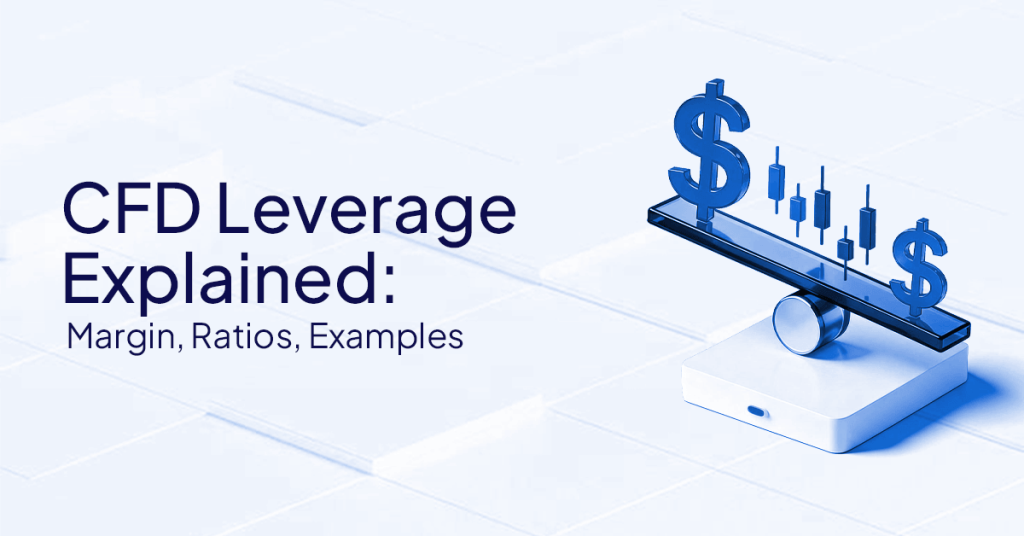
Leverage is likely the most discussed characteristic of CFD trading, and traders also misconceive it the most. It allows you to trade at a much larger size than you have invested, and this sounds attractive until a trade works against you and you discover that losses accumulate as quickly as profits.
That is what CFD leverage is really all about. Not a shortcut to greater profits. A multiplier, and it cuts both ways.
The vast majority of traders who blow up an account don’t do it because of a misreading of the market. They do it because they leveraged excessively on a trade they were not ready to lose.
The most pragmatic thing you can do as an inexperienced trader is to have a solid grasp of how leverage actually works before you use it.
Quick Answer
- Leverage allows you to manage a larger market presence than you would with the funds you have deposited.
- You make a small deposit margin; the broker extends the rest of the market exposure.
- You not only profit or lose on your deposit, but on the total position size.
- Ratios are expressed as 1:X; hence, 1:20 indicates that you manage $20 in margin for $1 in margin.
- The market can move sharply against you, making your losses exceed your initial deposit.
- The first step towards selecting the right leverage level is to know the amount of loss you are willing to incur, and not the amount of gain you want to achieve.
What Is Leverage in CFD Trading?
CFD trading leverage is the capacity to manage a large market size with a relatively small deposit.
One-Line Definition
Leverage is a multiplier; it magnifies your potential loss and potential profit beyond what your deposit alone can produce.
Why Leverage Exists in CFDs
CFDs are a derivative. You are not purchasing the underlying property but are guessing on a price move. Since you never own the position, you do not have to finance the entire value of that position.
The margin-based system of CFD trading leverage liberates capital, as traders can now engage in trading in many markets; indices, commodities, currencies, etc, without a huge starting balance.
In the absence of leverage, a trader would require substantial capital to make a considerable profit from a small price move in a market such as foreign exchange.
The margin system modifies that equation, which is one reason CFD trading attracted so much retail interest in the first place.
Leverage vs. Borrowing
Leverage is not a loan; no money is deposited in your account. What you get is prolonged exposure to the market. You may pay overnight funding charges on the value of the overall position, and you do not have to pay interest on the debt.
When you close the trade, it settles automatically. The position ceases; the exposure ceases along with it.
What Is Margin in CFDs and How Does It Connect to Leverage?
Margin is the deposit your broker holds while your trade is open; it’s not a fee, just collateral. When you close the trade, your broker releases it.
Leverage is the multiplier that determines how large a position the margin controls. Put up $1,000 at 1:10 leverage, and you’re controlling a $10,000 position.
Change one, and you change the other. That’s why people always discuss them together; they’re two sides of the same mechanism.
Initial Margin in Plain Language
The initial margin is the minimum equity required to start a new position. Assuming that a broker needs a 5% margin on a transaction of $100,000, it will take you to have $5,000 in your account to open such a trade.
That amount is locked up as long as the trade is open; it’s like the entry fee that keeps your position open.
Margin Requirement vs. Account Balance
- Account balance: The amount of money you have deposited in your account, including realised profits or losses.
- Used margin: The amount that is locked to maintain open trades.
- Free margin: What’s left to open new trades or feel the movement against you.
- Equity: Your balance plus or minus any unrealised profit or loss.
The number that counts in real time is the free margin. If it falls too much, a margin call is not too distant. Most traders commit the error of obsessively checking their open P&L and forget free margin completely, and that’s when a margin call hits as a surprise.
Maintenance Margin and Margin Calls
If your account equity falls to the maintenance margin level, your broker will issue a margin call: deposit more money or sell positions. Give it some time, and the broker can automatically liquidate your trades.
You should always have a buffer of free margin. Markets are volatile in response to news incidents, and that buffer is what can keep you in control of the choices you make, rather than having the broker do it on your behalf.
What Is the Leverage Ratio for CFDs and How Do You Calculate It?
The leverage ratio that CFD traders use shows you exactly how much of the market you are controlling compared to your capital.
The Formula in Plain Words
Leverage Ratio = Total Position Value/Margin Amount.
A $200,000 position with $10,000 of your own money will perform at a ratio of 1: 20.
Leverage Ratio Examples Using Round Numbers
| Leverage Ratio | Margin Required | Buying Power of $1,000 |
| 1:1 | 100% | $1,000 |
| 1:5 | 20% | $5,000 |
| 1:10 | 10% | $10,000 |
| 1:20 | 5% | $20,000 |
| 1:50 | 2% | $50,000 |
Common Ratio Formats and What They Imply
- 1:5: Widespread in less liquid securities, such as individual stocks.
- 1:10: The most common point of entry for index traders is 1:10.
- 1:20: Meaningful amplification in either direction.
- 1:30: Common on major forex pairs; needs cautious position sizing.
No high-leverage version will have low risk.
How Does CFD Leverage Affect Profit and Loss?
Your P&L is computed based on the entire value of the position, not on your margin deposit, and hence even small percentage changes in the price of the position can create large percentage changes in your account balance.
P&L Is Based on Full Position Size
When you open a leveraged CFD, the total notional value of the trade determines your gain or loss. A $20,000 position that moves 1% makes a $200 profit or loss, no matter if your margin was $1,000 or $4,000.
Price Move → Points → P&L
You are selling Gold at $2,000 an ounce; 10 ounces, and you have a total exposure of $20,000. At 1:20 leverage, your margin is $1,000.
Gold rises $20 to $2,020. Profit: $20 x 10 = $200. That’s a 20% return on your margin from a 1% market move. Flip it, and it’s a 20% loss: same maths, opposite direction.
Why Small Moves Can Feel Big
The size of the position is large, thus each movement is multiplied. A 1% movement in the underlying instrument does not seem like 1% when you have a leverage ratio of 1:20; it seems like 20.
That’s not a distortion. This is precisely the way leverage works.
The market was 1%, and your account was 20%. Awareness of this relationship before you trade prevents it from being a surprise when it occurs.
What Are Practical CFD Leverage Examples?
With practical CFD leverage examples, you can see how margin, position size, and price movement work together in different markets. This makes the math less abstract and easier to understand.
CFD Leverage Example 1: Index CFD Position
- Asset: US Tech 100 at 15,000 points
- Exposure: $15,000 at 1:10 leverage
- Margin: $1,500
- Result: A 1% move = gain or loss of $150, which is 10% of your margin.
CFD Leverage Example 2: FX CFD Position
- Asset: EUR/USD at 1.1000
- Exposure: $100,000 at 1:30 leverage
- Margin: approximately $3,333
- Outcome: 50 pips to 1.1050 = $500 profit
CFD Leverage Example 3: x1 Leverage
The CFD X1 leverage implies a multiplier of 0. The share is at $100, and 10 shares were bought, with an exposure of $1,000 and a margin of $1,000. At a $105 price increase, you earn $50, which is 5% of the asset’s actual movement.
Less risk, however, no capital efficiency. This option is especially useful when you are willing to familiarize yourself with the instrument’s movements before applying any multiplier to your position.
How Do You Choose a Leverage Level and Position Size?
Begin with the amount you are comfortable losing, then reverse it to the size of your position. The leverage ratio follows from that, not the other way round.
Start From Stop-Loss Distance, Then Size the Trade
Ask “where is this trade wrong?” first. You pick your stop-loss and your dollar risk, and let those two numbers determine your position size. The leverage ratio is an outcome of the process, not an input.
This shift in thinking from “how much leverage can I have?” to “how much can I risk losing?” completely transforms the behaviour of most traders in position sizing.
Use a Fixed Maximum Exposure Rule
Total market exposure should not exceed a set multiple of the account balance. A reasonable limit to control, with a sum of no more than $25,000, is to maintain a minimum of $5,000 across all open positions. It is not a formula; it is a sanity check.
Avoid Stacking Correlated Positions
Being long EUR/USD, GBP/USD, and AUD/USD simultaneously is not diversification; it is an extremely heavy exposure to the possibility that the US Dollar will appreciate. That’s hidden leverage. Three positions acting as a single huge one.
What Costs and Conditions Should You Check?
There are three costs directly involved in leveraged positions: overnight financing, the spread, and slippage.
Spread, Commission, and Overnight Financing
The spread is your initial expenditure on any trade, and on a leveraged position, the absolute dollar effect is greater, as you are in a larger position. Some brokers impose a commission on trades, especially on equity CFDs.
Positions held beyond market close at the end of the day are subject to overnight financing. Since CFDs are traded on leverage, the broker charges interest on the entire position value. The costs are minimal for short-term traders and significant for those holding for several days.
Slippage and Volatility Moments
Slippage occurs when the order fills at a price different from the requested price. The number of points on the slip is multiplied by a leveraged position. Limit orders and warnings concerning high-impact events mitigate this risk.
Contract Specs: Minimum Size, Margin Rate, Trading Hours
Check three things before buying or selling any instrument: minimum trade value, the margin rate of that particular asset, and trading hours with daily breaks. The margin rate varies widely across asset types; what holds for forex will not hold for an index or commodity CFD.
Common Leverage Mistakes in CFD Trading
The mistakes that damage accounts most include oversizing the first trade, entering without a stop or exit plan, increasing size after losses, etc. They aren’t about reading the market wrong, but about managing leverage poorly.
Oversizing the First Trade
Optimal leverage in the short term leaves no room for normal price movement. A prudently planned trade must have room; a position that is too large will drive you out of business at a loss before the trade can have an opportunity to do its business.
Increasing Size After Losses
The more the position size increases to overcome the loss, the worse the issue. Your trading rules should make decisions on size, not your previous performance.
Entering Without a Stop or Exit Plan
The absence of a stop-loss implies undefined risk. The market does your exit-making decisions, which are generally worse at a worse time than you would have made them. It is an easy habit to develop, and one of the most secure things you can do on a leveraged position.
Confusing Margin With Maximum Loss
Your margin deposit is not your maximum possible loss; it’s the collateral holding the position open. Under volatile conditions, you can lose more than your margin provided that the market is gaping. Use your real loss limit rather than your margin balance to determine your stop-loss.
Frequently Asked Questions
It is the application of a small margin deposit to manage a far greater market share. All profits and losses are based on the entire size of the position, and not the deposit alone.
The amount of cash your account needs to open and maintain a leveraged position. Locked whilst the trade is open, free when you close it.
The CFD leverage ratio is the ratio of total position to margin utilized. A $100,000 position with a $5,000 margin = 1:20.
Yes. CFD x1 leverage implies no multiplier; you finance the entire position value: reduced risk, and no capital amplification.
It scales both proportionally to the entire size of the position. On a 1:20 position, 1% of market movement gives you 20% change in your margin in either direction.
The minimum number of deposits required to open a new position varies by instrument and leverage ratio.
Yes. CFDs are leveraged instruments; that is, they are traded on margin-based exposure rather than with full ownership of the asset.
Pay attention to market exposure in general, not the ratio. Keep a combined exposure of all your open trades within two to three times your account balance.
Conclusion
Leverage is neither good nor bad; it is a tool. It trades CFDs in a truly capital-efficient manner through clear position sizing and a set stop-loss. Used carelessly, it quickly turns small market moves into large account problems.
Traders who use leverage well are not necessarily better market readers. They are only more serious about the figures before they venture into a trade.
Know your risk first. Size your position from there. Allow the leverage ratio follow.
This article is only informational and does not constitute financial, legal, or investment advice. The use of CFD entails significant capital risk. Leverage multiplies gains and losses, and you can end up losing even more than you started with. Never trade without an independent recommendation by a qualified financial advisor.
Tags


Open Live Account
 Email Address
 Phone Number
Important Notice
STARTRADER does not accept any applications from Australian residents.
To comply with regulatory requirements, clicking the button will redirect you to the STARTRADER website operated by STARTRADER PRIME GLOBAL PTY LTD (ABN 65 156 005 668), an authorized Australian Financial Services Licence holder (AFSL no. 421210) regulated by the Australian Securities and Investments Commission.
Important Notice for Residents of the United Arab Emirates
In alignment with local regulatory requirements, individuals residing in the United Arab Emirates are requested to proceed via our dedicated regional platform at startrader.ae, which is operated by STARTRADER Global Financial Consultation & Financial Analysis L.L.C.. This entity is licensed by the UAE Capital Market Authority (CMA) under License No. 20200000241, and is authorised to introduce financial services and promote financial products in the UAE.
Please click the "Continue" button below to be redirected.


