








 Web Trader MT5





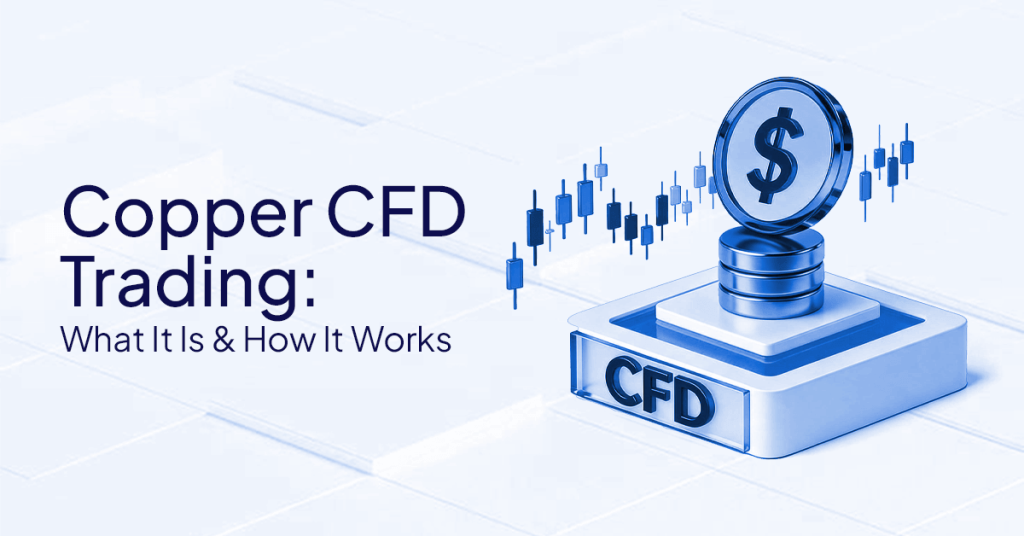
A copper CFD enables traders to trade on copper price changes without owning a single physical bit of the metal.
How come that copper is commonly referred to as “Doctor Copper”, and why is the movement of its price likely to indicate the well-being of the whole world economy?
This industrial metal is so profoundly embedded in infrastructure and manufacturing processes that its demand usually foreshadows economic trends.
A copper CFD (Contract for Difference) is a more convenient trading alternative for traders who wish to participate in this market without storing heavy bars or arranging delivery.
These, however, are leveraged products and therefore carry high risks. The article describes the mechanics of copper trading, costs, and risks involved, which will help you determine whether this instrument fits into your educational journey.
Quick Answer
A copper CFD is a financial contract which involves trading the difference between the opening and closing of a position of the metal. It is aimed at traders who wish to leverage market movements, rather than industrial buyers who require transportation. This approach eliminates storage costs but exposes the portfolio to greater market risk, as markets are volatile.
What Is a Copper CFD?
This is a derivative in which two parties sign an agreement to settle the price difference in copper between the trade’s opening and closing.
Copper CFD Meaning
Copper CFD meaning is an abbreviation of a “Contract for Difference”. In case you sell this tool, you do not trade the underlying instrument.
Instead, you are engaging a provider in a contract to transfer the value gap of the price of copper at the beginning and the end of the trade.
If the price fluctuates in the direction you desire, your provider will compensate you for the difference. If it turns out to your detriment, you pay the provider.
This type of structure is flexible because you do not need to worry about shipping, insurance, or warehousing physical copper.
Who Uses Copper CFDs
The market participants fall into two categories: hedgers and speculators.
- Hedging: Firms that are dependent on copper (such as electronics manufacturing or construction companies) can also use CFDs to hedge against unfavourable price changes. If they are afraid the price will go up, raising the cost of their raw materials, they may have an open position that is profitable on a price rise to cover the costs in the real world.
- Speculation: Retail traders and institutions lean on these instruments to aim to profit from short-term market fluctuations. CFD copper trading is not subject to ownership, and therefore, the physical market is usually slower to execute, enabling it to react more quickly to economic news.
Note: Speculation is the primary use for retail traders. This requires a good understanding of market risks, as losses can accumulate quickly.
How Does Copper CFD Trading Work?
Trading such derivatives involves creating a leverage-based speculation on price direction and, in the event of a price rise (or fall), may result in returns (or losses) on a smaller initial deposit.
Margin and Leverage
Leverage is the capacity to hold a larger position with comparatively small capital, referred to as margin.
For example, a broker may offer 10:1 leverage, and you could be required to hold a position valued at $10,000 with just $1,000.
This may free up capital, but it is a two-edged sword. Leverage magnifies gains when the market works in your favor and magnifies losses when it works against you.
Price fluctuations in volatile commodity markets may be acute, and margin management is critical.
Long vs Short on Copper
The opportunity to buy and sell with equal success is a key feature of CFD trading.
- Going Long (Buying): You open a buy position when you believe the price of copper will rise.
- Going Short(Selling): You open a sell position when you think that the price will fall.
This short capability allows you to bet against CFD on copper, unlike traditional investing, where you typically only benefit when the asset appreciates in value.
Copper CFD Symbol and Contract Specs
Depending on the platform, the specific ticker may differ, but it is essential to be familiar with standardized contract specifications to control trade size and cost.
Why the Symbol Differs by Platform
Copper CFD does not have a universal symbol. It usually relies on the underlying futures market the CFD follows (such as the COMEX or LME) or on the broker’s naming conventions.
- The symbols used are common symbols such as COP, XCU, or plain Copper.
- Others may include it as High Grade Copper (HG).
Always ensure that you check the symbol in the list on your trading platform to ascertain that you are trading the right asset.
Specs to Show On-Page
Reviewing the contract specifications before placing a trade is required: these are typically in the platform’s detailed section. Key specs include:
- Lot Size: The contract size of copper that is standard per quantity (25,000 lbs).
- Tick Size: The slightest price movement an asset can make.
- Trading Hours: The exact hours that the market is trading (commodities have off periods).
- Margin Requirement: The share of the entire trade value needed to open the position.
This is done by checking these details so you do not open a position larger than your account balance.
The STARTRADER commodities page lets you see which commodities are available and their specifications.
What Moves the Copper Market?
The equilibrium between industrial demand in large economies and the sustainability of the global mining supply chain primarily shapes the economics of copper.
Global Growth and Industrial Demand
Copper is required in electrical wiring, plumbing, and renewable energy technologies. By extension, its price is susceptible to the health of major global economies, such as China and the US, in terms of manufacturing.
- Green Energy Transition: The transition to electric cars (EVs) and wind turbines has significantly increased structural demand. The International Energy Agency (IEA) predicts that the demand for critical minerals required by clean energy technologies will quadruple, which will also have a massive impact on copper demand.
- Construction: A slowdown in housing markets across countries typically lowers copper demand.
Supply Risks
Copper production is concentrated in countries such as Chile, Peru, and the DRC.
- Disruptions: Labour strikes, political instability, and weather in these areas can choke supply, leading to price spikes.
- Falling Ore Grades: As current mines are depleted, ore grades tend to decline, making it more costly to extract the same quantity of metal.
According to a report from the U.S. Geological Survey, there were periodic interruptions in the production of copper mines caused by labor disputes and regulatory problems.
USD Strength and Risk Sentiment.
Commodities such as copper are traded in U.S. dollars.
- Inverse Relationship: As the USD strengthens, foreign buyers cannot afford copper, so demand tends to decline, and prices are usually lowered.
- Risk-On/Risk-Off: Copper is a risk-on asset. Prices are high during economic booms.
Costs and Risks in Copper CFD Trading
In addition to managing risks related to leverage and market volatility, traders must also consider expenses such as spreads and swaps.
Trading Costs
- Spread: The difference between the Buy and Sell prices. This is the direct cost to open trade.
- Financing (Swap): When you are leveraged beyond a specific time (typically 5 PM New York time), you are charged a financing fee. This can be costly when trades are held open for a long time. Therefore, it’s best to know the copper trading hours.
- Slippage: In a rapidly moving market, a trade might be filled at a price slightly different from the one you requested.
Key Risks
- Volatility: Copper may be volatile due to geopolitical news or inventory announcements.
- Leverage Amplification: As discussed, leverage may be used to make quick losses that are more than you had initially anticipated.
- Gapping: Allows prices to move directly between levels without intervening, avoiding stop-loss orders.
How to Trade Copper CFDs Step by Step
Effective trading involves a disciplined approach, and one must transition from market analysis to rigorous risk management before placing any order.
Pre-Trade Checklist
Prior to you trading copper CFD positions, go through a physical or mental checklist:
- Market Bias: Have you done fundamental and technical trend analysis?
- Catalysts: Does it have any upcoming economic data (such as PMI data or GDP figures) that can be volatile?
- Specs: What is the value of one pip/tick of this particular contract?
Risk Rules
- Max Risk Per Trade: A popular rule of thumb is to risk only a small percentage (e.g., 1-2%) of capital on a given trade.
- Stop-Loss Placement: It is always important to know where you will get out in case the trade goes bad, and then enter.
- Discipline: Do not follow your feelings; stick to your plan.
Common Mistakes Beginners Make
Beginning traders often fail because they overleverage their accounts or fail to account for overnight holding costs, which can erode their bottom line.
- Going after Volatility: Making a trade because the price is moving in a fast manner without a plan.
- Warping the Swaps: Having a position held over weeks without noticing that the daily financing charges are draining out the account.
- No Stop-Loss: Trading without a safety net in the hope that the market will rise.
- Misunderstand Contract Size: Opening a position that is excessive in that the trader failed to verify the Lot Size specification.
Comparison: CFD vs. Physical vs. Futures
| Feature | Copper CFD | Physical Copper | Futures |
| Ownership | No (Contract only) | Yes (Metal delivery) | No (Usually cash settled) |
| Leverage | Available (Varies) | None | Available |
| Typical Costs | Spread, Swap | Storage, Insurance | Commission, Exchange Fees |
| Accessibility | Retail Traders | Industrial Buyers | Institutions/Pro Traders |
| Expiry | Often none (Rolling) | N/A | Fixed Expiry Date |
FAQs
A copper CFD is a derivative product and enables you to trade on the price movement of copper, but you do not own the real metal. Your gain or loss depends on the difference between the initial and final prices.
It is the abbreviation of Contract for Difference on copper. It refers to you entering into an agreement with a provider to transact the variance in the asset’s value rather than purchasing the asset.
Depending on the broker and exchange, the symbol can vary; however, it is usually displayed as COP, XCU, High Grade Copper, or just Copper.
Yes. CFDs are leveraged products, so one can lose money very quickly. Geopolitical issues and supply chain disruptions are also volatile in the copper market.
Conclusion
Copper CFD trading offers a convenient way to trade the commodities market without the logistical strain of holding the commodity.
This asset category will be approached more confidently by first learning how copper CFD trading works, including how leverage works and what drives market prices. It is essential to keep in mind, however, that they are complex, high-risk instruments.
Education and strong risk management should be a priority. Before opening a position, make sure you understand the contract specifications and the appropriateness of the product.
Disclaimer: No representation is given, warranty made or responsibility taken about the accuracy, timeliness or completeness of information sourced from third parties. Because of this, we recommend you consider, with or without the assistance of a financial adviser, whether the information is appropriate having regard to your particular circumstances.
Tags


Open Live Account
 Email Address
 Phone Number
Important Notice
STARTRADER does not accept any applications from Australian residents.
To comply with regulatory requirements, clicking the button will redirect you to the STARTRADER website operated by STARTRADER PRIME GLOBAL PTY LTD (ABN 65 156 005 668), an authorized Australian Financial Services Licence holder (AFSL no. 421210) regulated by the Australian Securities and Investments Commission.
Important Notice for Residents of the United Arab Emirates
In alignment with local regulatory requirements, individuals residing in the United Arab Emirates are requested to proceed via our dedicated regional platform at startrader.ae, which is operated by STARTRADER Global Financial Consultation & Financial Analysis L.L.C.. This entity is licensed by the UAE Capital Market Authority (CMA) under License No. 20200000241, and is authorised to introduce financial services and promote financial products in the UAE.
Please click the "Continue" button below to be redirected.


