








 Web Trader MT5





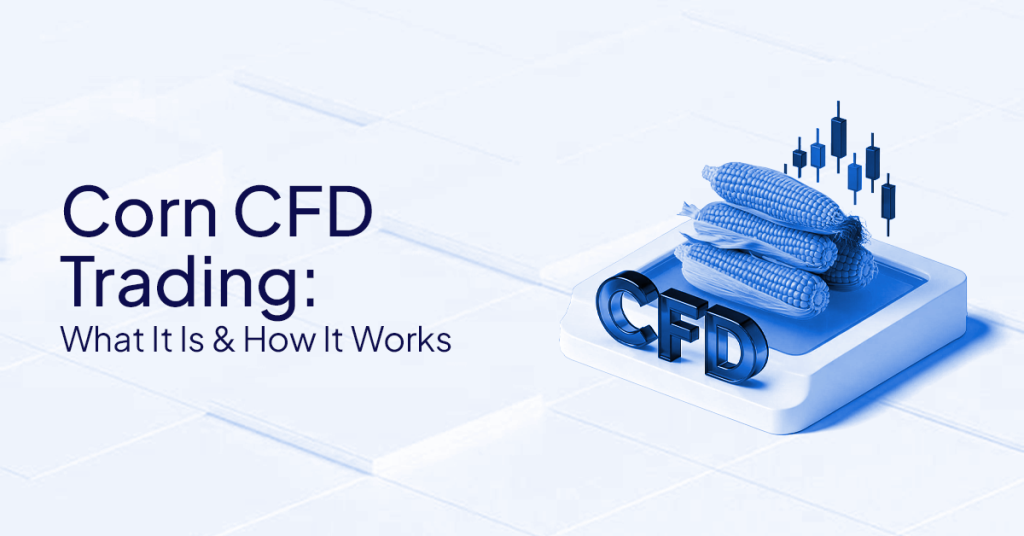
A corn CFD enables traders to trade on corn price movements without necessarily holding the commodity.
But have you ever wondered how traders can make a fortune by investing in commodities from farm markets without physically carrying a bushel of grain?
The answer is in Contracts for Difference, which are financial instruments that follow the direction of the corn price but avoid the hassles of physical ownership. Corn CFD trading provides access to one of the world’s most significant agricultural markets.
Here, supply and demand change continuously due to weather, global trade flows, and energy policies. In contrast to purchasing real-life futures or tangible grain, CFDs allow you to concentrate solely on the speculation of prices in either direction as markets are on an upward or downward trend.
This guide discusses the nature of corn CFDs, how these markets move, and the key risk factors to consider before trading. It should be noted that CFD laws vary by jurisdiction, and some jurisdictions, such as the United States, impose limitations.
Quick Answer
A corn CFD is a contract which enables you to buy and sell price changes of corn without the physical commodity being owned or delivered. Traders can go long or short, with margin, and focus on market drivers such as weather, supply, and demand, while understanding the costs and risks involved. CFDs are also limited in certain jurisdictions, such as some parts of the US.
What Is a Corn CFD?
A corn CFD is a financial agreement between a trader and a broker to trade the difference in the value of corn from the time the contract is opened and the time it is closed.
Corn CFD Explained Simply
Once you trade a corn CFD, you are not buying corn kernels, financing a harvest, or even making shipping arrangements. Instead, you are entering a contract based on corn’s price. On your favorable price move, the broker compensates you for the difference.
In the event of a price movement against you, you pay the difference to the broker. This market is more open to retail traders because trading physical commodities eliminates logistical obstacles.
What You Trade vs What You Don’t Own
Futures market contracts usually tend to result in the actual delivery of goods if they are not sold off. Physical delivery does not take place in CFD trading.
You do not possess the underlying asset. You are buying and selling the asset strictly for its value. This implies that you do not have to worry about storage charges, spoilage, and transportation logistics.
How Does Corn CFD Trading Work?
Corn CFD trading involves participants buying positions based on their market direction predictions, using capital efficiently through leverage.
Long vs Short Positions
Among the main properties of CFDs is the fact that they are easy to trade both ways equally:
- Going Long (Buy): You initiate a buying position when you expect the price of corn to rise. When the price rises, you are a winner, and when it falls, you suffer a loss.
- Going short (Sell): You open a sell position when you think that the price of corn will drop. When the price falls, you make a profit; when it rises, you make a loss.
Margin and Leverage Basics
CFDs are leveraged products. This implies that you have to post a small percentage of the total value of trade (which we call margin) to trade.
- Margin: This is the amount of deposit that must be opened to commence the trade.
- Leverage: The capability of covering a prominent position by using little capital.
Example: In case a broker is providing 10:1 leverage, you will be able to manage $10,000 worth of corn contracts using only $1,000 of your own funds.
Leverage is a double-edged sword, however. Although it can be potentially rewarding, it’s worth noting that you can lose just as quickly when the market works against you.
Cash vs Futures-Based Corn CFDs.
There is one significant distinction between these two types of CFDs: the expiration date and the calculation of financing costs.
What “Corn Cash CFD” Usually Means
A corn cash CFD is an instrument which tracks the spot price of the commodity. Such contracts do not have a fixed expiry date, so you keep the position open until you choose to close it.
These positions, however, are not subject to an expiry, so they usually incur an overnight financing cost (a swap) when held beyond the trading day. This makes them popular in short-term trading.
Rollover and Expiry
- Futures-Based CFDs: They track a specific futures contract (such as Dec Corn). They have an expiry date. At the expiry of the contract, the position will be automatically closed or rolled over to the next month’s contract.
- Cash CFDs: There is no expiry date to manage, but consider the holding (swaps) cost, which can accumulate over time.
What Moves Corn Markets?
Biological factors, supply chain logistics, and industrial crop demand are the main drivers of corn market volatility.
Weather, Planting and Harvest Conditions and Yields
Weather patterns mainly drive corn price volatility during critical growing periods, which directly affect supply expectations.
- Planting Season: During germination, pollination, and grain fill, corn requires a specific temperature range and sufficient moisture.
- Growing Season: The drought in July and August, when corn plants are flowering and forming kernels, can destroy yields despite good growing conditions earlier in the season. The USDA reported that corn yields in the US reached an all-time high of 186.5 bushels per acre, driven by favorable weather and seed varieties.
- Harvest: On the other hand, in the event of unfavorable events, such as hurricanes and flash drought that hit the crop, output in millions of bushels may plummet, driving prices to soar. Poor yield potential due to wet spring conditions or early-season frost can also create bullish sentiment months before harvest.
Large-scale producers such as the US and Brazil are the ones whose reports traders follow to gauge crop health.
Global Supply, Exports, and Logistics
Corn is a global commodity. Disruptions in the supply market in either region can increase global prices. Key factors include:
- Geopolitics: War in key export areas (such as the Black Sea) may stop deliveries.
- Shipping: Exporters must consider freight costs and availability.
- Stockpiles: The released data of agencies such as the USDA, including the Ending Stocks data, reflect the amount of corn left over, which can serve as a buffer against supply shocks.
Demand Drivers + Currency Effects
There are three pillars of demand for corn:
- Animal Feed: The most crucial element. Changes in the number of livestock herds influence corn demand.
- Ethanol: A large part of corn (particularly in the US) is used to fuel. This is affected by energy policies and oil prices.
- Food/Industrial: High fructose corn syrup and starch.
Also, there is the US dollar factor. On the world market, where corn is traded in USD, a strong dollar increases the cost of corn to foreign markets, which may potentially lower exports.
Costs and Risks to Know Before Trading
Corn trading is associated with certain financial outlays and market risks that may drain funds unless it is handled very strictly.
Spread, Financing / Overnight Fees, and Market Gaps
- Spread: The difference between the Buy and Sell prices. It is this cost that causes you to enter every trade slightly in the red.
- Swap (Overnight Fees): These are interest payments that are made to maintain an open position overnight.
- Market Gaps: Since agricultural markets are sensitive to news (such as weekend weather), prices may jump and miss stop-loss orders between the Friday close and the Monday open.
Leverage Risk and Volatility
The agricultural market is volatile. One weather report could trigger a sudden price increase. Add volatility and leverage, and the potential risk of not being able to cover a margin call (a broker demanding more funds or liquidating your trade) increases. You must ensure you account is well-funded to cover these swings.
How to Trade Corn CFDs Step by Step
This needs to be done formally, including analysis, risk analysis, and order entry.
Pre-Trade Checklist
Before opening a trade in a platform such as STARTRADER, be sure to have:
- Identified the Catalyst: Why are you trading? (e.g., A drought report).
- Checked the Calendar: Are there any significant reports (such as WASDE) in the offing?
- Assessed Volatility: Does the market change at a pace that you can take risks with?
Position Sizing, Stop-Losses, and Max-Loss Rules
Risk management is more significant than profit targets.
- Position Size: It is never a good idea to trade in a size that a regular market fluctuation will wipe out.
- Stop-Loss: It is always a good idea to set a hard stop-loss order to automatically sell the trade if the price is working against you.
- Max-Loss Rule: You should predetermine the highest percentage of your account that you will risk losing on a single trade (e.g., 1-2%).
Common Beginner Mistakes
New traders usually fail because they either fail to estimate market volatility or to employ stop-loss orders.
- Trading on impulse: Buying or selling without analyzing and as a result of gut feeling.
- Lacking Attentiveness to Seasonality: Lacking the understanding that corn prices tend to drop during crop harvest because of excess supply.
- Excessive leverage: Leverage is applied to the fullest extent, with no breathing room in the market.
Comparison: Corn CFD vs Futures vs ETF
| Feature | Corn CFD | Corn Futures | Corn ETF |
| Ownership | No ownership (Derivative) | Contract to buy (Derivative) | Shares in a fund |
| Leverage | High | High | Low to None |
| Time Horizon | Short to Medium | Short to Medium | Medium to Long |
| Complexity | Medium | High | Low |
| Min. Capital | Low | High | Low |
Checklist: Before You Trade Corn CFDs
- Catalyst Identified: I understand my reason for getting into this trade (e.g., weather news).
- Volatility Evaluated: I am aware of the current price swings.
- Position Size Defined: The trade size is suitable for my account balance.
- Stop-Loss Set: I have a defined point of exit in case I am wrong.
- Maximum risk capped: I have risked less than 2% of my capital.
FAQs
A corn CFD is a type of contract that follows the price of corn, whereby you will be able to trade on price fluctuations without having to own the actual crop.
You would buy (long) when you believe that the prices will rise, and you would sell (short) when you think that the prices will fall. The difference between the opening and closing price of the trade will be your profit or loss.
It is a CFD pegged to the spot price of corn. There is no expiration date on it, and it incurs overnight financing costs.
Yes. CFDs enable you to open a sell position to speculate on a declining market.
Conclusion
Corn CFD trading is a convenient way to trade international agricultural markets and allows traders to speculate on supply-and-demand dynamics driven by weather conditions, energy policies, and global trade.
The leverage and market volatility, however, combine to indicate that it should be subjected to a rigorous risk management strategy.
Should you wish to learn how such markets are moving in the real world and not risk capital at this point, you may want to practice on a STARTRADER demo account.
Tags


Open Live Account
 Email Address
 Phone Number
Important Notice
STARTRADER does not accept any applications from Australian residents.
To comply with regulatory requirements, clicking the button will redirect you to the STARTRADER website operated by STARTRADER PRIME GLOBAL PTY LTD (ABN 65 156 005 668), an authorized Australian Financial Services Licence holder (AFSL no. 421210) regulated by the Australian Securities and Investments Commission.
Important Notice for Residents of the United Arab Emirates
In alignment with local regulatory requirements, individuals residing in the United Arab Emirates are requested to proceed via our dedicated regional platform at startrader.ae, which is operated by STARTRADER Global Financial Consultation & Financial Analysis L.L.C.. This entity is licensed by the UAE Capital Market Authority (CMA) under License No. 20200000241, and is authorised to introduce financial services and promote financial products in the UAE.
Please click the "Continue" button below to be redirected.


