








 Web Trader MT5





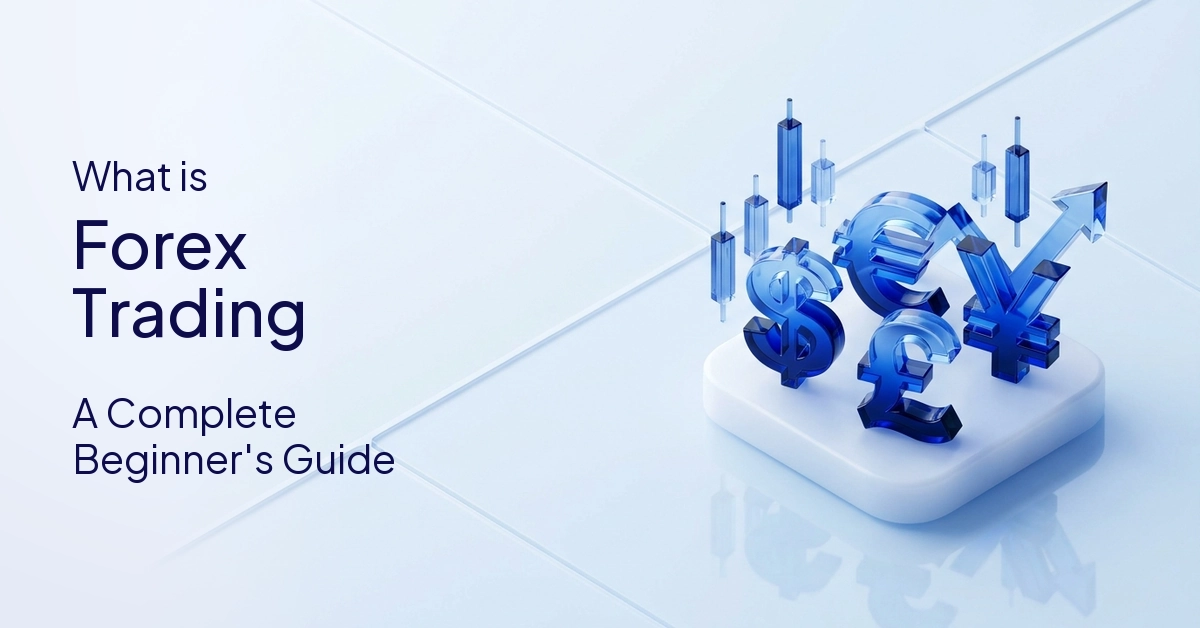
Forex trading refers to the worldwide buying and selling of currency that is done to take advantage of fluctuating exchange rates.
Ever wondered how trillions of dollars change hands every day without a single physical exchange building?
Forex trading is one of the most active financial markets in the world, supporting international trade, tourism and investment. But for most Indian beginners, the term is still unknown. So, what is forex trading?
Simply put, the first thing you need to know is that forex trading is simply exchanging one currency for another. In this guide, you will get to know about the forex market, how currency trading works, whether it is legal in India, what risks you should be aware of and how a person can approach it as a beginner.
Whether you’re looking into foreign exchange for fun or are considering serious trading, this guide provides a clear foundation for your next move.
Quick Answer
Forex trading is the act of buying and selling currencies on the foreign exchange market globally.
This is achieved by swapping one currency for another at an agreed price. Traders make money from fluctuations in exchange rates. This guide will tell you how the market works, its benefits, risks and what beginners in India need to know.
What is Forex Trading?
Forex trading, or foreign exchange, is the decentralized international marketplace where individuals and institutions trade one currency for another.
What Does Forex Mean?
Forex is the short form of “foreign exchange”. It is the act of swapping one currency to another currency for a variety of reasons, often for trading, commerce or tourism. Every time you travel abroad and exchange your Indian Rupees (INR) to US Dollars (USD) you are taking your part in the global forex market.
In the world of investing, forex trading is the digital buying and selling of currencies. Traders view the market through currency pairs, such as USD/INR or EUR/USD. The exchange rate is simply the price of one currency expressed in another currency. Traders speculate on whether the base currency will go up or down in relation to the quote currency.
Why Do Currency Prices Move?
Exchange rates are always on the move. Market analysis is based on understanding why these prices change the way they do. The key drivers are:
- Supply and demand: Like any other market, if demand for a currency increases, its value increases. If supply goes up, value goes down.
- Interest rates: When interest rates are high, lenders in a country can receive a higher return than in other countries. So high interest rates attract foreign capital and increase the exchange rate.
- Inflation: A country with a consistently lower inflation rate than another country will see an appreciation in its currency value.
- Economic data releases: Unemployment, manufacturing and GDP growth reports give insight into a country’s economic health, which can significantly impact investor confidence.
- Central bank decisions: Monetary Policy is in the hands of establishments like the Reserve Bank of India (RBI) or the US Federal Reserve. When they decide to print money or raise rates it directly impacts the strength of a currency.
- Geopolitical developments: Elections, trade wars and global conflicts bring uncertainty. In these times, safe-haven currencies are the currency of choice for traders.
What Is the Forex Market?
The forex market is unique in that it is totally decentralised. It is traded over the counter (OTC) meaning trades are made electronically between networks of computers across the world and not on a centralised exchange like the Bombay Stock Exchange (BSE).
Buying shares of a particular company like the stock market. Forex trading is a huge international network. Participants include major commercial banks, central banks, multinational corporations, governments and retail traders.
Key Points Table
| Concept | Explanation |
| Forex trading | Buying and selling currencies |
| Currency pair | Two currencies traded against each other |
| Exchange rate | Price of one currency in another |
| Forex market | Global decentralised currency market |
| Retail trader | Individual trader participating through a broker |
How Does the Forex Market Work?
Forex is an electronic currency trading network that is electronic and operates 24-hours a day, 5 days a week around the world.
The OTC Structure of Forex
It is traded OTC as it has no central physical location. Transactions are done electronically through worldwide networks of brokers and banking systems. In this structure, liquidity providers (large banks and financial institutions) and market makers post prices for buying and selling currencies. This constant flow of pricing makes for a very responsive, fluid marketplace.
Major Forex Market Participants
The forex market is huge. The Bank for International Settlements (BIS) says the average daily turnover of the global foreign exchange market is more than $7 trillion. This volume is driven by key drivers, including:
- Central banks: Regulate the quantity of money in their country and intervene to stabilize their currency.
- Commercial banks: Handle large currency transactions for customers and deal for their own account.
- Hedge funds and institutions: Speculate on currency moves to generate returns for their investor portfolios.
- Import/export businesses: Use currencies to pay for goods and services in different countries.
- Retail Traders: Individual investors who take a position on the direction of prices using online brokers and with low dollar amounts.
Forex Trading Sessions
Because it crosses multiple time zones around the world, the market is open all week long. When one place stops trading, it begins somewhere else. The main windows are:
- Asian session: Heavily driven by Tokyo, Sydney and Singapore.
- London session: The most active session by far and accounting for a massive part of the daily volume.
- New York session: Very active, especially in the overlap with the end of the London session.
Volatility varies in these sessions depending on which financial hubs are open. You can read more about the impact of trading volume these overlaps bring about in this guide to forex trading sessions.
How Forex Trades Are Executed
This is the usual process for placing a forex trade:
- Open a Trading Account: Register with a regulated broker and access a trading platform.
- Choose a currency pair: Pick the currencies you want to trade (e.g., EUR/USD).
- Market analysis: Check charts, indicators and economic news to see where the market is headed.
- Enter a buy or sell order: Select that the base currency will go up (buy) or down (sell).
- Monitor the position: Follow the trade as the currency pair moves.
- Close the trade: Close the position and fix the trade result.
What Are Pips, Lots, and Spreads?
To understand how the forex market works, you need to understand its unique measurement system.
A pip (percentage in point) is the smallest price movement in a currency pair, often the 4th decimal. A lot is the standard unit size of a trade. A standard lot is 100,000 units of currency. The spread is the small difference between the buy (ask) price and sell (bid) price this is usually the transaction cost charged by the broker.
Currency movements are often measured in fractions of a cent, so brokers provide leverage, allowing traders to control larger positions with a smaller deposit called margin.
Forex Mechanics Chart
| Term | Meaning |
| Pip | Smallest price movement |
| Spread | Difference between buy and sell price |
| Lot | Trade size unit |
| Margin | Deposit needed to open a trade |
| Leverage | Borrowed exposure to larger positions |
What Are the Main Currency Pairs?
Currency pairs are the value of one currency quoted against another and are classified into major, minor, exotic, and regional pairs.
Major Currency Pairs
Major pairs always contain the US Dollar (USD) on one side and are the most traded pairs in the world. They are the most liquid and usually have the lowest spreads. The examples include:
- EUR/USD (Euro / US Dollar)
- GBP/USD (British Pound / US Dollar)
- USD/JPY (US Dollar / Japanese Yen)
- USD/CHF (US Dollar / Swiss Franc)
Minor Currency Pairs
These, also called cross pairs, exclude the US dollar. Instead they show other major currencies trading against each other. They have moderate liquidity. For example:
- EUR/GBP (Euro / British Pound)
- AUD/NZD (Australian Dollar / New Zealand Dollar)
- EUR/JPY (Euro / Japanese Yen)
Exotic Currency Pairs
Exotic pairs consist of a major currency versus the currency of a developing or emerging market economy. They are characterised by lower liquidity, wider spreads and higher volatility. Such examples are:
- USD/TRY (US Dollar / Turkish Lira)
- USD/ZAR (US Dollar / South African Rand)
- USD/MXN (US Dollar / Mexican Peso)
INR Currency Pairs in India
If you are a trader in India, the regulations are clear about which pairs can be legally traded on local exchanges. Strictly these are pairs paired with Indian Rupee (INR) :
- USD/INR
- EUR/INR
- GBP/INR
- JPY/INR
To get more details on trading these local pairs, see what are currency pairs to trade in India for a deeper dive. India’s Foreign Exchange Management Act (FEMA) regulates the movement of capital across its borders. This is why it is necessary to trade only approved pairs in the domestic markets.
Currency Pair Categories Table
| Type | Examples | Typical Characteristics |
| Major pairs | EUR/USD, GBP/USD | High liquidity |
| Minor pairs | EUR/GBP, AUD/NZD | Moderate liquidity |
| Exotic pairs | USD/ZAR, USD/TRY | Higher volatility |
| INR pairs | USD/INR, EUR/INR | India-regulated trading |
Is Forex Trading Legal in India?
Forex Trading is Legal in India, provided it is done through SEBI-regulated exchanges, and only certain INR-based currency pairs are allowed.
SEBI and RBI Regulation
India has two big agencies that regulate the financial markets. The Securities and Exchange Board of India (SEBI) is the regulatory authority for the securities and commodities markets, ensuring that securities brokers adhere to regulations and safeguarding investors.
RBI is India’s central bank which manages the country’s monetary policy and foreign currency reserves. Both bodies are working together to ensure compliance with the Foreign Exchange Management Act (FEMA) that regulates the foreign currency transactions of Indian residents.
Which Forex Trading Activities Are Legal?
Indian residents have to trade INR currency pairs (USD/INR, EUR/INR, GBP/INR, and JPY/INR) to trade fully compliant with the law. Moreover, such trading is to be conducted on recognized and regulated domestic exchanges, namely, the currency derivatives segments of the National Stock Exchange (NSE) and the Bombay Stock Exchange (BSE). “You also have to use a broker registered with SEBI.
Restrictions on Foreign Platforms
RBI issues strong warnings against offshore forex platforms Trading of non-INR pairs (e.g. EUR/USD) through unregulated, foreign brokers on margin with funds remitted from India is considered a contravention of FEMA guidelines. Margin trading overseas using the Liberalized Remittance Scheme (LRS) is not permitted.
Is Forex Trading Legit?
Many beginners are concerned about the safety of the industry due to its global and decentralized nature. The forex market itself is the biggest financial market in the world and is completely legitimate. But traders have to be careful because of the prevalence of unregulated offshore brokers and “get-rich-quick” schemes. Here’s a breakdown on how to avoid scams and verify broker authenticity: is forex trading legit.
Always make sure your broker is properly licensed. The best way to protect your money and data as an Indian trader is to understand the role and regulation of forex brokers in India.
India Forex Regulation Table
| Topic | Summary |
| Regulator | SEBI and RBI |
| Legal pairs | INR-based currency pairs |
| Trading venues | NSE and BSE |
| Offshore platforms | Restrictions may apply |
| Compliance law | FEMA |
What Are the Benefits of Forex Trading?
The main advantages of forex trading include huge market liquidity, constant availability 24/5 and the ability to trade on both the rising and falling market prices.
High Liquidity
“Liquidity” refers to how easily an asset can be bought or sold without significantly affecting the asset’s price. The forex market is incredibly liquid as it deals with trillions of dollars every day. This means that orders are generally filled instantly for traders. High liquidity also reduces slippage, which is the difference between the expected price of a trade and the price at which the trade is executed.
24/5 Market Access
The stock market has a strict opening and closing bell . The forex market is open 24 hours a day, 5 days a week. The fact it opens from Sydney to Tokyo, London and New York means that traders can get involved at times to suit their schedule. This makes it very accessible for retail traders who may have full-time jobs during the regular hours of the market.
Ability to Trade Rising and Falling Markets
With traditional stock investing, you buy a share and hope the company goes up in value. In forex trading, currencies are traded in pairs. If you think a currency will increase in value, you take a “long” position (buy). If you think it will depreciate against the other currency you take a “short” position (sell). This allows traders to search for opportunities in either direction. But it is also vital to keep in mind that losses can occur in either direction.
Low Entry Barriers
The forex market is very user friendly. Many brokers are offering low minimum deposit accounts, allowing traders to trade in micro lots. This means that you don’t have to put huge amounts of capital to learn the mechanics of the market. Moreover, most reliable brokers provide free demo accounts, allowing beginners to learn the market without risking their own money.
Access to Multiple Currency Markets
Forex trading puts you right in the middle of the global economy. It has tremendous diversification potential because traders can react to international economic data and not just the domestic stock market.
Learn the advantages of forex trading and why many retail traders are interested in the currency markets.
Benefits Table
| Benefit | Explanation |
| Liquidity | Large volume of daily trading |
| Accessibility | Market open 24 hours during weekdays |
| Flexibility | Ability to buy or sell currency pairs |
| Low barriers | Demo accounts and flexible trade sizing |
| Global exposure | Access to international currency markets |
What Are the Risks of Forex Trading?
Forex trading is highly leveraged, and this high leverage is a double-edged sword that can work both for and against you.
Leverage Risk
Cuts are a double-edged sword. It allows traders to control large positions with a small margin deposit, but it also multiplies losses as easily as gains. If the market moves against your position you could lose your capital very fast. The single most important skill for a beginner to learn is how to calculate and limit leveraged exposure.
Market Volatility
Volatility gives the price movement to find trading opportunities but it also creates severe risk. Prices may fluctuate rapidly and unpredictably due to:
- Surprises in economic releases.
- Central bank interest rate decisions, unexpectedly.
- Natural disasters or geopolitical events.
During volatile market conditions, spreads may widen and stop-loss orders may be executed at prices worse than intended (slippage).
Emotional Trading
The mental aspect of trading is often the toughest hurdle. It is fear and greed that usually cause beginners to abandon their strategy. This can lead to over-trading, where you hold onto losing trades for too long in the hope that they will turn around, or revenge trading (trying to win back a loss immediately).
Counterparty and Broker Risk
You could put money in with an unregulated offshore broker and never see it again. Unregulated brokers are not supervised and provide no investor protection. This makes checking the regulatory credentials a key step in risk management.
Lack of Guaranteed Returns
Trading forex is purely speculative. There’s no such thing as a sure return. Market conditions are changing daily, and strategies that worked yesterday may not work tomorrow. Traders should avoid any person or system that promises a fixed and consistent profit.
Risk Management Basics
To minimize these risks, professional traders use strict rules of risk management:
- Stop-loss orders: An automatic order to close a trade once it hits a set loss amount.
- Position sizing: Always risking a small percentage of the total account balance on an individual trade (1-2%, for example).
- Risk reward ratios: Ensuring the potential gains are bigger than the potential losses mathematically over time.
- Practice on a demo account: Test your systems first in a no-risk environment.
Table of Forex Risks
| Risk | Explanation |
| Leverage | Amplifies losses |
| Volatility | Prices can move rapidly |
| Emotional trading | Poor discipline can increase losses |
| Broker risk | Unregulated brokers create additional risk |
| No guaranteed returns | Trading outcomes are uncertain |
Risk Warning: Trading on the Forex market involves significant risk of loss and is not suitable for every investor.
How Much Money Do You Need to Start?
The minimum capital to open a forex trading account differs from broker to broker but new traders should start with risk-free demo accounts.
Minimum Capital Requirements
One of the most common questions from new traders is how much does it cost to get started. The thing is, the entry barrier is pretty low. Minimum deposits will depend on the broker and the type of account you open. Some brokers will let you open accounts with very small amounts but the universal rule of traders is that you should never risk money you can’t afford to lose.
Starting Small vs Over-Leveraging
Starting with a small account is a fantastic way to transition from simulated trading and get a sense of real market psychology. But a common mistake with small accounts is to be tempted to use too much leverage, in an attempt to turn small capital into large capital quickly. This often results in the account being decimated. No matter the account size, gradual learning and strict position sizing are crucial.
Demo Accounts for Beginners
Beginners should open a demo account before committing any real capital. Demo account has virtual money but operates on a live trading platform with real time market data. This allows you to learn how to place trades, try out risk management strategies, and understand how the platform works, all without any financial risk.
Read this guide to find out the minimum amount for forex trading in India and the capital requirements for Indian residents trading on regulated domestic exchanges.
Capital Comparison Table
| Account Type | Purpose | Risk Level |
| Demo account | Practice trading | No real-money risk |
| Small live account | Learn with real conditions | Lower financial exposure |
| Larger live account | Advanced trading activity | Higher exposure |
How to Do Forex Trading in India
To start forex trading in India, you must learn the basics, choose a SEBI-regulated broker, and practice in a demo account before risking real capital.
Step 1: Learn the Basics of Forex
Education is the priority. Before you start trading on a trading platform, understand how currency pairs work, how to read exchange rates, and the importance of risk management.
Step 2: Select a Regulated Broker
To trade in NSE or BSE currency segments, it is mandatory to select a SEBI-regulated Indian broker. Be sure to check out the types of accounts they offer, how reliable their trading platform is and how much they charge in fees.
Step 3: Open a Trading Account
After you select a broker, you will want to open an account. This means following the Know Your Customer (KYC) norms, which involve identity verification (e.g., submission of a PAN card and address proof). Once verified, you can fund your account.
Step 4: Practise With a Demo Account
Familiarize yourself with the platform functions using a demo account. Try out your analytical strategies and get a feel for how volatile market conditions can be during different trading sessions.
Step 5: Start Trading Responsibly
Start with very small position sizes when going live. Always protect yourself on the downside with stop-loss orders. Have realistic expectations about the market.
To know more about how to get started compliantly, read our comprehensive guide on how to do forex trading in India.
Beginner Trading Checklist
| Step | What to Do |
| Learn basics | Understand forex terminology |
| Choose broker | Verify regulation |
| Open account | Complete KYC |
| Practise | Use demo account |
| Manage risk | Start with small trades |
Key Forex Terms to Know
To use trading platforms, understand the market analysis and manage your account risk, learning the basic forex terms is important.
| Term | Meaning |
| Currency pair | Two currencies traded against each other |
| Exchange rate | Price of one currency in another |
| Pip | Smallest price movement |
| Leverage | Borrowed capital for larger exposure |
| Spread | Difference between buy and sell price |
| Lot | Standard trading size |
| Margin | Required deposit for leveraged trades |
| Stop-loss | Automatic loss-limiting order |
| Take-profit | Automatic profit-target order |
| Volatility | Degree of price movement |
Common Mistakes Beginners Should Avoid
New traders lose capital fast by over-leveraging positions, trading emotionally and not using stop-loss protective orders.
Trading Without Understanding Leverage
Leverage is the number one reason that beginners fail. Leverage multiplies the financial consequences of every pip movement, and without a solid grasp of the exposure assumed, a minor negative price move can result in a margin call or the depletion of an account.
Skipping Demo Practice
Excitement is the perfect way to make costly platform mistakes, so don’t rush into live trading. If you skip demo practice, you are trying unproven strategies with real money. That is a very risky thing to do.
Using Unregulated Brokers
Falling for the flashy marketing of offshore, unregulated entities often ends up with poor trading conditions, hidden fees or worse, not being able to withdraw your own funds. Verification by regulators is hugely important.
Overtrading
This happens when a trader makes too many trades or trades too large a volume. This is usually caused by emotional decision making, whether it be boredom, the excitement of being in the market, or the desperation to get back to even after a losing streak.
Ignoring Risk Management
Not having a stop-loss order is like driving without a seatbelt. A massive spike in volatility from a surprise news event can cause a trader without risk management to risk too much capital on a single, catastrophic trade.
Expecting Fast Profits
The foreign exchange market requires discipline and time to learn. Focus on learning over the long term, not the short term, and don’t expect the impossible, like trading replacing a full-time income overnight.
Mistakes Table
| Mistake | Why It Happens | How to Avoid It |
| Overleveraging | Chasing larger gains | Use smaller position sizes |
| Skipping demo | Rushing into live trading | Practise first |
| Unregulated broker | Lack of research | Verify licences |
| Emotional trading | Fear and greed | Follow a trading plan |
| No stop-loss | Poor discipline | Use risk management tools |
Summary Table
Re-examining the basics of forex trading will help you get a better grasp on how the market works, the legality of trading, and how to manage risk.
| Key Point | Summary |
| What is forex trading | Buying and selling currencies in the foreign exchange market |
| How it works | Currency pairs traded globally through OTC markets |
| Legal in India | Yes — only INR pairs on SEBI-regulated exchanges |
| Main benefits | Liquidity, accessibility, flexible trading |
| Main risks | Leverage, volatility, broker risk |
| Minimum capital | Varies by broker and account type |
| Best starting point | Demo account and beginner education |
FAQ’s
Forex trading is the trading of currencies. For example, if you purchase US dollars with Indian rupees and the dollar becomes stronger relative to the rupee, you are able to sell those dollars at a profit. It works through currency pairs where you trade one currency for another at the current market price.
Yes, according to a few certain rules. INR to USD pairs, EUR/INR, GBP/INR, and JPY/INR are the possible currency pairs available for Indian Traders to trade on SEBI-regulated exchanges such as NSE and BSE. The FEMA regulations prohibit direct trading of non-INR pair in foreign platforms.
The forex market is a worldwide, decentralized exchange consisting of banks, institutions, and individual traders who trade currencies. It is available 24/7, 5 days a week, around the world. Prices are influenced by supply, demand, economic data and foreign events.
This varies by broker and account type, but the minimum amount. It is highly recommended to practice on a demo account before trading with real money, so you can get accustomed to the market without risking your savings.
Conclusion
Forex trading is one of the easiest financial markets to get involved with however you need to have a good solid trading education before you start.
From understanding how currency pairs are quoted and why prices move to knowing India’s rigid legal framework around SEBI and FEMA, this guide has covered the key mechanics you need to successfully navigate the markets.
If you want to go deeper, spend some time learning about forex trading sessions, the currency pairs available in India and how leverage works in practice before you try to open a live account.
Now that you know your next step, you could consider opening a free STARTRADER demo account to see how the forex market works live without risking any real capital.
CFDs are complex financial instruments and carry a high risk of losing money rapidly due to leverage. You should ensure you fully understand the risks involved and carefully consider whether you can afford to take the high risk of losing your money before trading.
Tags


Open Live Account
 Email Address
 Phone Number
Important Notice
STARTRADER does not accept any applications from Australian residents.
To comply with regulatory requirements, clicking the button will redirect you to the STARTRADER website operated by STARTRADER PRIME GLOBAL PTY LTD (ABN 65 156 005 668), an authorized Australian Financial Services Licence holder (AFSL no. 421210) regulated by the Australian Securities and Investments Commission.
Important Notice for Residents of the United Arab Emirates
In alignment with local regulatory requirements, individuals residing in the United Arab Emirates are requested to proceed via our dedicated regional platform at startrader.ae, which is operated by STARTRADER Global Financial Consultation & Financial Analysis L.L.C.. This entity is licensed by the UAE Capital Market Authority (CMA) under License No. 20200000241, and is authorised to introduce financial services and promote financial products in the UAE.
Please click the "Continue" button below to be redirected.


