








 Web Trader MT5










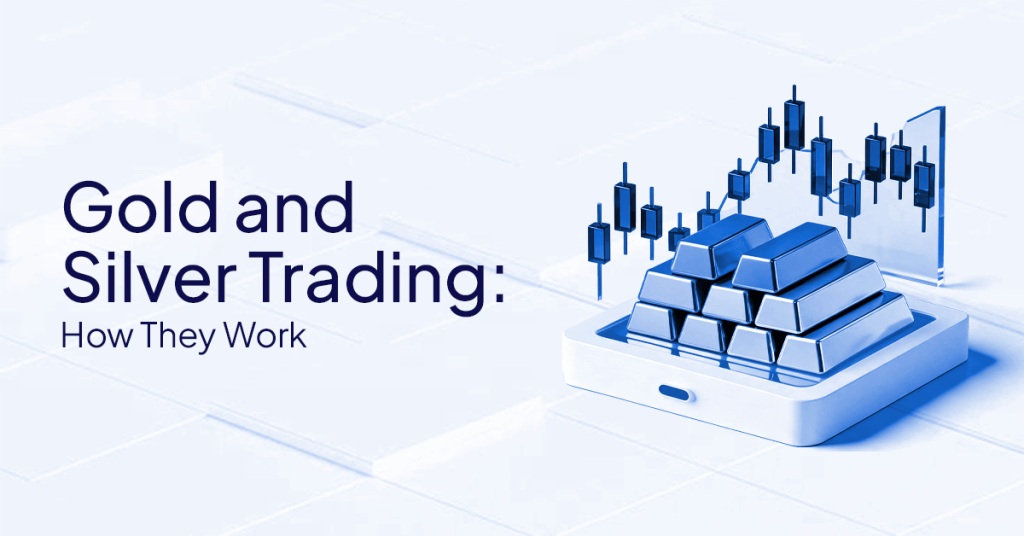
The topography of precious metals has undergone a significant shift over the last few years. While gold has remained a pillar of global reserves, silver has evolved into a fast-moving industrial giant.
In the previous year, gold prices had broken all-time highs, soaring to over $4,000 per ounce, and silver, which had risen by 150 percent a year, had outdone its yellow counterpart.
To the contemporary trader, gold and silver trading has ceased being merely a matter of possessing a slice of history. It has become a matter of operating within a complicated nexus of geopolitical insurance and high-tech industrial need.
Let’s explore how gold and silver trading work and the risks involved!
Quick Answer
- Gold and silver trading involves speculating on price moves rather than physical ownership.
- Central bank policies, inflation, and industrial manufacturing govern the prices
- The percentage swings are generally greater in silver than in gold
- You can trade 23 hours a day in the global financial hubs
- Novices commonly expose themselves to price risk through spot markets, futures, or CFDs
- To trade successfully, it is necessary to manage risk and expect volatility to be higher in the coming years
| Feature | Gold | Silver |
| Typical Volatility | Lower | Higher |
| Key Demand Theme | Store-of-value | Industrial + Store-of-value |
| Performance | ~65% Gain | ~150% Gain |
| Primary Driver | Central Bank Reserves | Solar & EV Manufacturing |
What Is Gold and Silver Trading?
Gold and silver trading refers to speculation on the price movements of precious metals using various financial instruments, without necessarily requiring delivery of the physical bars.
While an investor buys a gold coin to keep in a safe, a trader looks at price action. This implies they want to make a profit on the difference between the price they will receive when entering a trade and the price they will receive when exiting.
In the contemporary market, the futures and spot markets are the primary venues for pricing, as institutional participants and retail traders conduct their activities 24/7. This form of trading offers high liquidity, enabling you to enter and exit positions almost immediately.
How Does Trading Gold and Silver Work?
Trading gold and silver involves opening a position that gives you a view on whether the market will increase (going long) or decrease (going short).
By trading gold and silver, you are using leverage. Leverage enables you to manage a large position with a comparatively small amount of capital, or, more often, margin.
For example, if you feel that geopolitical tensions will push prices higher, you place a purchase order, also known as a buy order. Assuming the price has risen by 2 per cent, and you are using 1:10 leverage, you would be making 20% on the margin. On the other hand, when the price decreases, your losses increase.
What’s the Difference Between Gold and Silver as Markets?
The different volatility patterns and demand drivers for gold and silver make the two behave differently.
Silver is much more volatile than gold; swings of 5-10% in one day are not unusual. Silver is less liquid, and its market is smaller; hence, big orders can affect its prices drastically. To traders, it implies having larger profit potential but also larger drawdowns.
Also, industrial uses, electronics, solar panels, and manufacturing account for approximately 50% of total silver demand, according to the Silver Institute. This is what renders silver as an economically growth-sensitive item.
Gold’s different; only 10% is industrial. Jewelry, investment, and central bank demand are the largest drivers of gold demand, which react more to interest rates, currency weakness, and geopolitical uncertainty.
Key Price Drivers
| Driver | Usually Impacts Gold via… | Usually Impacts Silver via… |
| Interest Rates | Inverse correlation (Lower rates = higher gold) | Lower rates + industrial borrowing |
| US Dollar | Primary quote currency strength | Industrial export/import costs |
| Geopolitics | Safe-haven “flight to quality.” | Supply chain disruptions in mining hubs |
| Tech/AI | Minimal direct impact | High demand for conductive components |
What Are the Main Ways to Trade Gold and Silver?
Traders can have exposure to precious metals through spot, futures, options, or exchange-traded funds (ETFs).
- Spot/CFD-style exposure: For most retail participants, gold and silver online trading is conducted via spot markets or CFDs, which mirror the current market price.
- Futures: Standardized agreements to purchase or sell at any particular price on a future date. Very high leverage and narrow spreads; however, it requires margin maintenance and knowledge of contract expiry.
- Options: Right (but not obligation) to purchase or sell at a certain price before expiring. The premium paid is limited to risk, but options decay with time.
- Funds (ETFs): Track gold or silver prices by holding physical metal or derivatives. Trade like stocks with easy entry/exit, but they come with management fees.
- Physical: Direct ownership of bars or coins. Long-term wealth preservation, not active trading. No counterparty risk, but comes with storage costs and wide buy/sell spreads.
Instrument Comparison Table
| Instrument | Typical Use | Main Costs | Main Risks | Suitable For |
| Spot / CFDs | Short-term speculation | Spreads + Swaps | Leverage / Overnight gaps | Day traders |
| Futures | Hedging / Large moves | Commissions | Expiration / Margin calls | Swing traders |
| Options | Hedging / Volatility | Premium | Time decay | Advanced traders |
| ETFs | Long-term exposure | Management fees | Tracking error | Investors |
What Are Gold and Silver Trading Hours?
Gold and silver trading hours are almost 24/7, from Sunday evening to Friday evening (EST), and the busiest are during major market overlaps.
The market follows the sun, beginning in Sydney and Tokyo, then moving to London, and finally to New York. Although the market operates 23 hours a day, price movements do not remain uniform in all directions.
The peak turnaround usually occurs at the overlap of the London and New York sessions, when the world’s largest financial institutions are active.
When Liquidity is Usually Highest
| Session Overlap | What Tends to Happen |
| London / New York | Tightest spreads and highest volatility |
| Tokyo / London | Moderate liquidity; often sets the intraday trend |
| New York Close | Liquidity thins; higher risk of unpredictable gaps |
How Do You Start Trading Gold and Silver Futures?
First things first, to get acquainted with the principles of trading gold and silver futures, you will need to be familiar with contract specifications such as tick size, margin, and expiry dates.
Futures trading is more structured and controlled than spot trading. A single gold futures contract typically has a notional value of 100 troy ounces. Any slight price change will result in a significant dollar change in your account.
The best way to trade both gold and silver futures is to have a good idea of how to roll over your positions before the contract expires. You may find yourself obliged to take delivery, which most retail traders would not wish to do.
- Open a free business account: Use an institutional-grade execution provider such as STARTRADER, which provides human-speed order execution to allow you to enter a volatile silver market at the correct time.
- Learn the specs of the contract: Learn the value of every single “ tick ”, or movement of the price.
- Define your risk: Never enter a futures trade without a pre-determined stop-loss.
- Keep track of the calendar: Be aware of the “First Notice Day” to avoid unwanted delivery commitments.
What Indicators and Signals Do Traders Commonly Use?
Successful traders often combine trend-following signals with momentum oscillators to identify high-probability entries in XAUUSD and XAGUSD.
- Moving Averages: Used to estimate the general trend (e.g., the 200-day MA is a traditional long-term trend filter).
- Relative Strength Index (RSI): This helps determine whether silver or gold is overbought after a huge run.
- Average True Range (ATR): This is essential in silver because it allows you to set up stop-losses that account for current market volatility.
- Support and Resistance: Identifying price floors is essential for risk placement.
What Are the Biggest Risks in Precious Metals Trading?
The most significant risk for beginners is the combination of extreme volatility and excessive leverage.
Although the recent gains were historic, the market has demonstrated how fast it can correct itself. Gold fell by 21 percent in just two days following its peak, and silver fell by the most ever recorded, losing 41 percent of its value as leverage positions were liquidated.
These gaps may occur on weekends or during news events and may well exceed your stop-loss price.
Risk Checklist
- Position Sizing: Do not put more than 1-2 percent of your account into one trade.
- Stop-Loss Discipline: It is always a good idea to set an exit price and never move it farther away.
- News Awareness: Review the economic calendar for Fed rate decisions or manufacturing data.
- Correlation: Gold and silver tend to move in different directions. Go long on both of them and double your risk.
Frequently Asked Questions
A: It is the pricing of XAUUSD and XAGUSD under financial instruments such as spot contracts and futures.
A: Yes, silver has a smaller market, and with large industrial use, there will be greater percentage changes.
A: The major drivers are the interest rates, the strength of the US Dollar, central bank buying, and industrial manufacturing demand.
A: The markets operate approximately 23 hours a day, 5 days a week, across all major time zones.
A: You must open a brokerage account with the ability to support futures, understand the size of the contract, and make enough margin on the position.
A: The main risks include volatility spikes, losses from leverage, and price gaps at the time of news.
A: Yes, however, it has been advised to use gold first because its price tends to be a little more predictable.
A: It enables traders to see whether one metal is cheap relative to the other; a high ratio usually indicates a likelihood that silver will outperform gold in the future.
Final Thoughts
The market for precious metals offers plenty of opportunities like never before; however, only those who respect the associated risks will be able to take advantage of them.
Gold has remained a macroeconomic hedging platform, and silver is a high-reward momentum trade for those who tracked the industrial transition. You can navigate these historic price moves by understanding the various instruments (spot to futures) and by being disciplined with risk.
Disclaimer: No representation is given, warranty made or responsibility taken about the accuracy, timeliness or completeness of information sourced from third parties. Because of this, we recommend you consider, with or without the assistance of a financial adviser, whether the information is appropriate having regard to your particular circumstances.
Tags


Open Live Account
 Email Address
 Phone Number
Important Notice
STARTRADER does not accept any applications from Australian residents.
To comply with regulatory requirements, clicking the button will redirect you to the STARTRADER website operated by STARTRADER PRIME GLOBAL PTY LTD (ABN 65 156 005 668), an authorized Australian Financial Services Licence holder (AFSL no. 421210) regulated by the Australian Securities and Investments Commission.
Important Notice for Residents of the United Arab Emirates
In alignment with local regulatory requirements, individuals residing in the United Arab Emirates are requested to proceed via our dedicated regional platform at startrader.ae, which is operated by STARTRADER Global Financial Consultation & Financial Analysis L.L.C.. This entity is licensed by the UAE Capital Market Authority (CMA) under License No. 20200000241, and is authorised to introduce financial services and promote financial products in the UAE.
Please click the "Continue" button below to be redirected.


