








 Web Trader MT5










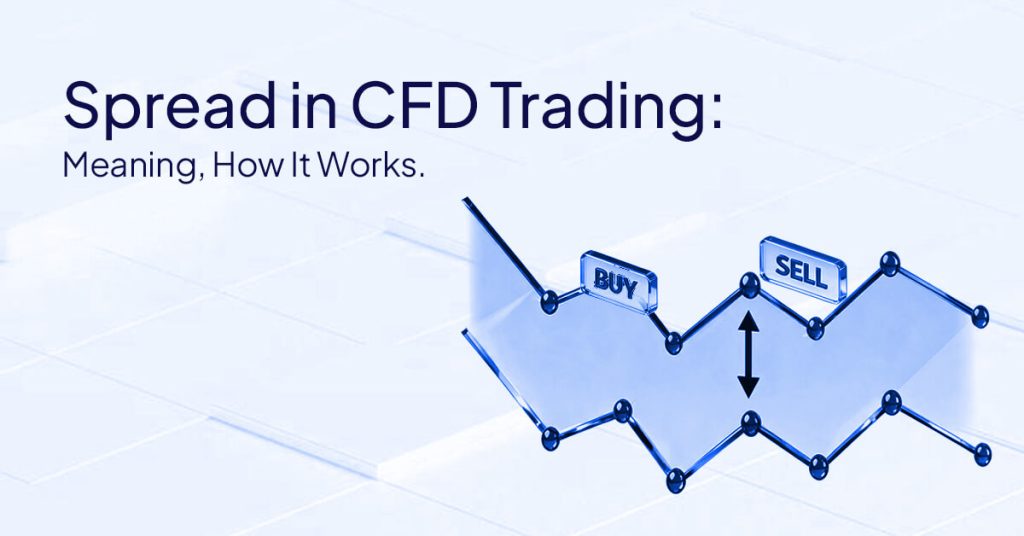
In spread CFD trading, the immediate difference between the bid price (where you sell) and the ask price (where you buy) is your entry cost, which is often referred to as the spread.
Have you ever wondered why your new trade instantly shows a small loss the moment you press the buy or sell button? Each trader incurs trade costs, yet new traders often ignore how these costs are directly reflected in the prices they see on the screen.
It is important to learn how spreads work so that you can assess the actual trade costs, assess the various markets, and calculate just how far the price has to move to break even.
This guide will break down the concept of spread in CFDs, how it affects your profitability, what factors affect it, and how to make a proper comparison of spreads across markets.
What is Spread in CFD Trading?
The spread is the built-in trade of a Contract for Difference (CFD) and applies as the difference between the buying and selling prices in the market.
The lower price at which you can sell is the bid, and the higher price at which you can buy is the ask. Every time you look at the price quote of an asset, you will notice two numbers.
The highest price a buyer is willing to pay is the bid price, and the lowest price a seller is willing to accept is the ask price. The difference between these two numbers is known as the bid-ask spread.
Why Trades Start Below Breakeven
Trades start below breakeven as you always buy at the higher ask price and sell at the lower bid price. When you buy an asset, you are opening a position at the ask price. If you were to close that trade immediately, you would have to sell it at the lower bid price.
Since this gap exists, the market will have to shift in your favor by a minimum of the distance of the spread on the market before your position can reach breakeven and possibly record a profit.
Spread vs Slippage
Whereas a spread is a familiar but predetermined cost when you place your order, slippage is another term for the unforeseen difference between the price you are asking and the price the stock trades at. Spreads refer to normal trading expenses, which prevail in every trading environment.
The slippage, on their part, generally occurs when there is a sudden movement in the market, and your order is not fulfilled because the prices move rapidly. Neither influences the end trade result, although the spread is a constant, structural cost.
CFD Spread Meaning: What it is and Why it Matters
A CFD spread is the difference in price between traders who are buying and selling, and this serves as the greatest challenge that you need to overcome to get into a profitable trade.
How Spread Becomes Your “Entry Cost”
The spread is a fee you pay to the market to take a position. This cost is deducted from your trade instantly, hence affecting your trade planning directly. When a very wide spread characterizes an asset, then you will require a significantly larger price change to offset the cost of entry.
By understanding this, you can easily know whether a prospective trade-based setup can provide you with sufficient reward to make the initial investment worthwhile.
What Makes Spreads Change
The spreads continuously vary depending on liquidity, market volatility, and the trading season. Spreads are narrow when buyers and sellers are actively trading in large numbers in an asset.
The bid-ask spread will automatically widen if market conditions turn chaotic or trading volume dries up during off-hours.
What Affects CFD Spreads the Most?
The asset being traded, the time of day, and breaking financial news are the greatest influences on CFD spreads.
Market Type
Large markets with high daily trading volumes have much tighter spreads than niche or new markets. For example, large currency values or international market indices attract millions of users, which keeps the bid-ask spread minimal.
On the other hand, small commodities or shares of smaller firms have fewer players, and hence they are more widely spread.
Time of Day and Trading Sessions
It is the large international trading centres that tend to be open and overlap, resulting in the tightest spreads. The booms introduce increased liquidity in the market. Trading volume declines when the major sessions come to an end.
This absence of participation leads to wider spreads, as there are fewer buyers and sellers to match orders effectively.
News Events and Fast Markets
Large news releases lead to immediate price re-adjustment and a transient liquidity vacuum, which necessitates immediate expansion of spreads. When major economic indicators are declining, participants tend to withdraw their orders to reduce uncertainty.
As research studies show, sudden volatility spikes consistently lead to temporary increases in spreads in international markets as market makers adjust the risk they take on.
Instrument Liquidity and Order Flow
High liquidity and order flow guarantee effective pricing and tight spreads. When a liquid tool is used, large orders can be executed without causing significant price movement.
The involvement ensures that the market is active and efficient, and its trading costs are low.
Spread vs Commission: What’s the Difference?
Spread is an expense incorporated into the asset’s price, whereas a commission is an independent, fixed fee per transaction.
Cost structures
Brokers will provide a spread-only model or a narrower spread with a flat commission fee. The adjudicated bid ask spread includes all broker charges under a spread-only model.
The spread in a commission-based structure tends to be significantly lower than the raw market price. However, a separate, open fee is charged to your account balance to execute the trade.
Support term integration: Comparing the concept of commission vs spread, neither is necessarily superior to the other; each is merely a different mode of structuring trading costs.
Which is Cheaper Depends on Trading Style
The least expensive structure will be based solely on your average trade size and trade frequency. Large-volume traders willing to make frequent movements usually request a fixed commission to trade on tighter spreads.
On the other hand, beginners with fewer and less frequent trades may find spread-only models easier to use, as all costs are incorporated into the price.
| Cost Model | How it Works | Best Suited For |
| Spread-Only | All fees are built into the bid/ask gap. | Beginners, infrequent traders. |
| Commission + Spread | Raw market spread + a flat fee per trade. | High-volume traders, frequent traders. |
CFD Spread Comparison: How to Compare Fairly
The best way to compare CFD spreads across different markets is to analyze average pricing under the same market conditions, rather than best-case scenarios.
Use “Typical” Spreads Instead of Minimum Spreads
Normal spreads indicate what the cost averages are going to be, whilst minimum spreads do not indicate anything more than the absolute lowest cost available under perfect conditions. Minimum spreads may only take a matter of seconds per day. Strategizing based on the minimums may result in low-cost estimations.
Compare During the Same Active Hours
Due to the fluctuation of the spreads during the day, the only way you can have a fair evaluation of the spreads is by comparing them during the same active trading hours. They will give you a distorted picture of the relative costs between two markets to compare the spread of a market in the peak volume with that of a different market in the off-hours.
Check Whether Commission Applies
A hefty commission could also be accompanied by an apparently tight spread, and it is essential to review the entire cost structure. Always ensure that you confirm whether the spread you are looking at is the final cost or whether an add-on commission fee is going to be charged to your ticket. Platforms such as STARTRADER publish full contract specifications, making it straightforward to verify the complete cost structure before committing.
Include Overnight Charges
When you are holding trades for more than one day, you need to add the financing fees (overnight) and the spread. Under the present regulatory requirements, in accordance with the Financial Conduct Authority (FCA), a clear assessment of the costs of trading should encompass the immediate cost of execution (spread/commission) and the holding cost (overnight cost).
Examples: How Spread Impacts Profit and Loss
The spread eats into your prospective profit margin, and its effect is most heavy when dealing with small price movements.
Example 1: Small Price Move Trade
The spread takes up a large share of your total potential gain when applied to small market movements. Suppose you sell an asset for $10.05, and the bid price is $10.00. Your spread cost is $0.05. When your target is to move out at $10.10 (a move in any of the $0.10), that $0.05 spread occupies half of your total target distance.
Example 2: Larger Price Move Trade
When market trends are large, the spread is a small percentage of the total trade outcome. When you venture into the same trade with a spread of $0.05, and you are also interested in trading the same for $12.00, you will find the price paid to the spread is almost nothing compared with the $2.00 value, which you are hoping to gain.
Example 3: Volatile Period
In volatile times, the spread can widen significantly, making your entry more expensive and the chance of slippage even greater. That $0.05 per standard spread could immediately rise to $0.15 in case of some big news strikes. When you enter this chaos, you begin way behind breakeven, and thus, it will take you a lot more market movement to merely return to zero.
Practical Tips to Reduce Spread Impact
The best way to reduce the effect of spreads in your trading is to trade only during periods when the market is highly liquid.
Trade During Active Market Hours
Trading in areas with significant overlap between major markets is inherently the most suitable, as it offers the narrowest spreads due to the concentration of participants. Trade during the essential hours when the particular asset that you are trading is at its best.
Use Limit Orders Where Appropriate
Limit orders allow you to specify the price at which you are willing to buy, to avoid entering trades when the spread is overstated. Limit orders let you wait until the market price (and the spread) reach the desired level, rather than paying the current market price.
Avoid Thin Markets and Sudden Price Spikes
Often, it is best to avoid the market when significant news is announced or when it is a holiday, as this can cause artificially wide spreads in low-liquidity markets. Thin markets are not large enough to sustain tight, efficient pricing.
Match Trading Horizon to Costs
By matching your trade duration to your cost structure, you will prevent the spread from completely eating up your desired profits. When you are paying wider spreads, you have to take large, longer-term price moves to make the entry cost worth the effort. The available market varieties will allow you to find assets based on your trading horizon preferences.
Common Mistakes Beginners Make with Spreads
The greatest mistake beginners commit is grossly underestimating the effect of spreads on the distance that they need to break even.
Comparing Only “From” Spreads
When one uses the advertised rates from the spreads, it gives the illusion of safety, as they are the lowest possible minimums, not the typical costs. Whenever you plan your trades, always check the average spread.
Ignoring Commission or Overnight Charges
By focusing on the spread and ignoring commissions and holding fees, one ends up with surprisingly large aggregate trading costs. A comprehensive trading plan considers all fees that may affect the bottom line.
Using Oversized Positions Without Considering Breakeven
Opening big orders magnifies the initial cash impact on the spread and psychologically burdens the trader with excessive pressure. Since the spread determines the distance below breakeven at which you begin, an oversized position implies a greater initial negative balance, which is likely to induce emotional decision-making.
FAQs
The spread is the difference between the bid (sell) price and the ask (buy) price. It is the first and inherent cost of a trade in the market.
The spread is the physical gap in price between the sell and the buy quotes offered on a Contract for Difference. Trading requires you to bridge this gap to make a trade profitable.
Spreads vary with the number of active participants (liquidity) and the degree of market chaos (volatility). Increased liquidity tends to narrow spreads, while high volatility or low liquidity tends to widen them.
No. Although it is one of the main expenses, the total trading expenses may also be composed of flat commission fees per trade and interest incurred on the overnight financing charges in case you have positions for more than one day.
Conclusion
In CFD markets, spreads are the main determinants of trading costs. Since spread is defined as the difference between the ask and bid prices, it is the initial cost incurred by traders when opening a position.
Knowing how spreads influence breakeven levels and how to plan trades and compare markets can help traders make better choices. Traders get to understand the relation between changes in spreads and liquidity, volatility, and market conditions.
It enables them to assess different markets more successfully and to control the cost of trade. Taking spreads, which are in addition to other trading costs like commissions and overnight, will give a better picture of the overall cost of a trade.
You can test the behavior of the spreads in various situations when you are ready to follow these market dynamics in real-time by opening either a demo or live account with STARTRADER.
Tags


Open Live Account
 Email Address
 Phone Number
Important Notice
STARTRADER does not accept any applications from Australian residents.
To comply with regulatory requirements, clicking the button will redirect you to the STARTRADER website operated by STARTRADER PRIME GLOBAL PTY LTD (ABN 65 156 005 668), an authorized Australian Financial Services Licence holder (AFSL no. 421210) regulated by the Australian Securities and Investments Commission.
Important Notice for Residents of the United Arab Emirates
In alignment with local regulatory requirements, individuals residing in the United Arab Emirates are requested to proceed via our dedicated regional platform at startrader.ae, which is operated by STARTRADER Global Financial Consultation & Financial Analysis L.L.C.. This entity is licensed by the UAE Capital Market Authority (CMA) under License No. 20200000241, and is authorised to introduce financial services and promote financial products in the UAE.
Please click the "Continue" button below to be redirected.


