








 Web Trader MT5






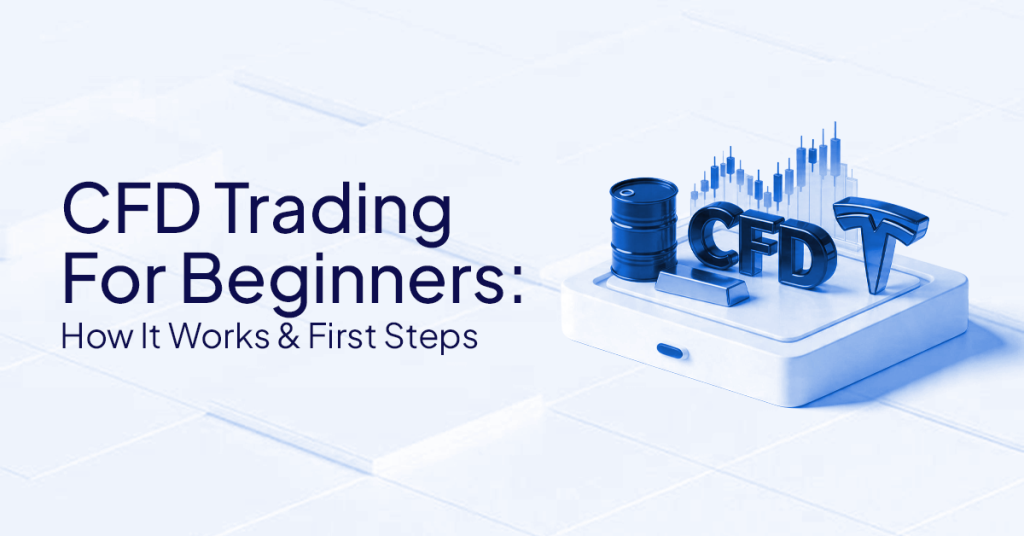
CFD trading is everywhere on the Internet: advertisements promising easy money, influencers with charts, and courses claiming to reveal “the secret.” What is CFD trading, and should beginners even consider it?
CFD trading for beginners is about learning to speculate on price movements of a commodity, such as a forex, an index, or a share, without owning the underlying asset. You gain or lose depending on the difference between the price at which your position is open and the price at which it is closed.
This trading guide provides a simple explanation of how CFD trading works, its costs, the associated risks (numerous), and the steps to get started, assuming you have decided it is worth the risk.
Quick Answer
- CFD trading basics for beginners teaches you how to trade on price movements without holding assets
- You can gain from an increase or a decrease in price (long or short)
- Leverage multiplies gains and losses; you can lose more than what is deposited
- Expenses include commissions, overnight financing, and slippage
- Start with a demo, low leverage, 1 per cent trade risk
- Restricted in some countries, including the US retail markets
What Is CFD Trading (Contract for Difference) in Simple Terms?
CFD trading is speculation on an asset’s price movement by entering a contract that pays the difference between the entry and exit price (you do not own the underlying asset).
What You Do vs. What You Don’t Do
Trading a CFD in gold does not mean that you are buying gold. You are agreeing to exchange the open-to-close price difference. If gold rises, you profit. If it falls, you lose. No warehouses, no transportation, no possession; just price speculation.
Where CFDs Are Commonly Used
CFDs are available on forex pairs, stock indices, commodities, and single shares. Anything that can be priced can be traded via a CFD. This flexibility is attractive, but it also increases the risk of costly errors.
Availability Note
CFDs are widespread globally but are limited in some jurisdictions. In the US, retail off-exchange CFD trading is prohibited under CFTC regulations. CFDs are permitted in other countries, but leverage limits apply. Before creating an account, check the local laws.
How CFD Trading Works for Beginners
CFD trading involves opening a long or short position, monitoring price movements, and then closing the position. Your profit or loss is the price difference multiplied by your position size and leverage.
Long vs. Short Example
Going long, you profit from price increases. Purchase EUR/USD at 1.0850; if it rises to 1.0900, sell. Gain is 50 pips × position size.
Going short? This will increase your profit as the price declines. Buy EUR/USD at 1.0900; if it falls to 1.0850, you have a 50-pip gain in the opposite direction.
Leverage, Margin, and Why Losses Can Exceed Expectations
Leverage is used to manage larger positions with less capital. Having 10:1 leverage, $1,000 controls a $10,000 position. With 50:1, $1,000 controls $50,000.
A 2% adverse move with 50:1 leverage wipes out 100% of your margin. Losses can exceed your initial deposit if positions move violently. This is why regulators limit retail leverage: high leverage kills beginner accounts.
What Triggers a Margin Call and How to Avoid It
A margin call occurs when the equity falls below the required maintenance margin. Positions are automatically closed by the broker to avoid a negative balance (but can still be done in fast markets).
Keep a buffer: do not take up all the margin—trade smaller positions. Establish predetermined stop losses to sell positions before reaching a margin call.
What Does It Cost to Trade CFDs?
CFD trading costs include spreads or commissions on entry, an overnight financing charge on positions that remain open after a rollover, and slippage during volatile periods. These can add up relatively fast for an active trader.
Spread vs. Commission
Some brokers charge only the spread, which is the difference between the buy and sell prices. Others charge tight spreads but add a per-lot commission. One is not automatically cheaper than the other; estimate the total cost for your trade size.
Overnight Financing
Hold a CFD overnight, and you incur or receive financing charges (swap/rollover). These are interest rate differentials or the cost of leverage. Overnight charges cost most retail traders more than they earn.
Slippage + Volatility
Slippage occurs when orders are filled at prices different from those anticipated, typically at worse prices. In fast markets or low-liquidity markets, the difference between expected and actual fills might be a few pips. When possible, use limit orders to set entry prices.
CFD Costs Explained
| Cost Type | What It Is | When It Applies | Beginner Tip |
| Spread | Difference between buy/sell price | Every trade entry | Check the spread before entering—avoid wide spreads |
| Commission | Fixed fee per lot/contract | Per trade (if broker charges a commission model) | Calculate total cost: spread + commission |
| Overnight financing | Daily interest charge/credit for holding | Positions held past market rollover time | Close intraday trades before rollover to avoid |
| Slippage | Difference between expected and actual fill price | Volatile markets, low liquidity, market orders | Use limit orders; avoid trading during news |
Is CFD Trading Good for Beginners—or Too Risky?
CFD trading would suit beginners who learn, train extensively on a demo account, and apply serious risk management. Still, it is unsuitable for most novice traders due to its high leverage and the risk of rapid losses.
When Can It Fit Beginners
CFDs can serve as a learning tool, in case you are comfortable spending months learning and practicing on a demo, using no real money, and with minimum leverage when you actually go live. The most important one is being willing, as most individuals jump into live trading at maximum leverage.
Novices who are winning see CFDs as a skill to develop over the years, not a lottery ticket. They trade in small amounts at a time, record everything, and are more process-based than profit-oriented.
Red Flags
High leverage on beginner accounts is a red flag. Brokers who give 500:1 leverage to new traders are trading them to failure. If you cannot resist using maximum leverage, you are not prepared to use CFDs.
Bad analysis can never ruin accounts as much as overtrading (making dozens of trades because you are bored or chasing losses). Trading with no plan is gambling. Chasing losses after a bad trade means emotions control you, not logic.
Simple “Risk-First” Rule of Thumb
Take no more than a 1 per cent risk on your account. With a total of $5000, the maximum risk per trade should be $50. Calculate the position size based on your stop-loss distance so that you reach the stop when the distance is $50.
This rule will keep you in the game long enough to learn. The worst attitude among most beginners is taking 10-20% per trade because they want huge returns in a short time, then blowing it up and quitting.
How to Start CFD Trading as a Beginner
A safe starting approach to CFD trading includes mastering the basics, training on demo accounts, creating a simple trading strategy, adopting an appropriately balanced risk approach, and regularly analyzing performance.
Step 1 — Learn the Basics
Know the types of margins, leverage, and order types before transacting. Understand the difference between market orders, limit orders, stop losses, and take profits. This is not optional; it is survival knowledge.
Step 2 — Practice With Demo
Demo accounts are used to trade using fake money. Continue until profitable for at least 2-3 months. Track win rate, win/loss ratio, and maximum drawdown. If you cannot succeed on the demo, you will fail with real money.
Step 3 — Build a Simple Plan
Select the market you trade and the session. Define your setup criteria. Record risk policies: each trade should have no more than 1 percent risk, the daily loss should not exceed 3 percent, and the maximum open positions should not exceed 2-3.
Step 4 — Place Your First Trade
Upon your setup, be sure to use the correct size. So set your stop loss immediately. Establish a take-profit or an exit rule. Then walk away (let the market do its thing).
Step 5 — Review With a Journal
Note down all: market, entry, exit, result, reason you entered, emotions, compliance with rules. Screenshot the chart. Review weekly, not daily. Find the trends and repair what is broken.
What Are CFD Trading Tips for Beginners?
Some of the best tips for beginners are to work with lower leverage, start small, always have an exit, avoid trading on big news, and focus on one or two markets before they understand how those markets behave.
Use Lower Leverage and Smaller Positions
Use the minimum leverage that the broker will give you, 10:1 or 20:1. Trade the position size that allows you to learn. Your goal early on is education, not profit.
Always Define Exit Points
Determine the stop-loss level based on technical indicators when your trade concept is invalidated, not on a random dollar value. Never trade without a stop. “I will watch it and close it manually” fails during fast moves.
Avoid News Spikes
Ridiculously volatile, wide spreads are driven by major economic releases. Close positions before major news or wait 30+ minutes after for conditions to normalize.
Stick to 1–2 Markets
EUR/USD does not act in the same way as crude oil. Get mastery of one or two markets, then expand. Find out what “normal” looks like to identify abnormal situations.
What Simple CFD Trading Strategies Work for Beginners?
The basic strategies for a beginner are trend-following on longer timeframes, range trading with distinct boundaries, and confirmed breakouts. All these need clear entry rules, defined stops, and achievable expectations.
Trend-Following
Determine the trend direction on either the 4H or daily chart. Wait until the price returns to the moving average or support, then enter once the price rebounds in the trend direction. Stop goes below the pullback low. This works during the trending markets.
Range Trading
When the price bounces between clear support and resistance, buy near support and sell near resistance. It is best to use narrow stops, since ranges eventually disintegrate—only trade when the market is low-volume.
Breakout With Confirmation
Price breaks resistance or support. Wait until the price retests the broken level. If it is new support, enter the breakout direction. The stop is above the retest level. Most breakouts are unsuccessful, resulting in losses.
Strategy Selector
| Market Condition | Recommended Strategy | Why It Works Here | What to Avoid |
| Strong trend | Trend-following pullback | Price tends to continue in the trend direction | Counter-trend trades |
| Clear range | Range trading | Price bounces predictably between boundaries | Holding when range breaks |
| Consolidation into breakout | Breakout with retest | Reduces false breakout risk | Chasing an immediate breakout |
What Timeframe Should Beginners Use for CFD Trading?
Beginners should stick to higher timeframes, such as 1-hour, 4-hour, or daily charts, to minimize noise and emotional trading; lower timeframes require faster responses and greater experience to trade profitably.
Why Higher Timeframes Reduce Noise
Every wiggle, which appears as patterns but is not a pattern, is represented in 5-minute charts. Noise is filtered out at higher timeframes, revealing clearer trends and levels. Daily charts are updated daily, giving you a chance to think rather than act on emotions.
Matching Timeframe to Holding Period
Day trading? Use 15-minute to 1-hour charts. Swing trading? Use 4-hour charts for daily charts. Correlate your chart time to the length of time you are going to maintain positions.
A Simple 2-Timeframe Workflow
Use one timeframe for context (trend direction, key levels) and a lower timeframe for entries. Example: 4H chart is the trend, 15M chart entries. Do not make it complicated with five timeframes; two are enough.
What Should You Look For in a CFD Trading Platform for Beginners?
A beginner-friendly CFD trading platform needs simple order placement, clear stop-loss and take-profit tools, easy-to-read margin indicators, price notifications, and basic charting with popular indicators. Anything beyond that is too complicated to be useful.
Must-Haves
Choose to buy/sell with easy Buy/Sell buttons and required stop-loss fields. Real-time margin display, in which you can see how much you are using and what is available. Price alerts, so you are not stuck to charts.
Charts + Indicators Basics
Basic charting, candlestick, and drawing tools (trendlines, support/resistance) are all that is needed. Popular indicators such as moving averages are helpful but not required. Additional indicators do no good; they only confuse.
MT4/MT5 Note
The most common CFD trading platforms are MT4 and MT5, which offer charting, indicators, and order management. Numerous brokers, including STARTRADER, provide these platforms. The interface is old, functional, and well-documented.
Common Beginner Mistakes in CFD Trading (and How to Avoid Them)
Common mistakes include overleveraging trades, shifting or removing stop losses during a trade, trading multiple markets at once, and confusing activity with skill, all of which consistently ruin accounts.
Oversizing Positions
The quickest way to blow up is to trade too large for your account size—fix: Set a maximum risk of 1% per trade. Position size should be calculated depending on the distance to the stop.
Moving Stops / No Stop-Loss
Setting a stop, then moving it further away, or not setting stops at all, guarantees disaster. Fix: Set stops before entering based on technical invalidation. Never force them unless your plan allows trailing stops in profit.
Trading Too Many Markets
When you see 10 pairs, 5 indices, and 3 commodities, you are not looking at anything good. Fix: Trade 1-2 markets until each is profitable over the next several months.
Confusing Activity With Skill
Taking 20 trades in a day because you are bored is not a skill; it is overtrading. Fix: stipulate the number of trades per day (3-5)—trade only when your setup is evident.
Long vs Short Example
| Position | Entry Price | Exit Price | Price Difference | Result (per unit) |
| Long (Buy) | 1.0850 | 1.0900 | +50 pips | Profit: 50 pips |
| Short (Sell) | 1.0900 | 1.0850 | -50 pips | Profit: 50 pips |
Both profit the same amount—direction doesn’t matter as long as you’re right about the move.
Beginner Safe-Start Checklist
- 2-3 months of minimum practice in a demo account
- Max leverage established at 10:1 or 20:1 (avoid higher)
- Risk per trade is limited to 1% of the account
- Maintained margin buffer (not 100 per cent of available margin)
- The trading journal is established and committed to using
Before You Place a Trade Checklist
- Conditions set according to your trading plan (yes/no, not maybe)
- Entry trigger confirmed (Not going in early, thinking that it works)
- The stop level is determined on technical grounds at the point of invalidation
- Calculated position size (stop distance 1% risk)
- No high-impact news in 30 minutes
Frequently Asked Questions
A: CFD trading for beginners means learning to speculate on price action without owning the underlying asset. You make a profit or incur a loss based on the difference between the opening price and the closing price.
A: Trading CFDs involves opening long or short positions on leverage and closing positions to make profits or incur losses depending on price movements.
A: CFD trading is effective for novice traders who self-educate, test on a demo, trade with low leverage, and manage risk carefully. Still, it is not effective for most new traders.
A: The minimum deposit depends on the broker, yet a beginner would need at least $2,000-5,000 for proper position sizing and to recoup the typical losing streaks.
A: Main risks include losing more than deposited due to leverage, margin calls, high costs from spreads and overnight financing, and emotional trading leading to poor decisions.
A: The spreads, commissions (if charged or not), overnight financing charges on positions held after rollover, and slippage in volatile markets are considered CFD costs.
A: Yes, the vast majority of brokers do offer demo accounts using virtual money. Beginners should go through months of training before risking real money.
A: The presence and use of CFDs depend on the country. US retail off-exchange CFD trading is not permitted under CFTC regulations. So, always check local laws before opening accounts.
Final Thoughts
CFD trading is not easy money; it is a high-risk undertaking that blows most accounts within a few months. It can be feasible for those willing to invest in education, practice regularly, and embrace risk management. If you’re eager, begin with education and practice demonstrations, use lower leverage, and risk small amounts.
This is not financial advice; it is an educational article. CFD trading is associated with high losses. Thus, before trading, carefully consider your experience level and risk tolerance. Do not invest money you cannot afford to lose.
RISK WARNING: CFDs are complex financial instruments and carry a high risk of losing money rapidly due to leverage. You should ensure you fully understand the risks involved and carefully consider whether you can afford to take the high risk of losing your money before trading.
Disclaimer: The information is provided for educational purposes only and doesn’t take into account your personal objectives, financial circumstances, or needs. It does not constitute investment advice. We encourage you to seek independent advice if necessary. The information has not been prepared in accordance with legal requirements designed to promote the independence of investment research. No representation or warranty is given as to the accuracy or completeness of any information contained within. This material may contain historical or past performance figures and should not be relied on. Furthermore estimates, forward-looking statements, and forecasts cannot be guaranteed. The information on this site and the products and services offered are not intended for distribution to any person in any country or jurisdiction where such distribution or use would be contrary to local law or regulation.
Tags


Open Live Account
 Email Address
 Phone Number
Important Notice
STARTRADER does not accept any applications from Australian residents.
To comply with regulatory requirements, clicking the button will redirect you to the STARTRADER website operated by STARTRADER PRIME GLOBAL PTY LTD (ABN 65 156 005 668), an authorized Australian Financial Services Licence holder (AFSL no. 421210) regulated by the Australian Securities and Investments Commission.
Important Notice for Residents of the United Arab Emirates
In alignment with local regulatory requirements, individuals residing in the United Arab Emirates are requested to proceed via our dedicated regional platform at startrader.ae, which is operated by STARTRADER Global Financial Consultation & Financial Analysis L.L.C.. This entity is licensed by the UAE Capital Market Authority (CMA) under License No. 20200000241, and is authorised to introduce financial services and promote financial products in the UAE.
Please click the "Continue" button below to be redirected.


