








 Web Trader MT5







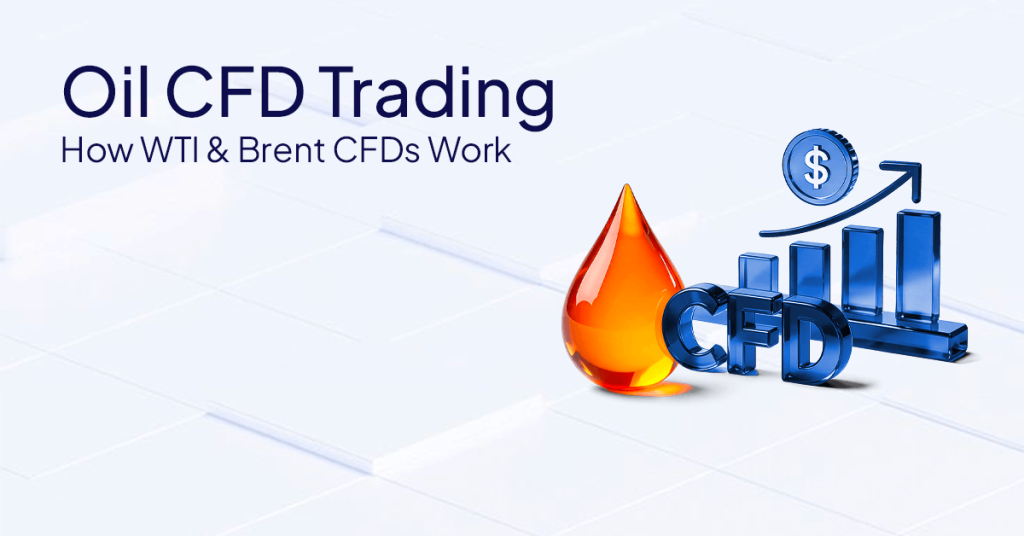
Oil CFD trading involves speculating on crude oil prices without owning the physical barrels.
However, how are you ever going to feel the benefit of a physical commodity thousands of miles away, without ever having touched a drop of oil, with a digital contract?
The logistics of physical energy storage and transportation are beyond the capabilities of many market players.
That is why Contracts for Difference (CFDs) have emerged as an effective way to access energy markets.
This resource provides a breakdown of what an oil CFD is, the most crucial distinction between the WTI and Brent benchmarks, and how these trades operate.
We will also discuss the costs, the risks you need to deal with, and the market analysis process in steps.
Note: This article should be regarded solely as educational and not as investment advice. Financial derivatives trading is a risky endeavor.
Quick Answer
An oil CFD is a contract in which you can gain or lose the difference between the price at the time you enter a trade and the price at the time you exit. When you think the price will rise, then you go long (buy); when you believe the price will fall, then you go short (sell). You do not own the underlying asset. The most widely used are the WTI (US oil) and Brent (Global oil). Traders need to know about risks, such as leverage, that may increase losses, as well as expenses, such as overnight financing charges.
What Is an Oil CFD?
An oil CFD is a financial derivative that tracks the price of crude oil, enabling traders to speculate on its price without owning the underlying asset.
Oil CFD Explained Simply
By trading crude oil, you are getting into a contract with a trader. You are willing to trade the difference in the value of the asset at the time you get into the trade to the time you get out.
There are no barrels to store, no pipelines to run, and no delivery logistics, unlike traditional commodity trading. In case there is an increase in the price of oil to your advantage, then this is credited to your account.
If the price shifts against you, your account is debited. This building has the advantage of being flexible enough that you can always seek to earn off falling prices as much as you can from rising prices.
One should keep in mind that, although the underlying market price is reflected in the CFD, it is an independent financial instrument. You are selling price movement and not the power source.
How Does Oil CFD Trading Work?
Oil CFD trading works through leverage: a small deposit is used to trade a larger market position.
Margin, Leverage, and Long vs Short Positions
The initial amount of capital required to open a position is called margin. Since oil CFD trading is leveraged, you may just be required to deposit a modest percentage of the entire trade value.
- Leverage: This exaggerates both potential gains and losses. Even minimal market movement can significantly change your account balance.
- Going Long: You purchase a CFD when you feel that the oil price will increase.
- Going Short: You buy a CFD when you are sure that the oil price will go down.
What Happens When You Hold Positions Overnight
If you hold a position past the daily cut-off time (typically 5 PM New York time), a financing fee is charged. This is referred to as a swap or a rollover fee.
This charge would be the interest on the levered amount of your trade. This fee is insignificant to short-term traders. But when individuals hold positions for weeks or months, these expenses can affect aggregate returns.
WTI vs Brent: Which Oil CFD Are You Trading?
The two primary benchmarks are the WTI, which originates in the US, and Brent, which is the global market for seaborne oil.
What Each Benchmark Represents
- WTI (West Texas Intermediate): This is the benchmark oil grade in the US. It is recovered from land-based wells in the United States and is commonly conveyed by pipeline to Cushing, Oklahoma. A WTI oil CFD may appear listed on such a platform as STARTRADER.
- Brent Crude: This is the oil produced in the North Sea (Europe). It is a maritime crude, so it is easier to ship around the world. As a result, the Brent oil CFD price can serve as a reference price in most global oil markets.
Typical Differences
Though these two benchmarks tend to move in the same direction, their price differences (the so-called spread) may vary.
| Feature | WTI (US Oil) | Brent (Global Oil) |
| Location | Land-locked (US) | Seaborne (North Sea) |
| Transport | Pipeline dependent | Tanker/Ship dependent |
| Sensitivity | US inventory reports | Geopolitical tensions (Middle East/Europe) |
WTI is also more susceptible to local supply problems in the US, including pipeline bottlenecks at Cushing. Brent will generally be responsive to international geopolitical developments that can affect shipping routes.
Spot-Style vs Futures-Based Oil CFDs: What’s the Difference?
Spot-style CFDs follow the existing cash price, whereas futures-based CFDs follow the price of oil to be delivered at a particular future date.
Rollover and Expiry Basics
You can visit your trading site and come across various versions of oil contracts.
- Spot CFDs: These are live cash-tracked. They tend to be tighter, but they levy overnight financing charges. WTI crude oil spot CFDs are the best to use for day trading.
- Futures-Based CFDs: These are the ones that trade on the oil futures market. These contracts have a predetermined expiry date. They do not usually charge overnight financing, but the spread (the difference between the sell and buy price) is generally broader.
The Rollover: In situations where a futures contract is running out or expires, you are forced to either sell or roll your futures to the following month. If the new contract is more expensive than the old one, the difference will be recorded on your account, with the net value neutral at the start, but costs will still be incurred.
What Moves Oil Markets?
The oil markets are mainly influenced by global oil supply constraints from organisations such as OPEC+ and by changes in demand driven by economic growth.
Supply and Demand Drivers
Oil is a traditional market of supply and demand.
- OPEC+ Decisions: The Organization of the Petroleum Exporting Countries and its allies (OPEC+) own a considerable share of the world output. Changes in production levels, whether to increase or reduce output, have a direct effect on prices.
- Global Economic Health: As the economy expands, factories are producing more goods, and transport is increasing, thereby requiring more fuel. On the other hand, oil demand is usually smashed by recessions.
- Disruptions: Wartime, pipeline spills, or even hurricanes in the Gulf of Mexico can abruptly decrease supply, leading to a price explosion.
To get authoritative information on demand and supply, the traders usually look to the data on the International Energy Agency (USA) or the US Energy Information Administration (EIA).
USD Strength and Risk Sentiment
Oil prices are priced in US Dollars. As a rule, there is an inverse correlation:
- Strong USD: Makes oil costly to foreign consumers, and it may decrease demand and prices.
- Weak USD: Oil is cheaper to foreign consumers, and this could be a price booster.
Oil is also a “risk asset.” During economic optimism (risk-on), oil is likely to increase. During times of fear (risk-off), investors can run out of commodities into safe havens such as bonds or Gold.
Costs and Risks in Oil CFD Trading
The principal expenses for trading oil through CFDs include spreads and overnight fees, and the principal risks arise from leverage, increasing losses.
Common Trading Costs
- Spread: The difference between the sell and the buy price. It is this cost that causes you to enter every trade at a loss.
- Financing (Swap): This is the cost of leaving an overnight position.
- Slippage: Slippage is the difference between the price that you requested and the price that you received. This usually occurs when the volatility is high.
- Gaps: When the market opens at a much different price than it was at the end of the day, you will have to exceed your stop-loss order.
Key Risks to Understand
- Leverage Risk: Leverage enhances the purchasing power, but at the same time, guarantees that the losses are rising at the same rate as the gains.
- Volatility: Oil is, by reputation, volatile. A single news headline can move the prices 3-5% in a single day.
- Emotional Execution: It is possible to experience panic selling or revenge trading following a loss due to the rate of change of the oil market.
How to Trade Oil CFDs Step by Step
The steps to trade oil CFDs include selecting your benchmark, determining the path you want to follow, setting your risk, sizing your position according to the risk, and observing your trade with an exit strategy.
Step-by-Step Workflow
Step 1: Market Selection
Choose between trading oil CFD contracts via WTI or Brent. Take into account which benchmark is more in line with your analysis or can provide better technical patterns. WTI might be more reactive to an analysis of the US supply dynamics. Brent can be a better fit in case you care more about geopolitics around the world.
Step 2: Decide Direction
Decide on whether to go long (buy) when prices are expected to increase or go short (sell) when prices are expected to fall. This decision should be based on your interpretation of the supply-demand variables, technical charts, or macro-market. Do not guess; be rational about why you are biased in the direction you are.
Step 3: Define Risk Before Entry
Before making the trade, decide on the maximum amount of money that you can lose in case of market reversal. Establish a particular dollar or percentage limit of your allowable loss on this one trade. This amount ought to be pegged to your age and general account size.
Step 4: Position Sizing and Execution
Calculate your position size to ensure that in case your stop-loss is reached, you are not going to go beyond your risk. More smaller positions enable you to weather volatility without being pushed out of business too soon. Larger positions make more profit but speed up the losses. Trade at the right time and at the correct order type, which can be market orders (immediate fills) or limit orders (specific entry prices).
Step 5: Monitoring and Exit Logic
After the trade has become live, follow it as planned. Have a desired level of profit or technical indicator to leave with a gain. Also, it is worth noting to adhere to your stop-loss. The only thing you change your stop to is to lock in profits (trailing stops) and not to provide a losing trade more spacing. When you realize changes in your thesis in between trades, then get out of the trade rather than wishing to win back.
Risk Checklist Before Every Trade
- Maximum Risk PerTrade: To set maximum risk per trade as a percentage of your total account. Most of the experienced traders are only betting against one or two percent per trade, and they would not feel the loss of a streak of bad trades devastating their capital.
- Max Risk Per Day: Set a maximum limit on daily risk to avoid an emotional spiral. In case you hit a day loss target, take a break. Trading after consecutive losses is likely to result in revenge trading and further downturns.
- Stop-Loss: Use stop-loss discipline without exception. Without it is like driving a car without brakes by joining a trade without a stop. Markets have the capability of moving against you at a quicker rate than you can manually react to, and as such, automated stop-losses are imperative.
- Exposure: Do not overexpose yourself by getting different exposures through different positioning or timeframes. When you have all your accounts in one oil CFD trade, this form of risk is dangerous, and you are at risk of being hit by an unexpected price shock.
FAQs
An oil CFD is a contract for difference which tracks the price of the crude oil benchmarks, such as WTI or Brent. Traders make profits or losses in regard to the fluctuations of the cost without actually having the physical oil. The contract is settled in cash as shown by the difference in prices at the two ends.
You open long (with expectations of price inclinations) or short (with expectations of price declines) with the use of margin. The leverage magnifies your exposure, i.e., it is a great profit or loss that swings on minor price changes. You then complete the trade by doing the reverse trade, and the account is credited or debited.
WTI measures North American crude oil, which is mainly driven by the production and supply of US crude oil. Brent is the world’s seaborne crude that is influenced by the expansion of the international supply, OPEC+ actions, and geopolitics of the Middle East. They tend to travel in groups, though they may separate due to regional factors.
The key risks here are that leverage magnifies losses, high volatility in the market leading to sudden increases and decreases in price, accumulation of the costs of overnight financing over time, and price gaps circumventing the stop-loss orders during the weekends or major news events. Losses are also caused by emotional decision-making and weak risk management.
Conclusion
The oil CFDs provide a convenient way to engage in the international oil markets without the hassles of physical logistics. You speculate on the price action regardless of whether you are watching the WTI of the US or the internationally known Brent; the mechanics work in much the same way.
But gaining a competitive edge in this market is not merely about having the ability to forecast an increase or decrease in the price. It is concerning coming to know the expenses, dealing with enormous risks of leverage, and being disciplined. A good risk management plan should be in place before you do your first trade.
Tags


Open Live Account
 Email Address
 Phone Number
Important Notice
STARTRADER does not accept any applications from Australian residents.
To comply with regulatory requirements, clicking the button will redirect you to the STARTRADER website operated by STARTRADER PRIME GLOBAL PTY LTD (ABN 65 156 005 668), an authorized Australian Financial Services Licence holder (AFSL no. 421210) regulated by the Australian Securities and Investments Commission.
Important Notice for Residents of the United Arab Emirates
In alignment with local regulatory requirements, individuals residing in the United Arab Emirates are requested to proceed via our dedicated regional platform at startrader.ae, which is operated by STARTRADER Global Financial Consultation & Financial Analysis L.L.C.. This entity is licensed by the UAE Capital Market Authority (CMA) under License No. 20200000241, and is authorised to introduce financial services and promote financial products in the UAE.
Please click the "Continue" button below to be redirected.


