








 Web Trader MT5





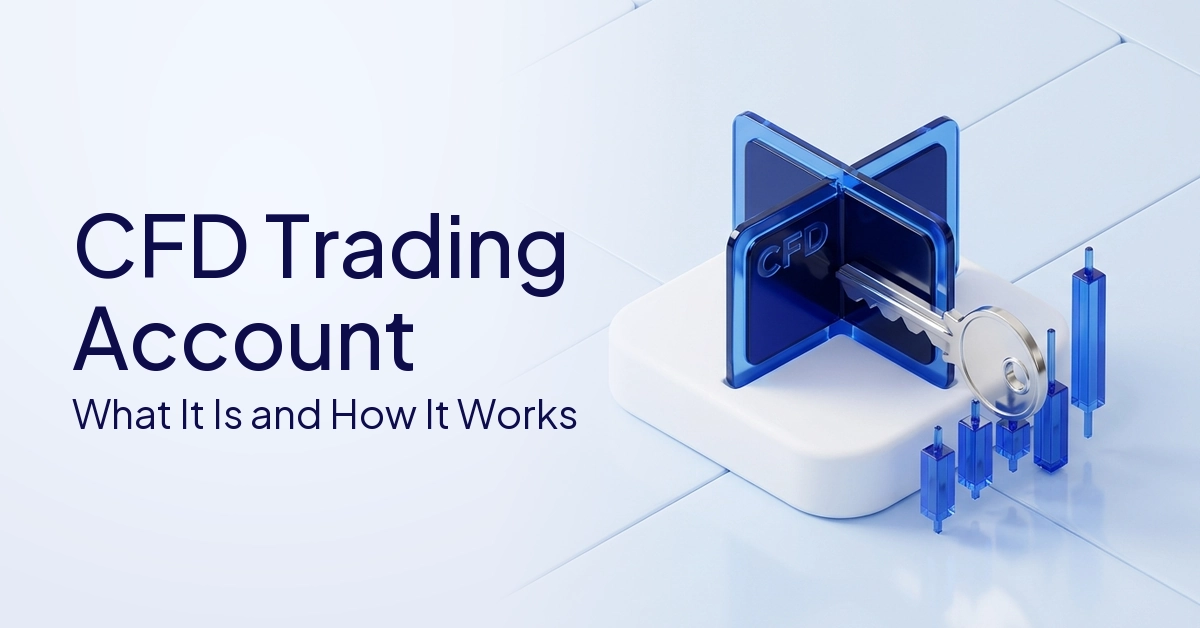
A CFD trading account opens your door to the world of the global financial markets, but not as a traditional brokerage account would operate. You are not buying, taking delivery of, or storing any oil barrels or gold. Instead, you are trading contracts that track the price of those assets in real time.
Such a difference is significant. It alters your profit-making, how you lose, the cost of holding a position, and the protection you have.
You can use this guide to review everything you need to know before going live, whether you are just starting or want a better idea of how it works, without being bombarded with jargon.
Quick Answer
- A CFD trading account will allow you to trade on the price changes in world markets without owning the underlying asset.
- You can make a profit on either an upward or downward price trend, by either going long or short.
- Leverage lets you play larger positions with a smaller deposit, which amplifies losses.
- Always begin with a demo account, as it is a good place to familiarise yourself with the platform before risking money.
- Establish the entire trading cost: spread, commissions, and the overnight financing fees.
- Stop-loss and limit orders help manage risk at the initial stage.
What Is a CFD Trading Account?
A CFD trading account is a dedicated account with a broker that monitors your margin, accessible funds, and open exposure in the market across CFD instruments.
You do not buy 100 shares of a technology company or a barrel of crude oil, but enter into a contract that tracks the price movement of that asset. If the price moves in the direction you expect, you make a profit. If it doesn’t, you lose. No actual ownership of any kind; price exposure only.
That structure can access a broad spectrum of markets using a single account, including global equities, stock markets such as the S&P 500 and the DAX 40, commodities such as gold and oil, and forex currency pairs in major, minor, and exotic markets.
CFDs vs. Owning the Asset
Here is the major distinction you should know early. When trading CFDs, you never get a share certificate or get possession of a commodity. You are just gambling on price movement.
Two things come with that structure: short sales are possible (realize a profit when prices decline), and leverage is available (control larger positions with less initial capital). That’s the flexibility traditional ownership simply doesn’t give you.
Who CFD Accounts Are Actually For
There are two kinds of traders for whom CFD accounts would fit. Novices who require exposure to the actual market but not at the steep price of purchasing actual property. And intermediate traders who wish to hedge a current portfolio, or take advantage of transitory price changes to make a profit.
This structure doesn’t work for long-term investing, but for people who trade actively.
How Do CFD Accounts Work? Margin, Leverage, and P&L
The margin is the deposit that keeps your position open; leverage lets you run a position larger than your deposit; your gain or loss is the price difference multiplied by your position size.
These are the three concepts that drive the CFD trading. Get them wrong, and they will hurt you. Get them right, and they are really helpful tools.
Margin in Plain Language
Margin isn’t a fee. Imagine it as a security deposit, a portion of your account balance that is locked up during an open trade. If the market works against you, and your free equity is too low, your broker can make a margin call, and you will have to deposit additional money or liquidate positions.
Leverage with a Real Example
Say a broker offers 10:1 leverage. That means you can control a $1,000 position with only $100 in margin. Sounds exciting, right? Well, it can be!
But here comes the veritable part: if that position happens to shift 10% against you, you have lost your complete $100 margin. With leverage, it’s either your profit or loss doubles, and they do equally. No form of leverage works in only one direction.
How Profit and Loss Is Calculated
Your P&L is straightforward:
Profit/Loss = (Exit Price – Entry Price) x Number of Units
Therefore, if you purchase 100 units of an asset at $50 and sell them at $53, you have made $300. If it drops to $47, you’ve lost $300. The calculation is easy; the difficulty lies in operating the positions that get there.
What Types of CFD Accounts Are There?
The primary account types include retail, professional, demo, live, and swap-free accounts, each with different protections, pricing, and requirements.
Retail vs. Professional Accounts
Most individual traders trade on retail CFD accounts. They carry significant consumer guarantees; most of all, a negative balance protection, meaning you cannot withdraw more than what is in your account. Leverage is also limited to the provisions of your local regulator.
The case with professional accounts is different. They have much greater leverage, but you must forego many of those protections to access it. The usual criteria for qualification are trading frequency, portfolio size, or professional experience.
For the vast majority of traders, the appropriate starting point is a retail account. Not in that professional accounts are bad, but in the sense that the protections matter until you really don’t need them anymore.
Demo, Live, and Swap-Free Options
A demo account uses simulated funds in an imaginary market. A live account involves real money and real consequences. However, a swap-free (Islamic) account eliminates interest on held positions daily and therefore aligns with the principle of Sharia law.
What “Funded Account” Actually Means
Prop firms often use this term. A funded account is one in which a third-party company offers the trading capital; however, you must initially earn access to it through a test or assessment of your risk management. In case you succeed, you trade their capital and share in the profits.
It is a special-purpose model, and not an ordinary broker offering.
What Is a CFD Demo Account and When Should You Use It?
A CFD demo trading account is a virtual trading portfolio with simulated funds; use it to practice on the platform, experiment with trading strategies, and develop trading habits before commencing live trading.
What a Demo Includes
Most demo accounts provide you with a simulated balance of between $10 to $100,000, access to real-time or near- real-time price feeds, and all the charting options and indicators that you would use on a live account.
What Demos Don’t Fully Replicate
Two things a demo can not provide. First, actual slippage; when you are trading live, your order may be filled at a poorer price than you would otherwise in volatile markets. Second, and more importantly, the weight of real money.
Traders will do better with a demo since there is nothing really at stake. That is a real gap that surprises quite a few people.
A 14-Day Demo Practice Plan
In case you are unsure where to begin, here’s a simple structure:
- Days 1-3: Learn the interface. Trade with market, limit, and stop orders until it becomes natural.
- Days 4-7: Select one asset. Gold is a simple place to start, and it’s a good place to practice 10 trades using a basic strategy. Record your reasoning on each of them.
- Days 8-14: Focus all attention on risk management. You should not put any trade at risk that takes over 1% of your virtual balance. Refine your exit strategy.
That’s it. A fortnight of concentrated practice will give you more information about your trading habits than months of clicking around.
How to Open a CFD Trading Account Step by Step
You can select the type of account you want, confirm your identity, enter your preferred base currency, leverage, and funding, and begin trading.
It is not a complex technique, but people trip up in a few steps.
- Step 1: Select the type of account. Choose whether you are ready to use a live account or if you should spend additional time in a demo. Many traders do both at the same time: test their new strategies in demo mode, then put them into practice on the live side.
- Step 2: Sign up and verify identity. KYC (Know Your Customer) is necessary for all regulated brokers. You’ll need a government-issued photo ID, passport, or national ID, along with proof of address from the past 3 to 6 months, such as a utility bill or bank statement.
- Step 3: Establish your base currency and leverage. You should align your base currency with your main bank account to avoid unnecessary conversion charges. Your regional regulator typically sets the leverage cap for retail accounts.
- Step 4: Deposit funds. The most popular methods are credit and debit cards (mostly instant), electronic wallets such as Skrill or Neteller, and bank wire transfers that may take one to three business days.
- Step 5: Download your platform and start trading. The industry standards are the MT4 and the MT5. Alternatively, numerous brokers are providing an online system that does not require downloading.
What to Check Before Opening a CFD Account
Before engaging with any broker, you must examine the entire cost structure, the quality of execution, and whether those funds are adequately safeguarded.
Trading Costs
Most traders focus on the spread, which is the difference between the buy and sell prices, and that is all they look at. That’s a mistake. The entire cost policy involves commissions on select instruments (particularly stocks), overnight financing costs (swaps) on leveraged positions held after the end of the day, and other inactivity costs should you go months between trades. Small numbers individually. They add up fast over time.
Trading Conditions
Confirm whether the broker provides instant execution or market execution, and what the minimum trade size is. Micro-lot brokers (0.01) are usually more welcoming to traders with smaller balances.
Safety and Support Signals
An approved, regulated broker shall prominently display its regulatory status and how they handle client funds. Pay special attention to terms like segregated fund; now your money is in a separate bank account from the company’s operating capital. If the broker fails, your money is not at risk.
How Deposits and Withdrawals Work for CFD Accounts
The deposits are usually quick; withdrawals have security measures, and they typically take 24-48 hours to reach your bank account.
The majority of brokers use a policy of returning to source; that is, if you deposited using a certain card, the money should be returned to that card first. This is a normal aspect of anti-money laundering and not a hindrance.
Name mismatch is the most prevalent reason for a delay in withdrawal. The name on your trading account must match your exact name as it appears on your bank account. Do that in the beginning, and you will save yourself the most common headache in the process.
Common Mistakes When Opening a CFD Trading Account
The biggest mistakes are going live too early, ignoring holding costs, overloading your watchlist, and trading without a plan.
The quickest way to unnecessary losses is to go live without knowing how to place and manage orders correctly. A poor demo habit costs you nothing, actually. But the same habit with real money is another story.
Ignoring the cost of carry is another one that stings. Maintaining a leveraged position over a few weeks can accrue overnight fees that creep through, eating up or completely wiping out your gains.
Watchlist overload is alluring but unproductive. Thirty currency pairs means thirty things to monitor and nothing mastered. One or two markets, understood deeply, will serve you far better.
And trading on a feeling, with no stipulated rules for entry and exit, is not a strategy. It is betting with additional measures.
Frequently Asked Questions
It is an account that allows one to trade the price movements of assets such as stocks, indexes, and commodities through contracts without holding the underlying asset.
Register an account with a regulated broker, verify your identity, configure your settings, and add funds to it via card or bank transfer.
Virtual practice account containing imaginary funds and replicating the live market environment. No monetary risk, however, actual price information and actual platform tools.
The price data is the same. But real slippage, wider volatility spreads, and the psychological pressure of risking real money are all part of live trading, and not in demo trading. Such distinctions are substantial.
A government-issued photo ID and a recent proof of address, such as a utility bill or bank statement from the past three to six months.
Overnight swap rates, inactivity fees, spread, and per-trade commissions. Consider all four and make your decision.
Frankly speaking, it is a matter of your needs. The optimal platform is regulated, offers competitive spreads, executes fast, and has an interface that matches your experience level. The most commonly used are MT4 and MT5 for valid reasons; however, it is always a matter of choice.
Yes, many brokers allow small initial deposits. You need to ensure that you have enough capital to cover the margin requirements of the trades that you desire to make.
Conclusion
Through a CFD trading account, you access world markets with the flexibility that traditional investing cannot provide, but again, that flexibility is on both sides. The leverage may either favour or not.
Expenses may creep away unnoticed. And the emotional aspect of live trading is something you can train for with a demo, but it will never be the same as on a real one.
Those who are successful with CFDs are not the ones who run the fastest. They’re those who know what they have to work with before they place actual money on the line.
Start in the demo. Learn the costs. Build your process. Then go live.
Risk Disclaimer
This article is informational and is not financial, legal, or investment advice. CFD trading is highly risky to your capital. Leverage may increase both losses and gains, and you might lose more than you invested.
CFD trading may not suit every investor. Always consult an independent qualified financial adviser before opening up a live account.
Tags


Open Live Account
 Email Address
 Phone Number
Important Notice
STARTRADER does not accept any applications from Australian residents.
To comply with regulatory requirements, clicking the button will redirect you to the STARTRADER website operated by STARTRADER PRIME GLOBAL PTY LTD (ABN 65 156 005 668), an authorized Australian Financial Services Licence holder (AFSL no. 421210) regulated by the Australian Securities and Investments Commission.
Important Notice for Residents of the United Arab Emirates
In alignment with local regulatory requirements, individuals residing in the United Arab Emirates are requested to proceed via our dedicated regional platform at startrader.ae, which is operated by STARTRADER Global Financial Consultation & Financial Analysis L.L.C.. This entity is licensed by the UAE Capital Market Authority (CMA) under License No. 20200000241, and is authorised to introduce financial services and promote financial products in the UAE.
Please click the "Continue" button below to be redirected.


