







 Web Trader MT5







Quick Answer
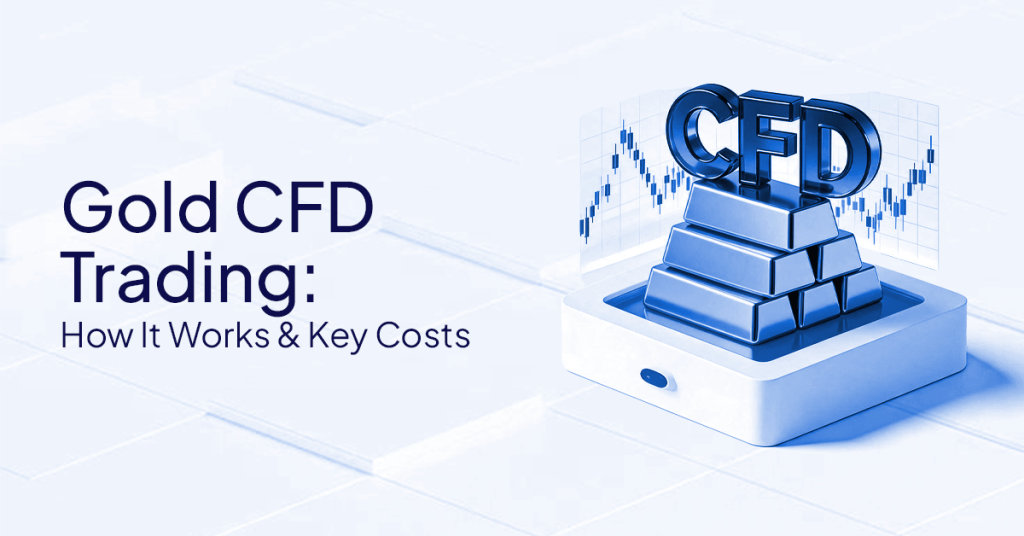
A gold CFDs (contracts for difference) allow speculating on changes in the price of gold without owning the metal. You make or lose in relation to price change, amplified by leverage. These risks are volatility, overnight financing costs, and the risk of incurring a loss greater than your initial deposit. This is not a recommendation to invest.
Traders often choose CFDs to access the gold market flexibly without the logistical burden of storing bullion.
A large number of traders are looking to be exposed to gold price movements without the hassles of purchasing, storing, or insuring physical bullion.
CFDs represent a simpler form instead. Here, you are not acquiring assets, but buying on the price difference. This generates the opportunity and risk.
The guide will help beginners or intermediate traders understand the working nature of the gold CFD market.
You will be told how the pricing process works, what the costs will be, the major variants of CFDs compared with other gold instruments, and how to simulate risk management.
This piece will cover the practical basics, whether you are starting your first position or expanding your knowledge base.
What is a gold CFD?
A gold CFD (Contract for Difference) is a derivative agreement that follows the price of gold but does not change the ownership of the actual metal.
Simple Definition
In trading a gold CFD, you get into an agreement with your broker to buy and sell the difference in the price of gold between the time you open and when you close the trade.
When the price is favorable to you, you gain. When it works against you, you lose. Compared with purchasing gold bars and coins, gold CFD trading means you never own the commodity.
CFDs are only speculative futures: It has no delivery, vault storage, and physical transaction. You are only exposed to price movements.
What You’re Exposed To
The profit or loss is only determined by the difference between the exit and entry price. Even a slight movement up can make it bring in profit, should you be long, or make a loss, should you be short.
This is the opposite when the prices are falling. Most CFD providers offer leverage, allowing you to manage a larger position with a smaller deposit (margin).
Though this increases the possible profits, it also increases losses. Even a slight price adjustment can result in a significant profit or loss relative to your margin.
How Does Gold CFD Pricing Work?
The quote displayed on one of the trading platforms indicates the underlying gold market prices, as well as the spreads and conditions of the brokers.
What the Quote is Based On
CFD quotes are typically based on major exchange or over-the-counter spot gold prices. An example is the CFD on gold instruments, which tend to follow the spot price of gold traded in the international market, expressed in US dollars per troy ounce.
Nevertheless, the price that you will see is not the same as the raw market price. A spread is the price at which brokers buy and sell (also known as the difference between the bid and ask). It is that amount that covers the broker’s costs and forms part of your trading expenses.
Why Quotes Can Differ
Spreads increase during volatile situations or when liquidity is thin. Quotes may vary above or below the underlying reference price due to significant economic announcements, geopolitical events, or off-peak trading times.
The Bank for International Settlements report says that gold trading volume is high during surges in macroeconomic uncertainty, and spreads are usually tight in high-volume sessions and wide in low-volume sessions.
The quotes from different brokers can also vary slightly depending on liquidity providers, risk management policies, and margin requirements.
What Costs and Fees Come With Trading Gold CFDs?
Each CFD trade is subject to costs over and above the market movement; primarily the spread, and possibly, overnight funding charges and other expenses.
Spread
The difference between the selling price and the price that you can buy is known as the spread. It is essentially your startup fee for a trade. The tighter the spread, the lower the cost of entry. The wider the spread, the higher the cost of entry.
Spreads widen when market conditions become erratic. Liquidity providers can withdraw when the US Federal Reserve makes important announcements or when there is a geopolitical crisis, which can lead to spreads widening in the short term.
In its annual report, the World Gold Council observed that volatility in gold shot up around central bank policy changes, directly affecting trading costs.
Overnight Financing (Swap) and When it Applies
If you have a CFD position after the market has closed (usually at 5 pm New York time), you will incur an overnight financing fee, also called a swap. This payment reflects the cost of holding a leveraged position.
Swaps are positive or negative depending on whether one is long or short, which is determined by existing interest rate differentials. There is no overnight financing if you close your trade within the same day.
Other Possible Costs
Other brokers charge a fixed commission per lot in addition to the spread. Others incorporate everything in wider spreads and do not impose any commission.
When you are dealing in a currency other than USD (the universal currency for gold quotes), you may incur conversion charges.
Slippage, where you place an order at a worse price than the one requested, can occur in fast-moving markets, particularly with market orders.
When Can You Trade Gold CFDs and When is Liquidity Highest?
Gold CFDs typically trade 24 hours a day, 5 days a week, with liquidity fluctuating throughout the day.
24-Hour Weekday Market Structure
The majority of CFD brokers provide 24-hour trading from Sunday evening to Friday evening (depending on the broker and time zone). This reflects the nature of the global market of gold, which works on Asian, European, and North American sessions.
In contrast to the fixed hours of stock exchanges, gold trading is transferable between regions, which makes the market almost continuous in the supply of quotes all week long.
Typical High-Activity Windows (Overlaps) + Why it Matters
Liquidity is highest when the major trading sessions overlap. The most significant volume and tightest spreads are usually experienced in the London-New York overlap (roughly 8 am – 12 pm EST).
In such windows, there are more market participants, and therefore, entering and exiting positions at reasonable prices is easy.
Wider spreads and greater slippage can result from low liquidity, such as late Friday afternoon in New York or the Asian-European shift-to-shift. Traders tend to increase or decrease their activity levels to fit the peak periods.
Gold CFD vs XAUUSD vs Futures vs ETFs: What’s the Difference?
All the instruments provide exposure to gold, though they vary in structure, leverage, expiry, and intended purpose.
Ownership, Leverage, Expiry, and Typical Use-Cases
Awareness of these differences will enable you to select the appropriate tool for your strategy. The following is a comparison between them:
| Instrument | Ownership | Leverage | Expiry |
| CFD Gold | No (derivative) | High (typically available) | No expiry |
| XAUUSD | No (spot pair) | High (FX leverage) | No expiry |
| Gold Futures | No (contract for delivery) | Moderate to high | Fixed expiry dates |
| Gold ETFs | Shares in fund (indirect) | No built-in leverage | No expiry |
XAUUSD, and CFD gold, is commonly used interchangeably in forex systems because they are both represented as gold and priced in US dollars. The main difference is semantic: the ticker symbol is XAUUSD, whereas CFD denotes the contract structure.
How Much Margin Do You Need and How Does Leverage Change Risk?
Margin is the amount of the deposit it takes to enter into a leveraged position, not a fee, but it does translate to your exposure and risk.
Margin Basics
Your deposit is larger by far than the notional value you are operating with when you open a CFD position. For example, assume your broker is offering 100:1 leverage, and you want to manage the value of $10,000 worth of gold; you would require $100 in margin.
The margin is not a cost you pay at the beginning; it is collateral held by your broker. Your account equity may be too low, and you may have to deposit more money or close positions, which is the case with a margin call: your position is opposing you.
Why Small Moves Can Have Big P/L Impact
Both gains and losses multiply with leverage. A 1% shift in the price of gold represents a 10% shift in your account in a 10:1 leverage or a 50% shift in your account in a 50:1 leverage. This cuts both ends; profits can be made fast, but losses can be made just as fast.
Research found that retail traders who heavily leveraged commodity investments, such as gold, had a much higher loss rate than traders with lower leverage. The data highlights the significance of the position sizing and risk controls.
How Do You Trade Gold CFDs Step by Step?
CFD gold trading is about deciding which type of order to use, trading on a platform, and holding the position until the time of closure.
Pick Order Type (Market/Limit/Stop) and Set Risk Controls
There are several order types available to you:
- Market orders execute as soon as the existing quote is available, which can be used to enter or exit the market fast.
- Limit orders will only be filled at your desired price or better, ensuring you have some control over entry but not certainty of making a trade.
- Stop orders are issued when the price reaches a given threshold, and they are typically used to enter breakouts or limit losses.
Take a trade with a stop-loss order to limit a possible loss and a take-profit order to sell at a pre-established level before placing the trade.
Place Trade on MT4/MT5
The majority of CFD brokers have MetaTrader 4 or 5. The overall process of workflow is comparable between providers:
- Open the platform and find the symbol for the gold CFD (usually marked as XAUUSD or GOLD).
- Choose the amount of the position (unit quantity or lot size).
- When prices are higher, buy (go long); when prices are lower, sell (go short).
- Additionally, add stop-loss and take-profit levels.
- Confirm the order.
When it is carried out, the position is shown in your open trades. STARTRADER provides MetaTrader environments that enable access to gold CFDs, allowing the traders to run such workflows on industry-standard software.
Manage/Close the Position
Once you open a position, you can track it in real time. When the price approaches your stop-loss or take-profit, the platform will automatically close the trade at those levels (subject to slippage on volatile markets).
Trailing stops are used by some traders as a stop-loss, which changes upwards as the price gains momentum, securing profit whilst leaving room to go higher. It is an intellectual tool to secure profits without the need to adjust levels.
To close manually, place an opposite order; if you go long, you sell the same quantity, and vice versa. The difference between the entry and exit prices, minus the spreads and financing costs, is your profit or loss.
What Are the Main Risks in Gold CFD Trading and How Can You Manage Them?
The trading of Gold CFDs has several layers of risks, which include the volatility of the price, leverage, overnight expenses, and gaps in the market.
Volatility + News Risk
Gold is a commodity that is volatile to macroeconomic events. The decisions made by the central bank, interest rate, inflation reports, and the strength of the US dollar all affect the demand for gold. A hawkish Federal Reserve statement will plunge gold, and low inflation figures will cause rallies.
Commodity projections released by the International Monetary Fund indicated that gold volatility rose when monetary policy was in doubt, which gives CFD traders an opportunity and a risk to invest in the asset. One should keep track of upcoming economic releases to predict volatile periods.
Gap Risk + Weekend Risk
Markets may gap due to major news events or because they did not open at a significantly different price they closed the previous week. When you are holding a position through the weekend and some unanticipated geopolitical news breaks on Monday, the opening price would be pretty different from that of Friday.
Stop-loss orders do not ensure that you will be able to execute the order at your specified price in gaps. You can get stuffed at a lower level, thereby incurring greater losses than expected. This is especially true with leveraged positions, where margin calls can result from gaps in the positions.
A Simple Risk Checklist
This checklist is to be considered before venturing into any trade:
- Position size: Are you putting a little percentage of your account on this trade (usually 1-2%)?
- Stop-loss: Have you established a risk tolerance and a technical analysis stop-loss level?
- Max loss: Are you aware of the dollar amount you will lose if you get stopped out, and are you comfortable with it?
- Leverage: Have you been leveraging in line with your experience and risk-taking capacity, rather than to the maximum?
- Market conditions: Do you know of any news that may be forthcoming that may cause volatility?
When applied continuously, these principles can be used to manage long-term risk.
FAQs
CFD gold is a contract that allows one to speculate on gold’s price fluctuations without holding any physical gold. You make or lose money depending on price movements, and leverage exaggerates either result.
The XAUUSD is the trading code for gold traded in US dollars and is typically used in the forex markets. The contract type is a gold CFD. They are virtually identical when buying spot gold by CFDs. The distinction is largely nomenclature.
Underlying spot gold prices, market supply and demand, central bank policies, inflation expectations, the strength of the US dollar, geopolitical factors, and the broker’s spread and liquidity situation influence the price of quotes.
Yes. When you are in a gold CFD position after the daily rollover time (which is usually 5 pm New York time), you will be charged an overnight financing or a swap. It depends on the broker’s rate and the direction (long or short). Intraday trades before the rollover do not incur this fee.
Conclusion
Gold CFDs are a more versatile way to enter the precious metals market, as an investor can speculate on either an upward or downward market without having to physically hold the product.
Nevertheless, leverage is in play, and it cannot be excluded, so pricing, spreads, and risk management are what one cannot learn.
Gold CFDs are an excellent portfolio-diversifying tool for well-educated, disciplined traders.
When you are prepared to venture into these markets, you can review the available account types and tools in the STARTRADER environment to ensure you have the right environment to pursue your strategy.
Disclaimer: No representation is given, warranty made or responsibility taken about the accuracy, timeliness or completeness of information sourced from third parties. Because of this, we recommend you consider, with or without the assistance of a financial adviser, whether the information is appropriate having regard to your particular circumstances.
Tags


Open Live Account
 Email Address
 Phone Number
Important Notice
STARTRADER does not accept any applications from Australian residents.
To comply with regulatory requirements, clicking the button will redirect you to the STARTRADER website operated by STARTRADER PRIME GLOBAL PTY LTD (ABN 65 156 005 668), an authorized Australian Financial Services Licence holder (AFSL no. 421210) regulated by the Australian Securities and Investments Commission.
Important Notice for Residents of the United Arab Emirates
In alignment with local regulatory requirements, individuals residing in the United Arab Emirates are requested to proceed via our dedicated regional platform at startrader.ae, which is operated by STARTRADER Global Financial Consultation & Financial Analysis L.L.C.. This entity is licensed by the UAE Capital Market Authority (CMA) under License No. 20200000241, and is authorised to introduce financial services and promote financial products in the UAE.
Please click the "Continue" button below to be redirected.


