








 Web Trader MT5





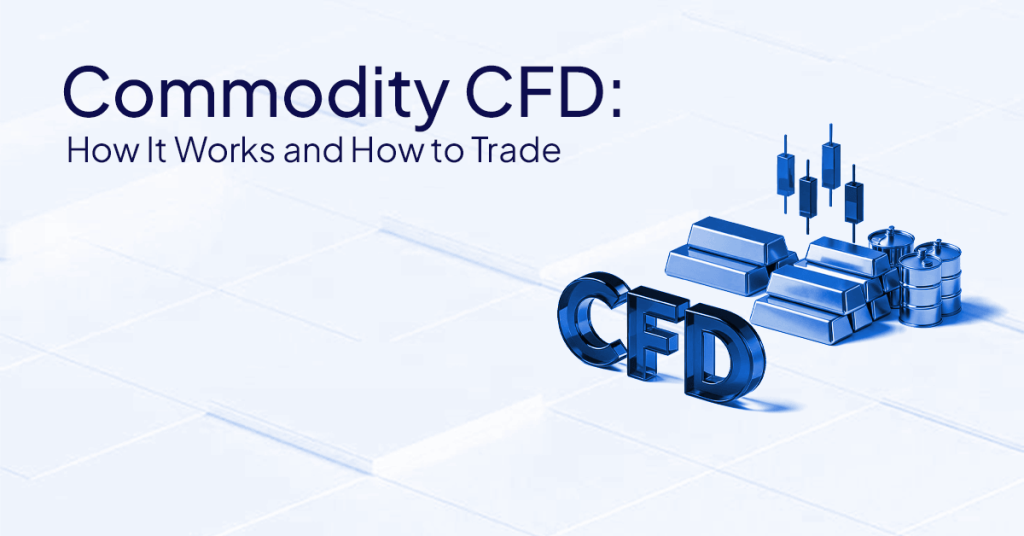
Did you know you don’t have to own a barrel of oil, a gold bar, or a bushel of wheat to trade them? With a commodity CFD, you have the price exposure of the raw materials without physical logistics involved, i.e., no storage, no delivery, no futures contract to roll.
This availability makes commodity CFD trading a handy tool. You can be speculating on the prices of energy, precious metals, or agricultural products. Still, the fundamental mechanics are the same: you buy ahead, manage your risk, and you pay up the difference in cash when you close the trade.
The guide discusses the nature of commodity CFDs, their prices, market movers, and how to approach them systematically.
Quick Answer
- A commodity CFD is a financial derivative that allows one to trade the price movement of raw materials without necessarily possessing the physical commodity.
- Entry and exit price differences are resolved in cash; no actual delivery is done.
- You can long or short – making profits on the markets’ rising and falling.
- Trades are made on margin, which means you are in control of a larger position than your deposit allows.
- The three commodity groups are metals, energy, and agriculture.
- Important costs are the spread, overnight funding charges, and possible slippage in active markets.
What Is a Commodity CFD?
A commodity CFD is an agreement between a trader and a broker to gain or lose the difference between the price of a commodity when the position is established and at the time of its closure.
Definition
You are not purchasing gold, oil, or wheat. You are getting into an agreement that tracks the price of such assets. With favourable price changes, you receive the difference. If it goes against you, then you pay it.
What You Trade vs. What You Don’t
Pure price exposure is the characteristic of a commodity CFD. CFDs are cash-settled, that is, you are speculating on direction, and you see the movement reflected on your account instantly. When you close, the difference is automatically settled.
Leverage is built in: you deposit a percentage of a position’s gross value as margin, and the broker extends the rest. That increases the prospective profits and losses.
Common Commodity Groups
Commodity CFDs are of three types. Metals —precious metals such as gold and silver, and base metals such as copper. Energy, in which natural gas and crude oil dominate. Agriculture: softs such as wheat, corn, coffee, and sugar. They all have their price drivers, volatility profiles, and contract specifications.
How Does Commodity CFD Trading Work?
CFD commodity trading works by providing price exposure in a leveraged agreement; your earnings/losses are the price variation multiplied by your position size.
Pricing Reference Explained
The value of a commodity CFD is based on the real futures market. A gold CFD tracks the price of gold on major commodity exchanges. The CFD price aligns with the underlying asset; however, it is a separate contract run by your broker, not a futures contract.
Margin and Leverage Basics
Your first margin is the amount of money you need to open a position. The minimum amount of equity required to keep it open is called your maintenance margin. Account equity below that amount can trigger a margin call. Leverage magnifies both ways: a price swing causes a proportionally greater increase in the account balance.
Profit and Loss Basics
For a long: exit price minus entry price, multiplied by units. For a short: entry price minus exit price, multiplied by units. The bigger your position, the more each price tick is worth — in either direction.
What Moves Commodity Prices Most?
Physical constraints, such as supply, weather, and geopolitics, influence commodities in the real world, and everything about the macroeconomic condition feeds directly into prices.
Supply, Demand, and Inventory
Prices normally increase when supply reduces, yet the demand remains unchanged. Prices decrease when supply and inventory accumulate and surpass the demand. The release of inventory and storage reports by government agencies is monitored and may lead to sharp moves around the time of release.
Weather and Seasonality
The most weather-sensitive category is agriculture. Drought or abnormal temperatures during sensitive growth stages may cause a dramatic shift in supply expectations. Markets are seasonal too: natural gas demand peaks in winter; oil peaks in summer. These cycles influence monthly price trends.
Macro Factors
The prices of most commodities are quoted in US Dollars. An appreciation of the dollar increases the prices of commodities for foreign consumers, which may decrease demand and burden prices. Broader macro parameters, such as growth expectations and risk sentiment, feed through to commodity demand expectations.
Event-Driven Volatility
The sudden, sharp price shifts caused by geopolitical tensions in resource-rich areas, key production decisions, and unforeseen supply disruptions are difficult to predict but usually lead to a considerable drop in volatility in the short term.
What Costs Should You Check Before Trading Commodity CFDs?
Spread, overnight financing, and slippage under fast-moving conditions are the key expenditures.
Spread and Commission
The spread is your major expense on each trade, paid immediately you open a position. Some brokers charge an extra commission per lot. Get to know your total entry cost before making any order.
Overnight Financing Charges
Keeping a commodity CFD overnight incurs a swap fee. For same-session traders, this does not matter. In the case of multi-day holds, it accumulates and may silently destroy net returns. Estimate all the costs of financing before venturing into any kind of position you intend to occupy overnight.
Slippage and Gaps in Fast Markets
Commodity prices may fluctuate strongly around the time of a major data release or geopolitical event. Your order may be filled at a lower price than anticipated. There may also be gaps between sessions in markets. Limit orders and awareness of scheduled events help address this risk, though they do not erase it.
How to Trade Commodity CFDs Step by Step
A systematic procedure prevents rushed judgments in CFD trading commodities.
Step 1: Choose One Commodity and Define Your Timeframe
Start with one market. Determine whether you are trading short-term around a particular event, or you are trading on the longer term on a trend. That determines your timeframe, the distance to the stop, and the size of the position.
Step 2: Confirm Contract Specs
Open the instrument specification on your platform. Check the symbol, contract size, tick value, and margin rate. Getting these wrong leads to unintended position sizes.
Step 3: Mark Key Levels and Define Your Entry Trigger
Find meaningful support and resistance. Specify precisely what must occur before you enter: a breakout, a pullback to a level, or a confirming signal. Before committing yourself, be specific.
Step 4: Set Your Stop-Loss and Target First
Identify when to take the exit before opening the position. Where trade is wrong, that is your stop. Where it is right, you have your target. You know, if you cannot define both, the trade isn’t ready.
Step 5: Calculate Position Size From Stop Distance
Determine the amount of your account you are prepared to lose if the stop is hit; typically, 1% to 2%. The amount of money you bring determines the size of your lot, along with your stop distance. Size is based on risk tolerance, not on available leverage.
Step 6: Place Your Order and Document the Trade
Select your order type: market, limit, or stop. Write down your reasoning as soon as this has been placed. Check closed trades regularly. This is where your decision-making patterns reflect.
Popular Commodity CFD Traders Start With
Three categories dominate commodity CFD activity: metals, energy, and agriculture. Each has its own volatility profile and price drivers.
Metals: Gold CFDs
One of the best entry points for a commodity trader is the CFD gold trading. Gold is very liquid and is expected to trade in long-term trends, and to be price-sensitive to macroeconomic factors such as the strength of the USD, inflation expectations, and risk sentiment.
It is also less susceptible to the abrupt supply shocks that can blindside energy traders, making it a little more predictable to learn the techniques of the commodities market.
Energy: Oil CFDs
The traders are attracted to crude oil CFDs for exposure to one of the world’s most actively traded commodities. The trading of CFD oil is driven by a set of well-established, clearly documented structural factors: OPEC+ supply decisions, weekly inventory levels, geopolitical events, and seasonal demand trends.
It is volatile, liquid, and can make huge movements around planned events.
Agriculture: Wheat and Corn CFDs
Agricultural commodity CFDs, such as a CFD on wheat or corn, respond to markets under totally different influences: the growing seasons, harvest yields, weather patterns, and supply reports. They are more likely to appeal to traders seeking seasonal themes or macro trends in food supply.
Liquidity is lower than that of metals or energy, which is worth considering when assessing spread and execution expectations.
Oil CFDs: Brent vs. WTI
Two benchmarks dominate oil CFD trading: Brent and WTI. They go hand in hand in most cases; however, they are not the same instrument.
What Brent and WTI Represent
A Brent oil CFD is a contract that tracks North Sea crude, the international standard used to sell most of the world-traded oil. It is liquid, can be transported easily, and is very vulnerable to the international supply dynamics and geopolitical trends.
CFDs on WTI crude oil track West Texas Intermediate, the US benchmark, delivered to Cushing, Oklahoma. It is a bit lighter and sweeter than Brent and is a bit more sensitive to the US energy market.
How Instrument Labels Can Differ by Platform
Neither benchmark is labeled in the same way across all platforms. Brent may appear as UK Oil, BRENT, or XBRT. WTI could appear as either US Oil, Crude, or WTI. Before placing a position, always check the instrument specification page to confirm the benchmark you are actually trading.
When Traders Choose One vs. the Other
Brent is likely to become the tool of traders focused on global supply dynamics and geopolitics. WTI is a preferred commodity among traders interested in US economic statistics, domestic stockpiling, and US energy policy.
Both are valid; it is a matter of what you base your analysis on. The most important rule: be sure your analysis and your instrument align.
Agricultural Commodity CFDs (Wheat and Corn) Basics
Agricultural markets move on a different set of variables than metals or energy; seasonality, weather, and supply reports take the centre stage.
Seasonality and Weather Sensitivity
Seasonalities in farming generate predictable patterns in agricultural prices. The two most observed periods are spring planting plans and autumn harvest yields. During critical growth periods, drought, floods, abnormal frost, etc., can significantly alter supply expectations and lead to price movements in a short time.
Supply Reports and Harvest Cycles
Government supply reports — which reveal current global stockpiles, production estimates, and demand forecasts — are the agricultural equivalent of inventory reports in energy markets. They are planned releases with high expectations and the potential to create significant price disparities at the time of release. Knowing when these reports are due is part of basic preparation before trading any agricultural CFD.
Liquidity and Volatility Notes
Agricultural commodity CFDs tend to be less liquid than gold or crude oil. It implies that spreads can be broader, especially during off-peak hours, and that price fluctuations in relation to supply reports become more unpredictable.
There are periods of extreme volatility in some agricultural markets, during which price changes so drastically that normal execution becomes uncertain. To a large degree, conservative position sizing and awareness of the scheduled report dates mitigate this risk.
Common Mistakes in CFD Trading Commodities
The most harmful mistakes in commodity trading are not about price forecasting, but about the process, sizing, and cost consciousness.
Trading Too Many Commodities at Once
Gold, oil, wheat, corn, and natural gas simultaneously is not diversification; it’s distraction. Every commodity possesses its drivers, chart structure, and volatility features.
Monitoring all markets simultaneously divides your attention and reduces the quality of your choices across all markets. Start with a single market, learn it, and then grow.
Ignoring the Total Cost of Holding Positions
Leveraged positions accrue overnight financing charges daily. When charges are taken over a trade that has been lingering for weeks in a sluggish or sideways market, they can eat up a significant portion of the profit on a winning trade or add to a losing one.
You should always calculate the aggregate financing cost you plan to incur during the period before entering. Include it in your profit goal, not as an afterthought.
Oversizing in Volatile Instruments
Major forex pairs tend to be less volatile than commodities. An increase in volatility results in a greater range of price swings, implying that stops must be set further apart to prevent noise hits. If your stop distance increases but your lot size remains the same, your actual dollar risk increases. Since you are trading volatile commodities, lower your position size to maintain the risk per trade you are used to.
No Plan for Exits
The most straightforward way to incur a huge loss is to open a commodity CFD without a stop-loss or profit objective. Without a stop, you are on the wrong end of the downside of a move. Without a target, you are taking exit decisions in real time under emotional stress; it’s not always the best time to make decisions clearly. Define both before you enter—every time.
Frequently Asked Questions
A contract that allows you to speculate in the price movement of raw materials such as gold, oil, or wheat without having possession of the actual commodity or even delivering it. Price variations are resolved by cash.
You agree with a broker. The difference between your opening and closing prices for the position, multiplied by the position size, determines your profit or loss. Leverage implies that you only margin a small percentage of the total trade value.
The spread on any trade, overnight financing fees for positions held past the daily close, and the possible slippage in a rapidly moving market. Some brokers charge a commission on the commodity instruments on a per-trade basis.
The price of the gold CFD is based on either the spot or futures price of actual gold on major world commodity exchanges. It tracks the market value of gold per troy ounce, adjusted for the broker’s spread and internal liquidity constraints.
The price of the wheat CFD is derived from underlying wheat futures contracts listed on commodity exchanges. It represents the analysis of the world wheat market’s supply and demand at a given time, but adjusted for the broker’s spread.
Yes, but first there has to be education. Begin with very liquid commodities such as gold, and use a demo account to practice leverage and margin, and also have a clear risk management structure before you start trading with real funds.
Brent follows North Sea crude, which is the international standard. WTI monitors the US crude sent to Cushing, Oklahoma. They often coexist but separate according to regional supply conditions, logistics, and geopolitical considerations related to each benchmark.
The most active ones are energy (crude oil and natural gas), metals (gold, silver, and copper), and agriculture (corn, wheat, and soybeans). Among them, gold and crude oil are always the most popular for trading.
Conclusion
Commodity CFDs open one of the most widely traded markets in the world, where real-world events, such as droughts, supply reductions, and geopolitical tensions, are directly mapped to price changes.
This relationship with the real world makes the commodities interesting. That is what makes them demanding, too. What generates a great opportunity may cut in another direction against an unprepared position.
Start with one market. Understand what drives it. Be aware of your expenses when you get in. Position according to risk tolerance, not ambition. And plan the entry, the stop, the target, before the market opens.
Please note that this article is educational and does not amount to financial, legal, or investing advice. Trading commodity CFDs carries a high risk to your capital. Leverage multiplies your gains and losses, and you can lose even more than your original deposit. Always seek independent advice from a qualified financial adviser before trading.
Tags


Open Live Account
 Email Address
 Phone Number
Important Notice
STARTRADER does not accept any applications from Australian residents.
To comply with regulatory requirements, clicking the button will redirect you to the STARTRADER website operated by STARTRADER PRIME GLOBAL PTY LTD (ABN 65 156 005 668), an authorized Australian Financial Services Licence holder (AFSL no. 421210) regulated by the Australian Securities and Investments Commission.
Important Notice for Residents of the United Arab Emirates
In alignment with local regulatory requirements, individuals residing in the United Arab Emirates are requested to proceed via our dedicated regional platform at startrader.ae, which is operated by STARTRADER Global Financial Consultation & Financial Analysis L.L.C.. This entity is licensed by the UAE Capital Market Authority (CMA) under License No. 20200000241, and is authorised to introduce financial services and promote financial products in the UAE.
Please click the "Continue" button below to be redirected.


