







 Web Trader MT5









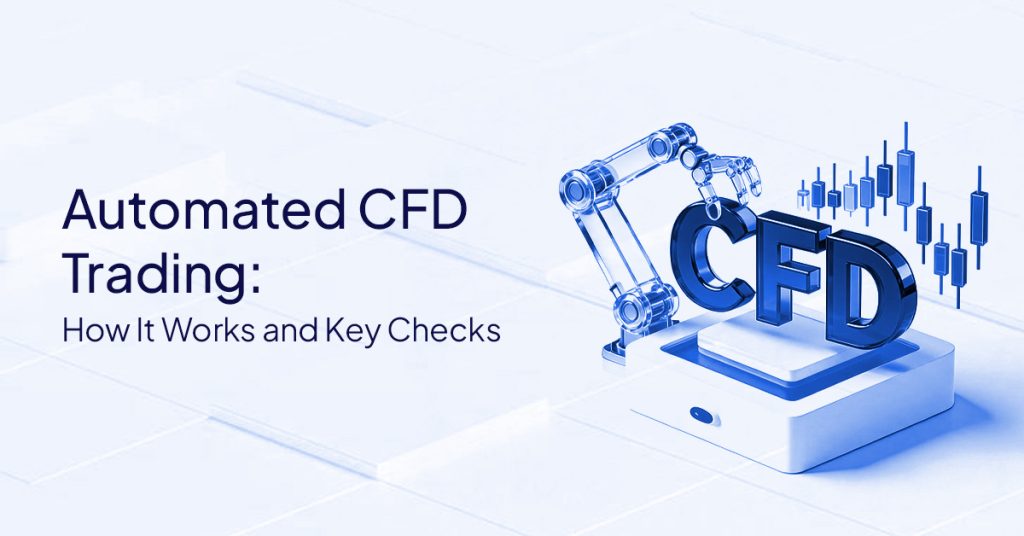
Automated CFD trading involves programmed rules that can execute trades immediately without a human being.
Have you ever wondered how certain market participants can implement their strategies perfectly without constantly looking at a chart? Automated CFD trading is the trading of CFDs through the application of automated rules or computer algorithms to trade automatically upon market signals and risk conditions.
A system does not require manual placement of trades, unlike a regular system. Still, it will use programmed instructions, such as indicator signals, price levels, or time filters, to open, maintain, and close positions. Simple alert-based automation can be practiced, or full automation of strategies that manage entries, exits, and risk management, with the trader tracking performance.
Modern trading has been entirely transformed by technology. Automation is used today by both institutions and retail traders to enhance consistency, execution speed, and eliminate emotional decision-making.
Nevertheless, one must keep in mind that automation does not guarantee profits. It merely carries out your orders and must be strictly tested, monitored, and disciplined. The concept of automation is entirely prescriptive, but not predictive.
The guide will define what automation in CFD trading means, discuss various setups, and explain how these strategies work. Before you can invest in systems, we will also discuss safe methods for testing and evaluating them.
Quick Answer
Automated CFD trading is the trading of CFDs using preprogrammed trading rules or algorithms in accordance with market factors and risk factors.
A system, rather than trading manually, takes programmed instructions, including indicator signals, price levels, or time filters, to open, run, and close positions. Automation may range from straightforward alert-based applications to very sophisticated autonomous measures that address entries, exits, and risk management as the trader reviews performance.
What is Automated CFD Trading?
Automated CFD trading uses computer software to execute trades according to pre-programmed instructions.
Definition and What “Automated” Actually Means
Automation refers to the process of making a trading strategy a strict, rule-based execution strategy. This idea is commonly referred to as algo trading, in which programs track the market and take action when certain conditions are met. A rule-based system does not hesitate, unlike a manual, discretionary trading system, where decisions are made on the fly by humans.
Automation Levels: Alerts → Semi-Automated → Full Automation
Automation comes in various forms, from simple notifications to fully automated execution. The alert-based systems merely notify you, either on your phone or computer, when a setup has been carried out, and it is up to you to make the final decision. Semi-automated tools help to compute risk and prepare the order, which is then subject to your confirmation before execution. Fully automated systems deal with the entire trade lifecycle, including entries, exits, and stops, without human intervention.
When Automation is Used
Automation helps traders remain absolutely consistent in implementing the selected strategies. It enables a much quicker reaction to market signals, and this is very much helpful in situations where prices change at a high rate. More to the point, it helps maintain discipline, eliminating emotional interference so traders do not overtrade or even fail to trade out of fear.
What is CFD Auto Trading?
CFD auto trading is the use of specialized software that interacts directly with a trading platform to execute contracts for difference.
Common Forms of Automation
The majority of the retail auto trading occurs via bots, expert advisors, scripts, or API connections. A trading bot is a self-executing program that continuously implements a given strategy. A popular tool called an expert advisor (EA) was developed with the express purpose of operating automated routines on a platform. Traders also use one-off scripts to perform single operations or rule-based strategies directly under the API in their brokerage account.
What it Can Automate
An automated system can manage all mechanical aspects of a trade, open positions, and risk management. This involves technical entries identified in the market. It also automates the closing of exits, positions, trailing stops, and stop-loss orders. Moreover, it controls the risk and exposure limits by computing precise position sizes and then executing the order.
What Still Requires Human Oversight
Although the name suggests otherwise, automated systems still require human control and direction. The strategy goals have to be established by a human being along with the logic on which they are based. You should also set strict restraints and risk margins to avoid catastrophic damage. It is necessary to monitor the system’s performance over time and analyze its behavior to ensure the code operates properly in real markets.
How Automated Strategies For CFDs Work
An automated, functional strategy generates a subsequent sequence of actions that starts with reading signals, then proceeds to decision-making, executes orders, and applies risk limits.
Signals
Specific data points that inform the system about the formation of a potential trade are called a signal. These inputs are usually provided by technical indicators, such as moving averages or momentum oscillators. They may also include price action criteria, time-related filters, or changes in larger market structure indications.
Decision Rules
Decision rules do the brain’s work, which means whether a signal is significant to trade. The system uses confirmation filters to weed out falseness. It then applies position sizing rules to determine the precise size of the trade, which should be based on account equity. Lastly, the core strategy’s logic determines whether all necessary prerequisites are fulfilled simultaneously.
Execution Rules
Execution rules specify the nature in which the system will interact with the market to open and close the trade. This entails careful selection of the order type, e.g., whether to use a market or a limit order. It also encompasses precision in locating stop losses to limit downside risk and in setting take-profit levels to gain profits.
Risk Controls
Risk controls are insurance, which will help prevent the account from taking too much losses or malfunctioning. It has programmed the system to limit exposure to avoid tying up a lot of margin. It also employs maximum loss limits and strategy pause requirements to stop trading when the market becomes too unfriendly.
Logging and Reporting
The logging process documents all system activities to assist the trader in reviewing performance in the future. Software keeps records of detailed trade journals, which are recorded by timestamps, price, and entry reasons. Monitoring this metric is important for understanding the system’s behavior and identifying areas for improvement.
Key principle: An Automated strategy can be as good as the rules it uses. Unpredictable results in live markets augment unclear or untested rules, no matter how attractive the backtest might have been.
Key Considerations Before You Automate CFD Trading
Trading costs, data quality, and platform stability are the three important factors to consider before launching any automated system.
Costs and Execution
Unidentified cost and performance variables may radically change the profitability of an automated system. You have to factor in spread considerations and overnight holding charges that are consuming margins in the long run. The Financial Conduct Authority statistics show that slippage in rapid markets can significantly affect the ultimate price of automated market orders due to execution friction.
Market Conditions
There is no automated strategy that will be effective in any market situation. A trending market design is likely a great loser in a ranging market, and vice versa. The adaptability of strategy is rare; hence, traders are required to monitor evolving volatility regimes and deactivate systems when conditions do not comply with the programming.
Data Quality
The quality of your system depends directly on the quality of the historical data used to construct it. Sampling bias is prevented by using appropriate historical data across different time periods. Traders need to learn to recognize survivorship bias and avoid the trap of analyzing only assets that performed well, rather than those that failed or were delisted.
Overfitting
The problem of overfitting occurs when a strategy is adjusted too much to fit historical data, and thus cannot work in real markets. How come that perfect backtests often do not work in real life? Since the risk of over-optimizing the parameters makes the system a memory of the past rather than a guide to the future.
Operational Reliability
The automated systems should have nonstop, round-the-clock internet and platform connectivity to operate safely. It is essential to understand the concept of platform uptime; a disconnected system cannot implement a stop-loss. This is why other traders opt to deploy remote hosting or VPS via cloud-based services to ensure their systems operate 24 hours a day, uninterrupted by local power outages.
Step-by-Step: Build and Test an Automated CFD Strategy
The creation of a strategy is a process that involves a systematic approach, starting with simple rules and proceeding through rigorous historical and live experimentation.
Step 1: Choose a Simple Hypothesis
Start with an easy, comprehensible idea grounded in a single market setup. One distinct setup, such as a breakout or a moving-average crossover, is ideal. Commodity-focused tools like automated gold trading software often use exactly these breakout and crossover rules as their core hypothesis. Complex combinations of rules should be avoided because it is not possible to know which variable is actually driving performance.
Step 2: Write Rules in Plain Language
Think of all conditions, get every one of them written down in simple English. State your entry rules precisely, without any room for interpretation. Do the same with your exit rules and risk management parameters so a developer can translate them correctly.
Step 3: Backtesting
Backtesting consists of executing your programmed rules on past market data to determine their performance. This historical simulation helps identify the basic mistakes made before risking money. The metrics to be analyzed include, among others, maximum drawdown, win rate, and the number of completed trades.
Step 4: Forward Testing in a Simulator
Paper trading also allows you to practice the system in a live market using simulated funds. Simulate the strategy in mock or simulation trading conditions for a few weeks. Monitor performance to see how the software performs over time without hindsight.
Step 5: Go Live With Small Position Sizes
When switching to a live account, roll out the system with the least risk. Introduce access to a limited number of people at first to reduce the financial cost of unforeseen technical bugs. Always keep the risk level low and tie your strategy to a high-reliability platform, such as STARTRADER, to facilitate a smooth implementation.
Step 6: Review Results and Refine
Constant upgrades require periodic, scheduled performance reviews of your operational system. Do a weekly performance assessment to compare real results with your testing data. When necessary, vary individual variables one at a time to be more precise in measuring the effect of a particular adjustment.
Tip: The testing process does not aim at discovering a perfect strategy. It is to understand a strategy’s behaviour under various conditions and determine whether to invest time and money in it on a strict risk basis.
A Practical Checklist For Automated CFD Trading Controls
The most significant measure for protecting your account against automated errors is implementing controls.
Position Sizing Limits
Each automated trade must have a particular cap on maximum size. Use it as a percentage based exposure to ensure the system does not jeopardize a high percentage of the account equity in an individual setup.
Maximum Trades Per Session
The restriction of the number of trades ensures that an account is not ruined by an unfunctional system overtrading. Limit excessive activity in the system by limiting executions in a day or session.
Maximum Daily or Weekly Loss Rules
A hard account drawdown limit is provided to cover the long losing streaks or changing market conditions. Code the system to automatically halt all trading when losses exceed a preset daily or weekly threshold.
News and Event Filters
Large economic announcements lead to unpredictable volatility, which contravenes technical rules. Break in and out generic news and event filters to automatically stop the system just before high-impact data releases.
Kill Switch and Manual Override Plan
You need a way to halt the entire system immediately if it starts acting out. Have the system shut down planned and manually overridden in case of abnormal behavior or connection failures.
Common Mistakes in CFD Auto Trading
Most beginners make mistakes by failing to account for costs, complex rules, and the need to maintain the systems.
Ignoring Costs and Slippage in Backtests
The most common reason a backtest performs better than the live system is that it did not realistically account for trading costs.
The results obtained when a CFD auto-trading backtest is run with zero spread or with ideal mid-price fills are impossible to reproduce. Consider costs always on the low side- in times of uncertainty, be sure to take a wider spread than the normal quoted one, to meet the surges and falls of the spread.
Too Many Indicators or Complex Rules
It is not true that the more conditions added to a strategy, the stronger it is; quite the contrary, a strategy is generally weaker.
Every indicator or filter added to the strategy decreases the number of trades it produces and increases the likelihood that historical optimization has created an overfit model. Most long-term automated strategies are constructed based on one or two central conditions and a few practical filters.
Lack of Monitoring
An operational risk, and not a convenience, is a fully automated system that will operate without any control. The connection between platforms may fail. The failure of order routing may be silent. The calculation of an indicator may behave unpredictably when data feeds are interrupted.
These failures may go unnoticed for hours without an active monitoring process or at least, automated notification of each unusual activity. To gain the background knowledge to view an automated system effectively, read guides on what CFD trading entails, and develop that awareness.
Changing Settings After Short Losing Periods
Adjusting strategy based on a series of losing trades will virtually never help and will almost certainly make the situation worse. All strategies, even the well-designed ones, pass through the losing periods.
In the absence of a statistically significant sample size (usually 50-100 or more trades in similar markets), it is not possible to differentiate between these situations. In the
The IOSCO report on risks in automated and algorithmic trading found that reactive over-adjustment is one of the most prevalent operational errors in algorithmic systems. The changes must be premeditated, evidence-based, and carried out individually.
FAQs
Automated trading is a system in which trading operations are executed automatically according to pre-programmed rules and decisions. It eliminates human execution and uses programmed logic to manage entries, exits, and risk.
Although the most common type of auto trading is bots, the EAs, scripts, and API rule engines are all forms of automation. An example of such software is a bot, but a more general idea is automation, which is the use of algorithms to run processes.
It is possible for beginners, but they must undergo intensive training, risk management, and testing. Beginners are advised to start with basic rules one at a time and avoid using black-box systems without understanding the logic.
The safest way is to use a three-step process: historical backtesting, paper trading, and lastly a small live deployment. This provides the system’s mathematical functionality before it ever touches actual capital.
Conclusion
Automated CFD trading is a rule-based approach to implementing market trading strategies with accuracy and speed.
Traders can be consistent and eliminate emotional hesitation by relying on pre-programmed logic rather than manual clicking.
But we must bear in mind that automation enhances execution discipline, not the risk of trade. Ongoing testing, close supervision, and sound risk management are non-negotiable conditions for any automated setup.
Simple hypotheses must always be the starting point of the trader, which must be tested in simulated conditions, and it is only after that that the exposure to a large scale must be increased. Finally, automation must be used to help you make disciplined decisions, not to substitute for strategy design.
When you are already willing to investigate how a solid foundation can help you with your rule-based plans, check out how your arrangements will work on a trial account with STARTRADER to see how automation addresses your plans.
Tags


Open Live Account
 Email Address
 Phone Number
Important Notice
STARTRADER does not accept any applications from Australian residents.
To comply with regulatory requirements, clicking the button will redirect you to the STARTRADER website operated by STARTRADER PRIME GLOBAL PTY LTD (ABN 65 156 005 668), an authorized Australian Financial Services Licence holder (AFSL no. 421210) regulated by the Australian Securities and Investments Commission.
Important Notice for Residents of the United Arab Emirates
In alignment with local regulatory requirements, individuals residing in the United Arab Emirates are requested to proceed via our dedicated regional platform at startrader.ae, which is operated by STARTRADER Global Financial Consultation & Financial Analysis L.L.C.. This entity is licensed by the UAE Capital Market Authority (CMA) under License No. 20200000241, and is authorised to introduce financial services and promote financial products in the UAE.
Please click the "Continue" button below to be redirected.


