








 Web Trader MT5









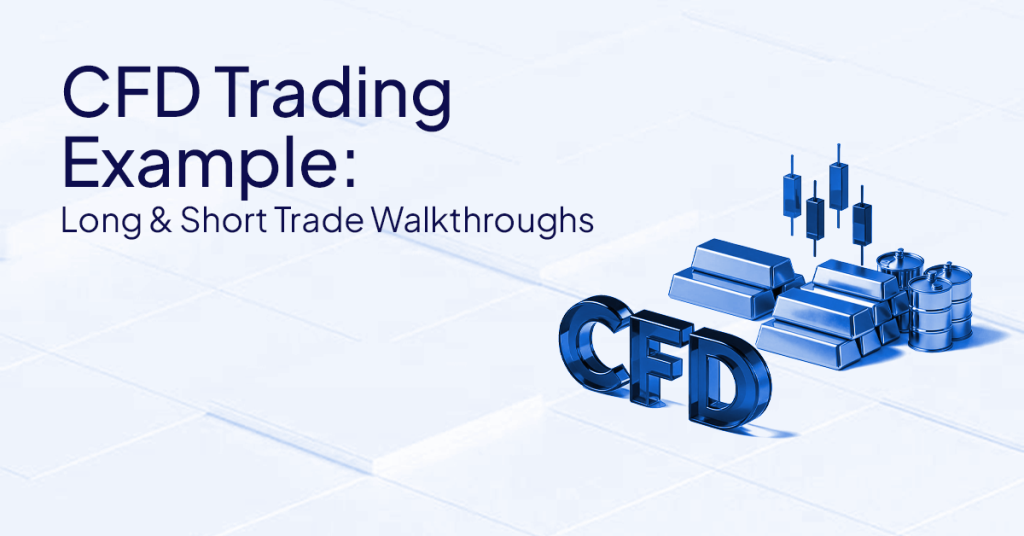
A CFD trading example would give you a glimpse of how price fluctuations translate into profit or loss without you ever possessing the underlying asset.
But what is the cause of so much change in your account when there is only a tiny movement in your stock price?
The difference between speculation and risk calculation of Contracts for Difference (CFDs) lies in knowing the math.
Although the idea of trading on the price difference may seem straightforward, leverage and overnight costs can make the result more complicated.
Note: CFDs are complex products and carry a high risk of losing money quickly due to leverage. They are not universal, and in some nations, like the United States, there are limitations.
To explain the mechanics, we will use two scenarios in this guide: one long trade and one short trade, with the numbers rounded.
Quick Answer
A CFD trading example shows how one can speculate on price changes without owning the underlying asset. It also follows a step-by-step process for opening a position (buy or sell), leveraging a position to reduce the required capital, and computing the resulting Profit and Loss (P&L) by considering the difference between the entry and exit prices, minus spreads and overnight financing costs. The outcome of the trade and risk management is decisive.
What Does a CFD Trading Example Actually Show?
These examples show the workings of leverage, margin, and expenses, and not a forecast of the market’s direction.
When you consider an example that has been worked, you want to know how the contract mimics the price of the tangible asset.
A CFD is not like purchasing a physical share of Apple or a bar of gold.
Rather, it is a contract between you and the broker to swap the change in value of a share between the time the contract is entered into and the time the contract is closed.
The 5 moving parts
To grasp the examples below, you have to follow these five elements:
- Entry Price: The price at which you open the contract.
- Position Size: The quantity of units or contracts that you are trading with.
- Margin and Leverage: This is a ratio of collateral deposited against the value of the trade.
- Trading Costs: Spreads (difference between buy/sell price), and swaps (overnight fees).
- Exit Price: The price at which you close the contract.
Example 1: A long CFD Trade (Buy) From Start to Finish
A long trade makes a gain if the closing price is higher than the opening price, minus commissions.
A good example of CFD trading is provided to demonstrate that a trader is confident that the price of a given asset will go up.
To simplify the math, we will consider a hypothetical stock, which will be represented as Company ABC.
Scenario Setup:
- Asset: Company ABC Shares
- Current price: $100.00
- Action: Buy (Long)
- Position Size: 100 CFDs (which corresponds to 100 shares)
- Leverage: 1:5 (You require 20% of the overall value)
The Trade:
You buy 100 CFDs at $100.
- Total Trade Value: $100 x 100 units = $10,000.
- Required Margin (Your Deposit): = $10,000/5 = $2,000.
Step-by-Step P&L calculation
In three days, the Company ABC prices increased to $105.00. You choose to close the trade to make a profit.
Gross Profit Calculation:
- (Closing Price – Opening Price) Units.
- ($105 – $100) * 100 = $500
- Your gross profit is $500.
How Spread and Financing Change the Outcome
It is not the gross profit that gets into your account. You must subtract costs.
- Spread: You probably paid slightly above the ASK price at the time of purchase (e.g., $100.10). Suppose that the total cost of the spread was $10.
- Overnight Financing (Swap): You had held the position for 3 nights. Should the swap rate be $5 per night, that would be $15 total.
Net Profit Calculation:
$500 (Gross) – $10 (Spread) – $15 (Swap) = $475.
In such a case, you would have gotten back your deposit of $2,000 on a margin of 23.75%, though the stock has gone only 5%. This is leverage (and risk) power.
Example 2: A short CFD trade (sell) from start to finish
Shorting is an activity in which traders can potentially profit from a downward price movement by selling high and repurchasing low.
Short selling can be challenging to understand for beginners who want to start trading. With a CFD, you do not even have to own the asset to sell it, but you are just entering an agreement that gains you money in case the price drops.
Scenario Setup:
- Asset: Crude Oil
- Current price: $80.00
- Action: Sell (Short)
- Position Size: 100 contracts
- Leverage: 1:10 (10% margin required)
The Trade:
You sell 100 contracts at $80.
- Total Trade Value: $8,000
- Margin Required: $800
Short Trade Mechanics
Suppose that the market concurs with your analysis, and the price of Oil falls to $75.00.
Gross Profit Calculation:
(Opening Price – Closing Price) x Units.
$80 – $75 x 100 = $500
You made a profit of $500 because the asset became cheaper, thus you were able to purchase it back (close the contract) at a lower price than you sold it for.
What Happens if Price Spikes Against You
Suppose the opposite occurs. The prices of Oil spike to $85.00, up from falling.
Loss Calculation:
$80 – $85 x 100 = –$500
You have lost $500.
- Margin Pressure: You put in only $800, so a $500 loss represents more than 60% of your initial investment.
- Margin Call: Your broker may call your margin, or your trade may be automatically closed to avoid you going into negative equity if the price rises significantly.
How Leverage Affects the Same Trade Outcome
Leverage magnifies both profits and losses by enabling you to trade a prominent position using a small deposit.
The distinguishing power of CFDs is leverage. It enables you to sell the markets at a fraction of the entire trade value.
Low Leverage vs Higher Leverage Comparison
We will consider the exact price change, that is, $500 change in prices in Case 1 (Company ABC changing between $100 and $105), but with varying leverage readings.
| Leverage | Margin Required | Profit ($) | Return on Margin (%) |
| 1:1 (None) | $10,000 | $500 | 5% |
| 1:10 | $1,000 | $500 | 50% |
| 1:20 | $500 | $500 | 100% |
- The Upside: You doubled your account balance on a slight 5% movement of your stock with 1:20 leverage.
- The Cons: If the stock fell 5%, you would have lost 100% of your deposited margin. High leverage hastens the rate at which you can lose capital.
The margin is completely wiped off at 20:1 leverage at a $5 negative move. The purchase would cost you 25% of your margin at 5:1, leaving you with money to trade or retain.
The CFD industry currently encompasses more than 5.92 million active accounts worldwide, and leverage is one of the main reasons for winning and losing traders.
Leverage is neither good nor bad; it is a tool. Increased leverage is more efficient in terms of capital but requires greater risk management and decision-making.
Less leverage gives breathing space at the expense of raising such capital to equal exposure.
Common CFD Costs Shown Inside Examples
Overhead costs, such as spreads and swap fees, directly reduce your net profit and increase your net loss.
Considering “friction” costs relative to the example is important when evaluating the example on a platform such as STARTRADER.
Spread, Swaps/Overnight Fees, slippage and gaps
- Spread: The difference between the Buy and Sell prices. This is why you enter all trades slightly in the negative.
- Swaps (Overnight Fees): You pay (or receive) an interest adjustment if you are invested after a specific time (typically 5 PM EST). This is essential for long-term trades.
- Slippage: Fast-moving markets may fill your order at $100.05, even though you ordered at $100. This insignificant variation is slippage.
Risk Controls You Should Add to Every Example
Effective risk control is best achieved by specifying how much you want to lose before the trade is placed.
CFD trading has its pros and cons. But the key thing here is, do not open a trade on a hunch without a safety net.
Position Sizing Rule
One of the most widely used rules of thumb is to never risk more than 1% to 2% of the total account balance on any one trade.
- You should have a limit loss of $200 when you have a $10,000 account.
- In case your stop loss is 50 points apart, you have to change the size of your position to ensure that 50 points is worth $200.
Stop-loss Placement
Do not put a stop-loss at an arbitrary dollar price. Put it in where your trade concept is disproved.
Example: If you buy at support ($100) and place your stop just beneath it ($98). If the price breaches $98, probably, the trend has shifted, you are supposed to be out.
Common Beginner Mistakes When Copying Examples
The fact that beginner traders do not account for financing fees and leverage risks when following the steps of theoretical examples is easily overlooked.
- Ignoring Overnights: Trying to hold a short-term CFD in weeks can incur financing costs, which can wipe out all your gains.
- Over-Leveraging: The maximum leverage (e.g., 1:500) provides no room for the market to breathe. It takes a minute jitter to shut you down.
- Variable Spreads: They involve fixed numbers. As a matter of fact, the spreads increase during news events (such as Non-Farm Payrolls).
- No Plan: Getting into a trade without the knowledge of how to exit.
The Financial Conduct Authority (FCA) and other regulators have documented that, when engaging in CFD trading, many retail investor accounts lose money. Still, poor risk management often leads to losses.
Tables / Checklists
Table: Long vs Short CFD Example
| Feature | Long Trade (Buy) | Short Trade (Sell) |
| Market View | Bullish (Price Up) | Bearish (Price Down) |
| Entry Action | Buy at Ask Price | Sell at Bid Price |
| Exit Action | Sell at Bid Price | Buy at Ask Price |
| Profit Condition | Exit > Entry | Entry > Exit |
| Loss Condition | Exit < Entry | Entry < Exit |
| Risk | Price falls to zero | Price can theoretically rise infinitely |
Checklist: Before Placing a CFD Trade
These are some of the boxes you must tick before opening your platform:
- Instrument: Have I analyzed the right asset (e.g., Gold vs. USD)?
- Volatility: Does it have any high-impact news (such as CPI data) in the near future?
- Position Size: Does this size comply with my rules of risk management?
- Stop-loss: Does the system have my stop-loss?
- Maximum Loss: Am I aware of the amount that I lose when my stop is hit?
- Total Costs: Have I verified the spread and swap rates?
FAQs
An example of CFD trading is a hypothetical or historical situation in which the Contract for Difference is described. It calculates the entry and exit prices, the leverage applied, and the fees paid to indicate the net profit or loss on a trade.
The fundamental equation is: (Closing Price – Opening Price) x Number of Units. On short trades, you reverse the prices. You then have to deduct spreads, commissions, and overnight swap fees to arrive at the net P&L.
A general rule is always to add the spread (difference between the buy/sell price), overnight financing costs (swaps), and any broker commission if you hold it for more than 24 hours.
No. CFDs are widely standard in the UK, Europe, Australia, and some regions of Asia, though they are heavily restricted or prohibited for retail traders in the USA and Hong Kong due to regulatory issues.
Conclusion
A good CFD trading example provides you with the principles of price action, the effect of leverage, and the actual cost of the trade.
The math is simple enough: the difference in prices multiplied by the number of units; however, the implementation requires discipline. These examples show that leverage can increase your returns, but it can also reduce them.
This article is not investment advice but only educational and should be taken as such. CFDs are not something that everyone can do, and they can be limited by jurisdiction. It is time to put these numbers into action.
You can also see real-time prices and practice this kind of calculation safely by visiting the STARTRADER Demo Account.
Tags


Open Live Account
 Email Address
 Phone Number
Important Notice
STARTRADER does not accept any applications from Australian residents.
To comply with regulatory requirements, clicking the button will redirect you to the STARTRADER website operated by STARTRADER PRIME GLOBAL PTY LTD (ABN 65 156 005 668), an authorized Australian Financial Services Licence holder (AFSL no. 421210) regulated by the Australian Securities and Investments Commission.
Important Notice for Residents of the United Arab Emirates
In alignment with local regulatory requirements, individuals residing in the United Arab Emirates are requested to proceed via our dedicated regional platform at startrader.ae, which is operated by STARTRADER Global Financial Consultation & Financial Analysis L.L.C.. This entity is licensed by the UAE Capital Market Authority (CMA) under License No. 20200000241, and is authorised to introduce financial services and promote financial products in the UAE.
Please click the "Continue" button below to be redirected.


