








 Web Trader MT5










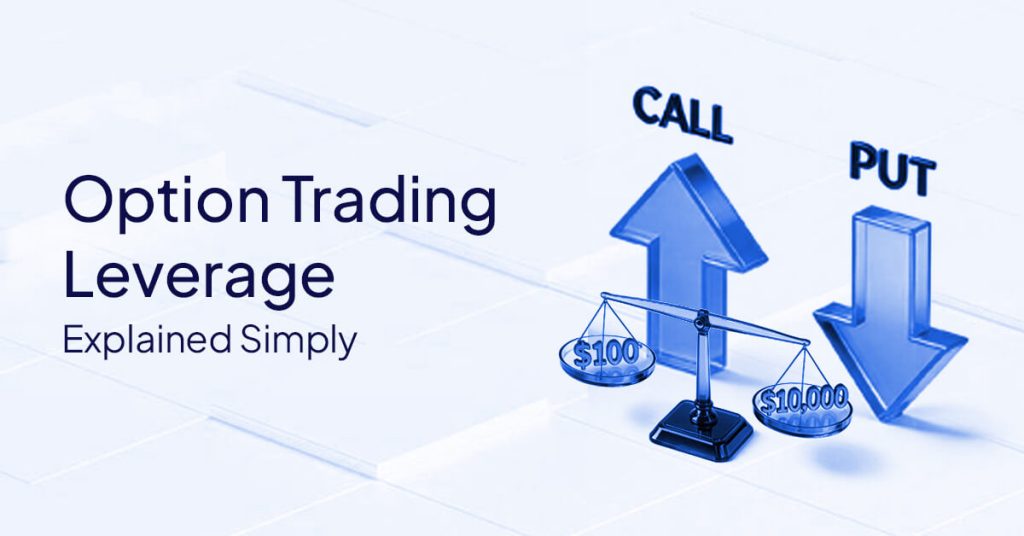
Leverage in options means using a relatively small amount of money (the option premium) to control a much larger position in an underlying asset.
What if we had a way to engage in the price movements of hundreds of shares while paying only a small portion? That is the question at the heart of options leverage, and the answer is more accessible than many beginners may think.
Options are highly applicable in the international markets, and leverage is one of the most misconstrued aspects of this tool. This guide demystifies the concept in simple language and includes realistic examples of the risks, along with a straightforward dissection of them.
Quick Answer
Leverage in options is the ability to use a relatively small amount of money (option premium) to control a much larger position in an underlying asset.
This built-in leverage can enable a trader to multiply the potential for profit, but also carry the risk of losing the entire premium if the trade fails. Before engaging in any trade, it is important to comprehend how option trading leverage works.
What Does Leverage In Options Mean?
Leverage in options enables you to increase your exposure to the market with a small fraction of the asset’s overall price.
You are not buying shares directly; you purchase a contract that gives you the option to sell or buy those shares at a certain price.
Capital efficiency is highly achieved through this system. It implies that you can participate in large market movements without having the entire cash deposit required.
Understanding Leverage In Plain Language
Leverage can be easily explained as a magnifying glass for trading capital. Imagine it is a down payment on a house.
The property is all under your control, and you enjoy the inflation of its prices even though you paid a mere percentage at the time of buying. In the financial market, the concept enables small accounts to dominate huge blocks of shares.
Why Options Are Considered Leveraged Instruments
Options are leveraged by default since you only pay a premium to have full price exposure to the underlying asset. There is a direct relationship between the capital and when you purchase a stock.
Options themselves are constituted by the contract, which means they are inherently leveraged financial instruments. It is one of the basic characteristics of derivatives as stipulated by the U.S. Securities and Exchange Commission (SEC), which controls the trading of these instruments. Data confirms US options volume is on track to exceed 13.8 billion contracts, a sixth consecutive annual record.
Premium Vs Notional Value Explained
The actual out-of-pocket cost is the premium, and the notional value is the aggregate footprint you have in the market. Assuming a stock is priced at $100, a notional value of $10,000 is required to buy 100 shares.
Nonetheless, a contract on options covering the same 100 shares can be priced at only a $500 premium. You are only financially at risk for the $500 you paid the insurance company; however, your market exposure has a face value of $10,000.
How Does Option Trading Leverage Work In A Simple Example?
Option trading leverage allows a small initial payment to be made at the start of an option trade, enabling control of a block of shares and a larger percentage of returns.
To experience this, we have to compare a traditional stock purchase and an options contract. The difference in capital required shows precisely how the magnification effect occurs.
Stock Purchase Vs Call Options.
The capital outlay for buying an option is much lower than for buying the same number of shares. For example, we will take a breakdown of capital requirements and potential returns.
| Trade Type | Asset Price | Quantity | Capital Required | Profit if Stock Rises 10% | Percentage Return |
| Buy Stock | $50 | 100 shares | $5,000 | $500 | 10% |
| Buy Call Option | $50 strike | 1 contract | $200 (premium) | ~$300 | 150% |
The buyer of the stock in this case faces a 10% risk of $5,000. The option buyer has a risk of only $200, yet, since they have the same number of shares, 100, a beneficial change results in a significant percentage increase.
What Happens If The Trade Goes The Wrong Way?
When the market turns against you, the options leverage may leave your original premium fully lost. Options are unlike owning a stock that goes down in value, as they expire.
Unless the stock reaches your target price on that date, the contract will expire worthless. This would represent the loss of all that you invested in the situation above of $200.
How Do Stock Options Create Leverage?
The leverage of stock options stems from their standard contract size, which requires a small cash payment for a large number of shares.
It is this standardization that enables traders to know their risk and exposure. In the absence of such a structure, options would not give the regular effect of magnification they are known for.
Understanding Contract Size
A single standard equity option contract typically represents control over 100 shares of the underlying stock.
This standardization is implemented by clearinghouses, such as the Options Clearing Corporation (OCC), which help ensure stability and transparency in the market.
At an option price of $2.00, you need to multiply by 100 to find out how much you really paid: $200.
Notional Exposure Vs Premium Paid
When you leverage a stock option, you have high notional exposure, but only to the premium paid, which is smaller.
An example of that is the ability to control a stock worth $15,000 and purchase it at a premium of $300, which provides a leverage ratio of 50-to-1.
The dynamic enables traders to continue trading heavily in the market without spending a large proportion of their cash.
How Is Options Leverage Different From Margin Leverage?
Options leverage is inherent to the cash structure of the contract, unlike margin trading, which requires borrowing funds.
The two should not be confused, as many beginners do, yet they act on completely different principles of mechanics. This distinction is an important aspect that must be understood to manage risks appropriately.
Options Premium Vs Borrowed Funds
Options require no borrowed money, which means that you are not at risk of a cash premium that you have paid upfront.
You borrow money from your broker to purchase additional stock, and you are charged interest on the borrowed money through margin.
Under options, the leverage is contractual in nature; therefore, no interest is paid on any borrowed funds, and no interest is charged on the position.
Defined Risk Vs Open-Ended Exposure
The risk that is presented by buying an option is very precise, instead of the limitless potential losses that you can run with margin trading.
When a margined stock goes down or crashes, you might owe your broker more than you deposited, triggering a margin call.
Your loss as an options buyer is limited to the maximum premium which you paid to get into the trade.
Built-In Leverage In Options Contracts
The leverage is an option contract’s mathematical characteristic rather than a financial loan.
Since the contract is based on the underlying asset, leverage is fully incorporated into the pricing model.
All you need to access this leverage is a common dealer financing, which is used to buy the contract.
How Does Leverage Work In A Call Option?
A call option gives levered upside exposure, which means the value of the contract can skyrocket when the stock price of the underlying stock goes up.
Call options give you the right to buy stock at a set price. The price of your stock will increase aggressively once the stock price rises above that price.
Call Options Leverage Example
The practical call options leverage situation demonstrates how even a minor rise in the stock price can cause a massive increase in the value of the option. Imagine a stock is trading at $100. You buy a call option for $100, which has a premium of $300.
When the stock rises to $110, the option’s intrinsic value is $1,000 (controlling 100 shares at a discount of $10). Your investment in the stock, which was worth $300, increased by more than 200% in comparison to your stock going 10% in that period.
Why Small Stock Moves Can Create Bigger Option Moves
Options are also very sensitive to price variations in that their value is directly dependent on the chances of the contract expiring in the money.
A slight increase in the stock price has a massive change in these probabilities. It is this sensitivity that is usually quantified by an option of Delta, which is the driver of the sudden price variations in the premium.
What Are The Main Risks Of Using Leverage For Option Trading?
The risks of options trading are uniquely structured, unlike those of stocks; leverage here increases both the pace and the magnitude of potential losses, not just the upside.
The financial magnification is both ways round. These structural risks are unique, and traders need to be aware of them to protect their capital.
Losing The Full Premium
The immediate risk is that your option will expire with no value, which means that the capital will be lost completely. In case the underlying stock fails to go positively beyond your strike price, the contract becomes worthless.
The Financial Industry Regulatory Authority (FINRA) has regularly cautioned purchasers of options that they may incur a complete loss of their premium.
Time Decay
Options are a waste of assets, and this implies that every single day, they depreciate in value as the expiry date nears. This is referred to as Theta decay.
Although the stock may be trending correctly, if it is not moving in the right direction, staying too long will result in a losing trade due to time-value erosion, turning a winning prediction into a losing one.
Volatility Changes
Even when the stock price is perfectly stable, a sudden decline in market volatility can crush an option’s premium.
Options prices rise when markets are gearing up or anticipating big trends. If such expectations are disappointed, the premium is quickly reduced, and buyers with such contracts suffer losses.
Wrong Strike Price Or Expiry Choice
The most frequent pitfall is choosing a strike price that is unrealistic or a schedule that is overly brief, which destroys trade value.
Beginners tend to make low-priced, well out of the money bets, hoping to have a lottery-ticket payoff. These contracts expire worthless statistically, and the most important step taken in options trading is the selection of the contract.
When Can Options Leverage Be Useful?
This inherent leverage is an excellent portfolio hedging and capital management tool when applied in strategic use.
It is not only the aggressive speculation. The institutional investors and experienced retail traders use options to work their way through complex market conditions safely.
Hedging Existing Positions
Options such as an insurance policy are usually taken by investors to cushion their stock holdings in case of an unexpected market loss.
They can buy the put options on the stocks they already hold to ensure a minimum selling price. It is a strategy that protects long-term portfolios against short-term market crashes at a comparably low premium cost.
Defined-Risk Directional Exposure
The traders will be able to speculate on the market’s direction, knowing the maximum amount they are likely to lose before they can get into the trade.
Since the risk is implicitly limited to the premium paid, traders have an opportunity to engage in unpredictable activities such as the earnings reports without having to risk the destruction of their accounts.
The development of strong market fundamentals assists in the detection of these directional setups.
Capital Efficiency For Experienced Traders
Traders can retain the remaining portion of their funds as cash or other liquidity, since they only need to use a smaller amount of capital to achieve the same market exposure.
A trader may use $2,000 in options to create the same footprint as they would with $50,000 in shares.
They may then invest the remaining $48,000 in interest-earning accounts or on any other diversified trade, which makes them have the best risk management principles.
What Should Beginners Check Before Using Leveraged Options?
Beginners would have to scrutinize contracts closely and establish an airtight exit plan before committing any capital.
This is the quickest way to lose money by skipping this diligence. Having a systemized routine means that you know exactly what you are purchasing.
Platforms like STARTRADER provide demo environments where you can apply this pre-trade checklist in real market conditions before committing capital.
Simple Pre-Trade Checklist
Proper inspection before trade will let you know exactly what you are risking and when. There are always details to be checked before executing an order:
- Premium price: Make sure you’re comfortable with losing 100% of this.
- Contract size: Substantiate the multiplier (usually 100 shares).
- Expiry date: You should make sure that you have allowed the trade time to mature.
- Strike price: Ensure the target price is achievable within your time frame.
- Maximum loss: Before committing to risk, make sure that it is clearly spelled out.
- Clarity in the trade plan: Be aware when you will make profits or reduce losses.
FAQs
Leverage in options is the power to manage a huge size of an underlying asset with a significantly small sum of capital. It depends on a premium payment on a contract instead of purchasing the asset.
It operates by detaching the market exposure costs from the actual market asset prices. You pay a small amount to have the right to either sell or buy 100 shares. That is, small movements in the stock’s price will cause a large percentage change in the contract’s value.
They are leveraged because the financial footprint you control is significantly big as compared to the cash in question. Tens of thousands of dollars in stock can be easily controlled by a few hundred dollars.
The built-in mathematical aspect of the contract is known as options leverage, which limits your risk. The second aspect is margin leverage, in which you borrow funds from your broker, and this can result in unlimited losses.
Conclusion
The leverage effect in options enables traders to gain significant market exposure with minimal upfront capital requirements.
This is a double-edged sword of a powerful mechanic, since it can deliver high percentage returns on a small investment, and, equally, cause the loss of the entire premium paid.
You can navigate these markets more effectively without falling into the trap of time decay by analyzing contract sizes, mastering this, and following strict risk management. If you are ready to apply those educational ideas in practice, one option is to explore a live account on STARTRADER to see how option prices change in real time.
Never forget that what is better than defense is knowledge of the math behind the contract.
Tags


Open Live Account
 Email Address
 Phone Number
Important Notice
STARTRADER does not accept any applications from Australian residents.
To comply with regulatory requirements, clicking the button will redirect you to the STARTRADER website operated by STARTRADER PRIME GLOBAL PTY LTD (ABN 65 156 005 668), an authorized Australian Financial Services Licence holder (AFSL no. 421210) regulated by the Australian Securities and Investments Commission.
Important Notice for Residents of the United Arab Emirates
In alignment with local regulatory requirements, individuals residing in the United Arab Emirates are requested to proceed via our dedicated regional platform at startrader.ae, which is operated by STARTRADER Global Financial Consultation & Financial Analysis L.L.C.. This entity is licensed by the UAE Capital Market Authority (CMA) under License No. 20200000241, and is authorised to introduce financial services and promote financial products in the UAE.
Please click the "Continue" button below to be redirected.


