








 Web Trader MT5










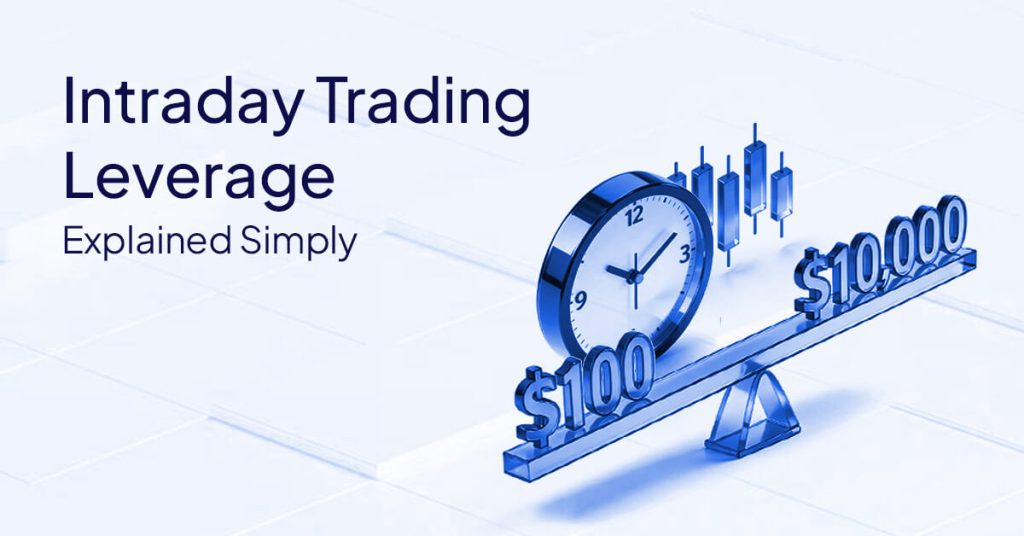
The intraday trading leverage acts as a financial magnifying glass, which extends your buying capacity by the number of trades that you make in a single market day.
However, what is going to become of your account balance when the market is moving fast against a heavily leveraged day trade?
The idea of increasing market exposure attracts many beginner traders. Even a small price shift can magnify and have a huge impact. Nevertheless, the same process increases your risk at the same rate.
This guide offers an easy, practical description of how these mechanics operate. We will go step by step through clear examples so that you will know both the opportunities and hidden risks.
Quick Answer
Intraday leverage enables traders to take a larger position with less capital on the same day.
It increases both the potential profits and losses, and thus makes risk management to be very important. The majority of intraday positions are entered and exited before the market’s close, so leverage is short-term yet highly impactful. The most important thing before intraday trading leverage is to understand the margin, charges, and risk.
What is Intraday Leverage?
Intraday leverage is a tool that allows you to trade a large market position with a small fraction of your own capital, specifically to open and close trades on the same day.
Brokers provide this feature to allow the traders to take advantage of small price fluctuations in the short term.
Since day traders do not hold positions overnight, brokers usually view such trades as less risky than long-term positions. They therefore tend to place greater emphasis on intraday trading, as it offers higher leverage.
It is important to know, though, that leverage exposes you much more than you have invested. If you have a position that is five times your account balance, your possible profits and losses are five times as great. This dramatically increases market volatility, affecting your bottom line.
What is Intraday Margin Trading?
Intraday margin trading is a process in which a small initial deposit (called margin) is required to obtain a leveraged position that the trader can use to trade the same day.
Consider the margin a good-faith deposit, not a fee. It is the minimum capital required in your account to launch the trade. If a broker requires a 20% margin, you can deposit only 20% of the total trade value.
This creates a relationship between leverage and margin. A 20% margin is equivalent to 5 times leverage. With a 20% margin, you will be able to open a total position worth $5,000 with your own money of $1,000.
How Does Leverage in Intraday Trading Work?
Leverage in intraday trading works by using your broker’s capital to amplify your own, allowing you to increase the size of your trades.
To gain a proper appreciation of this mechanism, consider the figures at work. We will break down the impacts on a typical trading account.
Simple 2x and 5x Example
Using leverage means that a lower starting account balance yields a significantly higher aggregate trade value, given the required margin. Assume you have a balance of $1,000 in your account.
- Without Leverage (1x): You buy an asset of value of $1, 000. The profit is $10 when the price increases by 1%.
- At 2x Leverage (50% Margin): You use your $1,000 and control a $2,000 position. The same 1% price increment would present a $20 profit now.
- At 5x Leverage (20% Margin): You use your $1,000 position to control a $5,000 position. The profit is $50 on a 1% price increment.
Under such circumstances, it will always be your original $1,000 deposit. Nevertheless, the impact of such a slight price change becomes much greater as the leverage ratio increases.
What Happens If the Market Moves Against You?
When the market fluctuates against a leveraged position, it subtracts gains directly from your initial margin deposit, and your account is at risk much faster.
When you are holding a position of $5,000, and you have the amount of $1,000 in your account, then a 5% decrease in the price of the asset will give you a loss of $250. That single loss wipes out a quarter of your real account balance.
There will be a margin shortfall as long as prices keep falling. This implies that your position does not have sufficient capital to remain open. Brokers will force an exit to save themselves, thus automatically closing your trade before your balance falls below zero.
How Does Intraday Trading 5x Margin Work in Practice?
With intraday trading 5x margin, the trader can multiply their buying power by 5, requiring only 20% of the total trade value at the start. We can take an example with round numbers that have been worked out.
For example, you may sell a highly favored share at $100 per share. You have $2,000 in available capital. You can buy 20 shares without leverage. However, with a 5x intraday margin, you can purchase up to $10,000. You can now purchase 100 shares.
This is very appealing, as with each one-dollar rise in the stock price, you get a $200 gain instead of a $40 gain. This, however, raises your risk. Your loss is $200 in case the stock price drops by $2. The table below demonstrates this perfectly.
| Trade Setup | Initial Capital | Buying Power | Shares Bought ($100 each) | Profit if Price Rises $2 | Loss if Price Drops $2 |
| No Leverage | $2,000 | $2,000 | 20 | +$40 | -$40 |
| 5x Leverage | $2,000 | $10,000 | 100 | +$200 | -$200 |
Does Intraday Equity Leverage Work Differently?
Intraday equity leverage applies only to the stock market and is usually highly regulated regarding account size and trading frequency.
Although the core math of leverage is the same, the rules are quite different in the stock market. The margin structure of various asset classes (such as forex or commodities) is not always the same.
Intraday Equity Leverage Basics
Intraday equity leverage is borrowed capital used to day trade stocks or stock indices. Regulators are keen to maintain stability in equity markets.
The margin regulations contained in the FINRA pattern day trader rules state that the pattern day trader should have at least $25,000 in their stock market account to allow them to use up to 4x intraday leverage.
When a trader keeps these equity placements overnight, the maximum permitted leverage is typically reduced to 2x. This difference is intended to ensure traders have sufficient capital to cover potential overnight market gaps.
How Sock Volatility Affects Leveraged Intraday Positions
The leverage and high stock volatility produce rapid price fluctuations, which can lead to immediate margin calls or heavy losses. Technology stocks and those tied to recent news or earnings announcements often experience significant price movements within a few minutes.
When leverage is applied to a volatile asset, your chances of forced exit are high. There is dynamism in brokers’ margin requirements for volatile stocks. They may temporarily decrease the leverage from 5x to 2x to cushion both the trader and the brokerage firm against too much risk.
Are There Intraday Leverage Charges?
Intraday leverage fees may include brokerage fees, transaction fees, and, occasionally, financing fees, but same-day trade fees are often cheaper than holding them overnight.
The broker will have to facilitate that transaction since you are actually borrowing capital to open a bigger position. Although some platforms do not charge for overnight financing of trade when the trade is closed within a day, other charges apply.
Such costs typically take the form of conventional broker fees, a higher commission structure for more trades, or wider spreads. The precise fee structure will vary widely among brokers.
Before trading, traders are advised to carefully review the platform’s cost structure and margin terms. With your STARTRADER account dashboard, you can understand your unique cost structure, and thus you can precisely determine your net income or loss.
What Are The Risks Of Using High Intraday Leverage?
The main risk of large intraday leverage is that it increases your exposure to financial risk, which otherwise would have been merely ordinary market fluctuations, to a catastrophic loss of your account.
High leverage does not leave much room for mistakes. FINRA data confirms 72% of day traders end the year with net financial losses, regardless of the strategy employed. A very competent trader will still lose trades, but leverage will ensure they lose hard on the account.
Faster Losses
Leverage amplifies the negative immediately, which means that a few percentage points decline in the worth of the asset causes an extensive percentage decline in your account equity.
When you are extremely leveraged, one little pullback, which might have been a dot on a graph, can erase a large percentage of your margin. Such speed does not give the traders much time to respond or change their strategy.
Margin Calls or Auto-Square-Off
When your account equity is lower than the minimum maintenance margin required by the broker, then they are going to automatically wind up your positions to ensure that you do not incur any further loss.
Such a compulsory shut-off is called an auto-square-off or a margin call. The SEC regulations on day trading state that brokerages are free to liquidate your positions without consulting you in advance.
Emotional Overtrading
The emotional responses to perceiving exaggerated returns and immediate losses often lead traders to abandon their strategies and trade out of emotion.
Traders often attempt to revenge trade to recover losses after a heavy, leveraged loss. Such an emotional spiral normally results in even bigger errors and more capital used up.
How Can Beginners Use Intraday Leverage More Carefully?
Beginners can use leverage as a tool, not a shortcut, by ensuring risk management is taken extremely seriously on every trade.
Day trading is not an overnight success but a matter of survival and regularity. The only solution is to implement safety rules to maneuver the leveraged markets.
Start With Lower Exposure
You should not jump to full leverage. Start with 1x or 2x to see how market speed affects a specific account balance. Finding out the market feels without worrying about losing a lot of money gives confidence. Leverage can be gradually increased as your consistency increases.
Use Strict Position Sizing
Only put 1% to 2% of your total capital on a single leveraged trade. It is also possible to reduce the business problem to a coping expense by maintaining a small position, but if one is on the losing side of a trade, it could turn into an accounting nightmare.
Set Stop-Loss Rules Before Entry
Pre-define your precise exit level and set a hard stop-loss order so the trade automatically terminates if the market moves in the wrong direction. A stop-loss removes the emotional factor. It serves as a self-operating circuit breaker, saving you capital till you have the next opportunity.
Avoid Using Full Buying Power
Maintain a buffer of good cash in your account, and do not overstretch the total margin you have in your account. Spending the full amount of your purchasing power will ensure that any minimal activity in the downslope direction triggers a margin alert. A cash buffer absorbs normal market volatility.
What Should Traders Check Before Using Intraday Leverage?
The primary consideration before an actual leveraged day trade is to review available capital, the asset’s volatility, and the predetermined exit strategy.
Even errors that can cost a lot will be prevented with a mere pre-trade checklist. It is important to check the following parameters before clicking on either the buy or sell button:
- Available Capital: Does it have sufficient buffer above the minimum margin requirement?
- Leverage Ratio: Do you have the right multiplier (e.g., 2x vs. 5x) for your risk level?
- Fees: Have you included the spread and transaction fees in your target profit?
- Market Volatility: Is there any big news event in the offing that may lead to an unforeseeable price spike?
- Stop-Loss Strategy: Does your automated stop-loss order go into the platform?
- Exit Plan: Are you aware of the precise amount of profits you will make before the trading day concludes?
FAQs
Intraday leverage is borrowed cash issued by a broker that enables you to trade at a much greater volume of positions accomplished and disposed of within a single day. It increases your purchasing power, maximizing potential profit and loss depending on the applied ratio.
Intraday margin trading requires the trader to deposit a small percentage of the trade value as an initial deposit. This margin is a deposit that serves as a guarantee, and the trader can borrow the broker’s funds to make a larger same-day trade.
An intraday 5x margin implies that you can manage a position that is five times the account balance. Using a $1,000 cash balance, you can trade a day which has a value of $5,000, but this requires a 20% deposit of the initial margin.
Yes, leverage in intraday trading is very dangerous as it amplifies your losses as effectively as it amplifies your gains. Even a minor negative price change will soon drain your margin and automatically close your trade.
Conclusion
The intraday leverage is an effective tool which enables traders to manage bigger positions and have a chance of profiting on small market changes.
Understanding the relationship between margin requirements and your purchasing power, you can navigate the hectic atmosphere of same-day trading and succeed.
Nevertheless, it is important to keep in mind that leverage is merely a tool, which is not a promise of profitability. Because it can amplify losses as much as profits, high leverage can easily drain an account if a rigorous risk management plan is not followed.
Never take risks. Always focus on preserving capital, follow a strict stop-loss policy, and ensure you are fully familiar with the margin requirements and charges on your platform. You must take the time to develop your strategy step by step with the caution that leverage requires.
Tags


Open Live Account
 Email Address
 Phone Number
Important Notice
STARTRADER does not accept any applications from Australian residents.
To comply with regulatory requirements, clicking the button will redirect you to the STARTRADER website operated by STARTRADER PRIME GLOBAL PTY LTD (ABN 65 156 005 668), an authorized Australian Financial Services Licence holder (AFSL no. 421210) regulated by the Australian Securities and Investments Commission.
Important Notice for Residents of the United Arab Emirates
In alignment with local regulatory requirements, individuals residing in the United Arab Emirates are requested to proceed via our dedicated regional platform at startrader.ae, which is operated by STARTRADER Global Financial Consultation & Financial Analysis L.L.C.. This entity is licensed by the UAE Capital Market Authority (CMA) under License No. 20200000241, and is authorised to introduce financial services and promote financial products in the UAE.
Please click the "Continue" button below to be redirected.


