








 Web Trader MT5









The foreign exchange leverage enables traders to have a bigger market share with much less capital outlay.
Have you ever wondered how traders open modest accounts that have tens of thousands of dollars to open positions? The answer is leverage, which is one of the most effective and misunderstood tools in currency markets.
One needs to know the leverage mechanism before making a single trade. This guide is a breakdown of the concept into simple, worked examples, and the connection between leverage and margin, as well as the risks involved.
Quick Answer
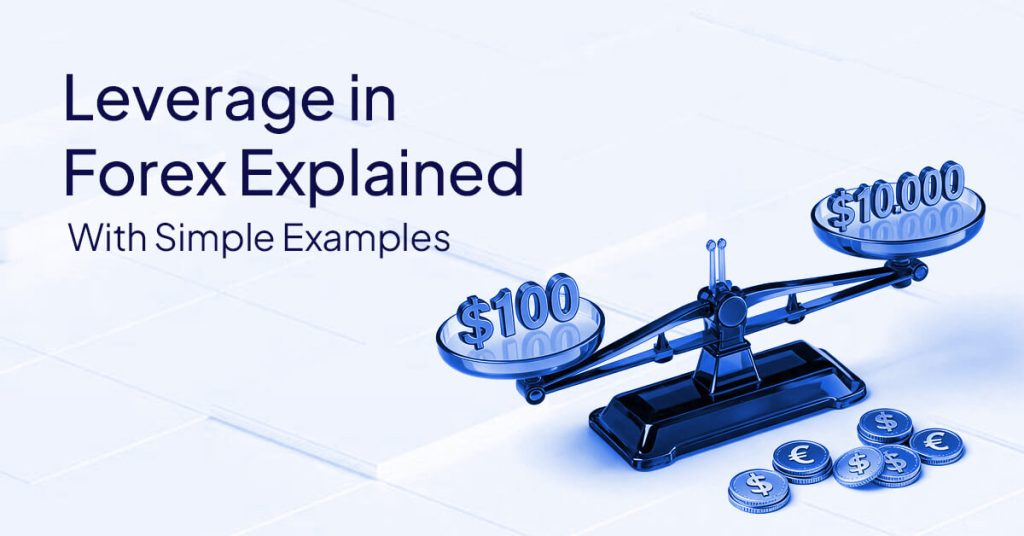
In forex, leverage enables traders to trade with a large position using a smaller deposit (margin). An illustration of this is the 1:100 leverage, where a $10,000 trade can be controlled by $100. Although this is capable of boosting the potential profits, it is also capable of boosting the potential losses. This forex leverage demonstrates that even a slight change in price can make a great impression on your balance.
What Is Leverage In Forex?
Leverage allows you to control a much larger position than you deposit in the form of money, by borrowing the difference directly from your broker.
It is like a house deposit; you leave a small percentage of the value of the house, and the lender finances the rest. In forex, the broker effectively covers the remaining portion of your trade size, and you get to bear the gains or losses on the entire position.
Leverage is in the form of a ratio. Common examples include:
- 1:30 — You have $30 control over every one dollar of your own money. Applied in regulated retail markets like the EU and UK.
- 1:100 — You have control of $100 to every $1 deposited. Widespread among the international brokers.
- 1: 500 — You control $500 of the money in every dollar. Very high leverage, which highly magnifies both results.
The main point here is: leverage magnifies both possible gains, as well as the possible losses, by an equal amount. Even a 1% shift in your favour on a 1:100 trade generates 100% of your margin.
Just 1% of your movement is cancelled out by the same movement, to take away 100% of that margin.
How Does A Leverage In Forex Example Work?
An example of applicable leverage in forex shows just how margin calculations determine how much you are actually exposed in the market.
In order to really understand how this concept works in actual market conditions, it is useful to demystify the concept. We will consider two cases where we will examine how the amount of deposit needed varies with the ratio that you take.
Simple 1:100 Example
Suppose that you start with an account balance of $500. You wish to open a micro lot position in the EUR/USD currency pair that would amount to a trade size of $10,000.
Your broker will offer you a 1:100 ratio, and you do not need to deposit the entire $10,000. To determine what the margin you need is, you divide the total trade size by the leverage percentage.
Here $10 000/100 = $100.
- Account Balance: $500
- Trade Size: $10,000
- Required Margin: $100
Your broker holds the trade open by taking $100 off the balance as a deposit, and you are left with $400 in free margin. When the market shifts 1% point your way, your position of $10,000 would earn you $100. You have just made a 100% profit on your locked-up capital. Nevertheless, when the market drops by 1%, you lose $100.
1:500 Leverage Example
And now a situation, with a much higher ratio. You still wish to open the very same position of $10,000 in EUR/USD.
At a 1:500 ratio, your margin is a lot less. You take the amount of trade, which is $10,000, and divide it by 500 to get a mere $20.
- Account Balance: $500
- Trade Size: $10,000
- Required Margin: $20
Since it is only a very low margin that is needed, entry into the trade appears a lot easier. But the risk is materially greater with reference to your used margin. A 1% shift in prices against your stance will still mean you lose $100.
Whereas it costs you only $20 to get into the trade, a mere market fluctuation can cut five times the amount that you were so far obliged to deposit, and leave you counting the remaining balance in your account.
What Is The Difference Between Leverage And Margin?
The multiplier used on your buying power is leverage, and the cash deposit you actually need to activate the multiplier is margin.
Most beginners tend to interchange these two terms, yet they are two sides of the same coin. Knowing the difference is an initial process in the right management of risk.
Leverage Ratio
The leverage ratio is an indication of the precise amount of exposure you have in comparison with your own money. When the account is 1:100, this is an indication that you are exposed 100 times to the market of your actual deposit. It is a pre-determined situation imposed by your broker which defines your buying power to the maximum.
Margin Requirement
The margin is the dollar amount that the broker secures to your account balance to initiate a particular trade. It serves as a good-faith deposit so that you can meet any possible loss. When your trade is closed, this margin is released back into your available balance.
Financial regulatory authorities such as the Financial Industry Regulatory Authority (FINRA) have a very rigid requirement on how margin accounts should be managed in order to ensure market integrity.
Concept Breakdown Table
| Concept | Meaning | Example |
| Leverage | Multiplies trade size | 1:100 ratio |
| Margin | Required deposit | $100 for a $10,000 trade |
How Does Leverage Work In CFD Trading?
Leverage in CFD trading works the same way as in forex, except that it is used in contracts that track the prices of stocks, indices, or commodities.
The Contracts for Difference (CFDs) product enables you to hedge against the price changes of different world assets even though you do not own the underlying asset.
To offer an insight into the variety of these markets, you can visit various asset classes. The mechanism of borrowing capital has not changed fundamentally, although the specifications of the contract are out of control.
CFD Leverage Example
In order to illustrate this, we will compare two types of assets. As a forex-type trade, you could borrow 1:30 leverage, €30,000 worth of EUR / USD with only €1,000 margin. Currencies tend to be less volatile historically, in that price fluctuations tend to be slow.
At this point, take an example of CFD leverage based on a stock index. You want to transact 10 contracts of an index that is quoted at $4,000 per contract, and therefore, you will have a total contract position of $40,000.
Assuming that the broker will give 1:20 leverage on indices, then you will need a $2,000 margin. However, the underlying margin mathematics is the same, but commodities and stock indices are often more volatile by more than a few percent in a single day, compared to currencies.
Even a decline of the index by 2% at once would cost the index $800. Due to the varying sizes of contracts and asset conducts, traders will have to modify their risk expectations.
Why Can High Leverage Be Risky?
High leverage is dangerous as it increases the risk that your account experiences severe financial losses at a rapid rate.
Although the temptation to control large positions with a small amount of capital is immense, it presents a certain degree of vulnerability that requires high discipline. An increase in ratios implies a reduced error margin. ESMA data confirms 74–89% of retail forex and CFD accounts lose money, with average losses of €1,600–€29,000 per client.
Faster Losses
Since your profits and losses depend on the size of your entire position, the losses multiply at an unbelievable rate. When you are operating with high leverage, even a single percentage point change in the market in a direction contrary to your forecast will immediately eat up a large percentage of your working capital.
This fast burnout leaves you with very minimal time to respond and change your strategy.
Margin Calls And Stop Out
As soon as your losses begin cannibalizing your account balance, you can be heading into a danger zone. When the amount of equity you have available is less than a specified percentage in relation to the amount of margin you have used, your broker will make a margin call. It is a notification that your account is in dire need of money.
In case the market keeps working against you and your equity falls further, then you will reach the stop-out level. This is where the broker automatically closes your trades at a loss to make sure that your account balance does not drop to a negative.
Emotional Trading Mistakes
When leverage is high, there is a natural increase in the emotional intensity of trading. When you see your balance in your account swinging, because you have been magnified, fear and greed usually step in.
It is this emotional strain that causes most mistakes of a beginner, such as closing a winning trade too soon because one is scared, or clinging to a losing trade hoping it will improve.
How Can Beginners Use Leverage More Carefully?
The leverage is safe as it allows beginners to maintain low ratios, position sizes, and focus on risk protection tools.
The defensive mind is the only way to maneuver the leveraged markets. In the beginning, you should not be concerned with the speed of account growth, but with preserving capital and developing what you can do best.
Start Small
No regulation says that you should be using the highest ratio that your broker will provide you with. Higher margin requirements are kept by using lower ratios, e.g., 1:10 (or 1:20). This inherently makes you size down the position, and this helps slow down the rate at which you may be making losses and hence offers you time to learn.
Use Stop-Loss Orders
A stop-loss order is the computerized instruction that you provide to your broker in order to close a trade, once it reaches a determined price. It is a necessary tool for minimizing losses. By establishing a stop-loss point before you get into a trade, you determine the amount of money you have committed to lose, irrespective of the amount of leverage you are about to take.
Focus On Position Sizing, Not Just Leverage Ratio
Professional traders also trade on their risk per trade, and not necessarily the multiplier. You should never have more than 1% to 2% of your total account balance on one setup. Simply by dividing your position size by this strict percentage, the leverage ratio is reduced to a background mechanic and not a primary risk driver.
Practice On A Demo Account First
These concepts can only be learned best through simulated environments with no financial risk. With a demo account, you will have the opportunity to practice margin calculations, placement of stop-loss orders and experience the pace at which leveraged market movements will occur using virtual funds.
This step is important to develop muscle memory prior to trading live. Platforms like STARTRADER offer demo environments where you can simulate margin calculations and leveraged positions before committing real capital.
What Should Traders Check Before Using Leverage?
A strict pre-trade checklist should also be reviewed by traders whenever they can undertake the magnified exposure in their account without risking.
Always stop and evaluate your position before clicking the buy or sell button. When it comes to making expensive mistakes, a few seconds of revision can save a lot of money.
- Account size: Do you have sufficient available free equity that will cover the normal market swings without requiring a margin call?
- Risk per trade: Does your risk loss limit to 1% to 2% of total balance?
- Margin level: Would the opening of this new position reduce the margin level to a dangerous percentage?
- Market volatility: Is there anything significant in terms of news that is just going to happen and lead to an abrupt spike in prices?
- Stop-loss strategy: Have you identified the point of exit and put in an automated stop-loss order?
- Risk management plan in general: Does this trade meet your established trading rules for the long-term?
FAQs
One simple example of a forex trading leverage is to buy a $5,000 position with the help of a 1:50 leverage. You are not required to deposit the whole amount of the money (i.e. $5 000) but only a $100 margin deposit to your broker. This means that your ten dollars can act like it is five thousand dollars in the real market, and this will multiply any gains or losses that are incurred.
No, very high ratios are usually not suggested to beginners. An example of a 1: 500 leverage means that with an amount of 100,000 (standard lot of stocks), a margin of $200 is adequate to control the stock. Due to the low entry cost, new entrants tend to open positions much larger than their account size; that is, a small market movement can immediately completely flush them out.
Leverage is the multiplier engine which determines your entire market exposure, and margin is the dollar amount which your broker has put up as a deposit to have that trade completed. Leverage is the magnitude of the position, and margin is the security on which the position is held.
Although the underlying mathematics is the same, a typical CFD would have far more underlying volatility, e.g., stock indices or crude oil. The size of contracts also has significant variations. Thus, a leverage ratio used with a CFD can cause enormous dollar movements as compared to a sluggish currency pair.
Conclusion
Leverage is an effective financial tool that enables retail traders to access international markets, yet it requires high discipline and proper management of risks. It is by knowing margin calculations and their influence on your account balance that you come to the markets with more realistic expectations.
Keep in mind that a leverage ratio is not an assurance of profits, but it just increases your exposure in the market. It is always advisable to focus on the preservation of capital, use stop-loss orders on all trades, and exhaustively test out your strategies in a simulation environment before spending actual capital.
Tags


Open Live Account
 Email Address
 Phone Number
Important Notice
STARTRADER does not accept any applications from Australian residents.
To comply with regulatory requirements, clicking the button will redirect you to the STARTRADER website operated by STARTRADER PRIME GLOBAL PTY LTD (ABN 65 156 005 668), an authorized Australian Financial Services Licence holder (AFSL no. 421210) regulated by the Australian Securities and Investments Commission.
Important Notice for Residents of the United Arab Emirates
In alignment with local regulatory requirements, individuals residing in the United Arab Emirates are requested to proceed via our dedicated regional platform at startrader.ae, which is operated by STARTRADER Global Financial Consultation & Financial Analysis L.L.C.. This entity is licensed by the UAE Capital Market Authority (CMA) under License No. 20200000241, and is authorised to introduce financial services and promote financial products in the UAE.
Please click the "Continue" button below to be redirected.


