








 Web Trader MT5







The key to managing your risk when trading with smaller account balances is to understand the basics of forex leverage.
Have you ever thought about how retail traders can control big currency positions without having to put down thousands of dollars up front? Leverage is a common tool in the foreign exchange market for closing this gap.
Leverage can increase your trading chances and financial risks. That’s why it’s very important to know about beginner leverage in forex before you make your first live trade.
This guide tells you how leverage works, how margin keeps your account safe, and how to find safer places to start. By the end of this article, you will know exactly how new traders can avoid being too exposed in the markets.
Quick Answer
When you start trading forex with a small account balance, you can use borrowed money to increase your trading exposure.
This is called beginner leverage in forex. Most new traders find it easier to handle lower leverage levels, such as 1:10 or 1:30, because they reduce the risk of losing a lot of money while they learn how the market works.
What Does Beginner Leverage In Forex Mean?
In forex, beginner leverage means using a multiplier from your broker to make trades larger than you could with just your cash deposit.
Leverage is like a financial magnifying glass, in simple terms. It lets traders control much bigger positions with only a small amount of starting capital. But it’s important to remember that leverage only increases your exposure to the market. It doesn’t guarantee profits, though.
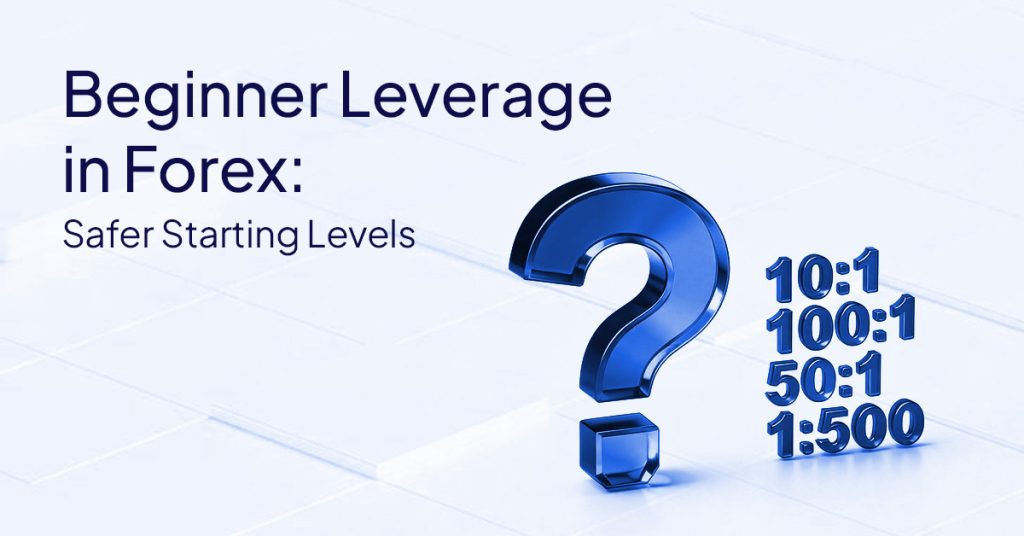
Forex leverage is always displayed as a ratio on a trading platform, such as 1:10, 1:30, or 1:100. If you have a 1:10 ratio, you can control $10 in the market for every $1 you have. This ratio is the most important thing to remember when balancing risk and reward in your trading.
How Does Leverage In Forex Work For Beginners?
When you use leverage in forex, it gives you more buying power while only requiring a small deposit, called margin, to keep the trade open.
When you open a leveraged position, the broker gives you the extra money you need to make the trade. You only need to put up a small amount of the trade’s total value.
A Simple Forex Leverage Example
A leverage ratio shows you how much money you can control with each dollar in your trading account.
Let’s use an easy example with whole numbers. If you want to make a trade, here is a setup you might think about:
- Account balance: $100
- Leverage: 1:10
- Position size: $1,000
- Margin required: $100
Your $100 is the margin you need to control a $1,000 position because your leverage is 1:10. To find out how big the trade is, you will just multiply your margin by the leverage ratio.
What Happens If The Market Moves Against The Trade?
When a trade goes the wrong way, leverage makes your losses bigger just as quickly as it makes your possible gains bigger.
If you have a $1,000 position and only $100 in your account, a 5% drop in the price of the asset means you lose $50. You have lost 50% of your initial capital because $50 was taken from your real account balance.
Higher leverage can cause losses to occur much faster, which is why it’s so important to manage your risk. This risk compounds further during a high-volatility forex trading session, when prices can move sharply in seconds following economic data releases.
Is There A Best Forex Leverage For Beginners?
There isn’t one perfect ratio for beginners to use when trading forex. The best leverage for them depends on how much risk they are willing to take and the size of their account.
When traders enter the market, they all have different amounts of money and emotions. The “best” leverage is the one that works best for you.
If your account is small, you should use high leverage to grow it quickly. But for people who are just starting, lower leverage is usually easier to handle. It lets you make mistakes and learn about the market without losing all of your money.
What Is A Safer Leverage Range For Beginners?
For beginners, a safer forex leverage is usually between 1:10 and 1:30. This gives them exposure to the market without the risk of extreme volatility.
This is why many regulatory bodies worldwide limit retail forex leverage. The European Securities and Markets Authority (ESMA), for example, limits retail forex leverage to a maximum of 1:30 across major currency pairs to keep people from losing too much money.
Lower Leverage And Risk Control
Lower leverage helps limit downside risk by making your account equity change more slowly during daily market movements.
By keeping your exposure low, you make sure that one bad trade won’t ruin your whole portfolio. This lets you keep learning and improving your skills. You will be prioritizing survival over fast account growth.
Why Very High Leverage Can Be Hard To Manage
Using a very high leverage makes you much more vulnerable to normal price changes, which makes it very hard to manage risk.
If you have a lot of money in your account, even a small price change can cause you to lose a lot of money. Most beginners lack the skills and experience to keep risk under control. This is why it is best to stay neutral and practical when it comes to leverage.
What Is The Difference Between Leverage And Margin In Forex?
Leverage is the number that makes your trading power stronger, and margin is the amount of money you need to put down to start and keep that trade going.
People often use the two words, leverage and margin, together, but they mean two different things. Leverage sets the maximum size of your trade, and margin is the money you put up as collateral.
What Leverage Ratio Means
A leverage ratio tells you the exact number that your account equity is multiplied by to find out how much of the market you are exposed to.
For instance, a 1:30 ratio means that your buying power is 30 times greater. It sets the limit on what you can trade.
What Margin Requirement Means
A margin requirement is the exact percentage of the total trade value that your broker keeps as collateral.
This money is not a fee; it is kept to ensure you can cover any losses that may occur. To make this clear, look at the small table below that compares leverage and margin:
| Leverage Ratio | Position Size | Margin Required |
| 1:10 | $1,000 | $100 |
| 1:30 | $3,000 | $100 |
| 1:100 | $10,000 | $100 |
You can see that higher leverage lowers your margin requirements for the same position size, but it greatly raises your risk if the market goes against you.
Why Can High Forex Leverage Be Risky For Beginners?
High forex leverage is risky because it magnifies your trading account’s potential losses, making them happen faster and in larger amounts.
The Financial Conduct Authority (FCA) said in a report on retail trading risks that high leverage remains one of the main reasons retail clients lose money. There are both mathematical and psychological risks that come with high leverage.
Faster Losses
Because you have a bigger position, every pip movement against your trade takes more money out of your actual cash balance.
The more leverage you use, the more your losses will go up. A market drop that doesn’t hurt a 1:1 account could be very bad for a 1:100 account.
Margin Pressure
If your leveraged losses deplete all your available margin, your broker will call you and automatically close your trades.
When your account equity drops below a certain level, you get a margin call. The broker steps in to close the position to prevent your account from going into the negative. If this happens, your money can go down very quickly.
Emotional Decision-Making
When beginners trade with a lot of leverage, they often get stressed and panicked, which makes them make quick and emotional decisions.
When traders see their real money disappearing quickly, they might give up on their plans, trade too much to make up for losses, or just stop trading. Removing high leverage reduces much of this mental stress.
How Should Beginners Choose A Leverage Level In Forex?
Beginners should use a strict, well-defined risk management plan to determine how much leverage to use.
It’s not a guess when you choose a leverage level; it’s math and discipline. You can handle this process by doing a few simple things. You can also review the educational materials on STARTRADER to refine your strategy further.
Start With Risk Per Trade
Before you open your account, always specify how much you are willing to lose on a single trade, like 1% or 2%.
If you start with a set amount of risk, your leverage is just a way to carry out that risk. It stops you from putting too much money at risk.
Match Leverage To Account Size
If you have a smaller trading account, you need to be more careful with your leverage settings so that you don’t get a margin call right away when the market moves.
If you only have $500, maxing out your leverage means you can’t make any mistakes. Keeping the ratio low protects your smaller balance.
Consider Volatility And Stop-Loss Distance
You should use less leverage to keep your dollar risk manageable, since highly volatile currency pairs require wider stop losses.
Your strategy depends on the market’s state. The Bank for International Settlements (BIS) says the forex market handles trillions of dollars every day, which means volatility is always present. Change your exposure depending on how much a pair moves.
Practice On Demo Before Increasing Exposure
The safest way for forex beginners to find the best leverage is to test their risk management strategy on a demo account with no risk.
Don’t practice with real money. With a demo account, you can see how margins change in real time without having to worry about money. Once you know how things work, you can move on to a real environment with confidence.
What Should Beginners Check Before Using Forex Leverage?
Before making any leveraged trades, new traders should check their margin requirements and ensure their stop-loss limits are set correctly.
Having a routine helps you avoid making expensive mistakes. Before you go into the market, check this simple list:
- Chosen leverage ratio: Make sure your account has a ratio that you can handle, like 1:10 or 1:30.
- The margin needed for each trade: Check whether you have enough free margin to cover the position.
- Where to put the stop-loss: Set a hard stop-loss so that the trade will automatically end if it goes wrong.
- What the risk per trade is: Make sure that the amount you could lose doesn’t go over your 1–2% risk rule.
Knowing about market news and how volatile it is: Look at economic calendars to see if any big news events could cause prices to go up quickly.
FAQs
In forex, beginner leverage means borrowing money from a broker to trade larger amounts than what a new trader’s initial deposit would allow. It makes both possible profits and possible losses bigger.
A lower ratio, like 1:10 or 1:30, is a good place to start. These levels give you enough exposure to the market while keeping your risk under control, instead of going for extreme ratios like 1:500.
Yes, lower leverage is a lot safer for new traders. It reduces the risk of losing money, slows the rate at which losses can occur, and lets beginners learn how the market works without worrying about their account running out of money quickly.
You can open a much bigger position by using a small amount of your own money (called “margin”) as collateral. With 1:10 leverage, a $100 margin deposit lets you trade $1,000 worth of currency.
Conclusion
Anyone who wants to get into the currency markets needs first to learn how beginner leverage in forex works.
Leverage can amplify your trading power, but you should be careful with it because it also increases your risk of losing money.
Knowing the big difference between margin requirements and leverage ratios can help you protect your account equity. Remember that lower leverage is usually easier to handle because it causes drawdowns to occur more slowly and in smaller amounts.
Put learning first, make risk management a priority, and use a structured approach before you take on more risk.
Once you feel comfortable with these ideas, consider opening a STARTRADER live account so you can practice managing beginner leverage forex strategies in a safe environment. Don’t rush; try out your ideas and don’t put more money at risk than you can afford to lose.
Tags


Open Live Account
 Email Address
 Phone Number
Important Notice
STARTRADER does not accept any applications from Australian residents.
To comply with regulatory requirements, clicking the button will redirect you to the STARTRADER website operated by STARTRADER PRIME GLOBAL PTY LTD (ABN 65 156 005 668), an authorized Australian Financial Services Licence holder (AFSL no. 421210) regulated by the Australian Securities and Investments Commission.
Important Notice for Residents of the United Arab Emirates
In alignment with local regulatory requirements, individuals residing in the United Arab Emirates are requested to proceed via our dedicated regional platform at startrader.ae, which is operated by STARTRADER Global Financial Consultation & Financial Analysis L.L.C.. This entity is licensed by the UAE Capital Market Authority (CMA) under License No. 20200000241, and is authorised to introduce financial services and promote financial products in the UAE.
Please click the "Continue" button below to be redirected.


