








 Web Trader MT5









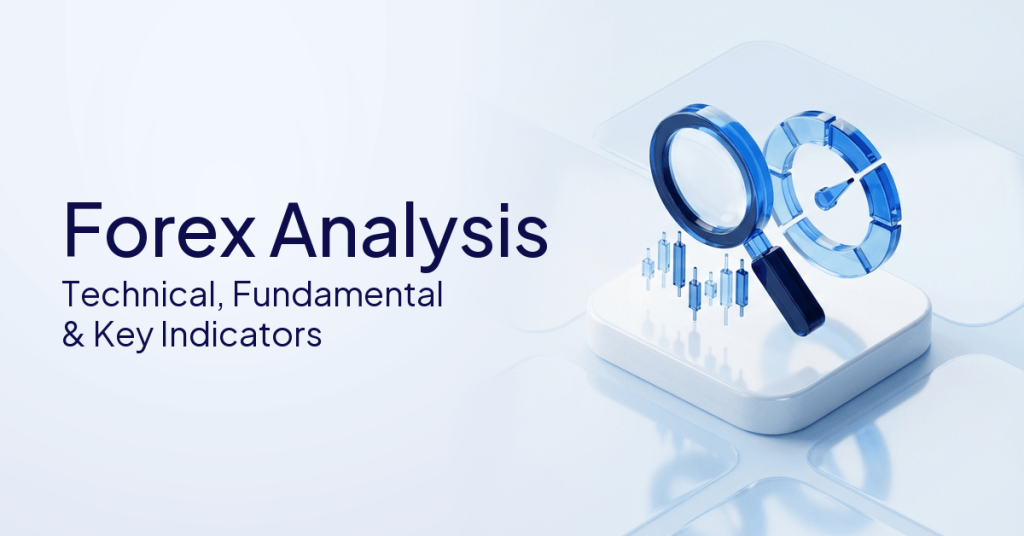
Market analysis is performed by traders before executing any forex trade to understand the price direction.
Ever wonder how professional traders get to avoid having to guess when trading in the highly liquid currency markets? The answer is systematic forex analysis, which is the foundation of every good trading strategy. In general, the analysis can be split into two main categories, technical analysis and fundamental analysis.
Technical analysis means looking at price charts and mathematical indicators and trying to find patterns that repeat and can give hints about when to trade. On the other hand, fundamental analysis looks at the economic health of a country, examining data releases, central bank decisions and global news to find out the true value of a currency.
Some traders also add sentiment analysis as a secondary way of assessing mass market psychology but the technical and fundamental methods are still the bedrock. With an array of advanced charts, economic data feeds and robust trading tools, market participants can evaluate potential opportunities 24/7.
This guide is not an in-depth tutorial of one setup. It is a broad overview of many. Exploring these key concepts will help you have a good understanding of how forex analysis works and how it shapes informed trading decisions.
Quick Answer
Forex analysis is the examination of the market to find potential trading opportunities.
There is technical analysis that uses charts and past patterns and fundamental analysis that takes into account economic data and news events. Many traders use both methods to get a complete view of the market. Mathematical indicators, Fibonacci levels and integrated trading tools allow traders to better evaluate market conditions and manage their overall risk.
What Is Forex Analysis?
Forex analysis is the process of analyzing market data to determine the most probable future price movements.
Traders do not rely on gut feeling but rather they analyze historical and current market data to make a logical case for buying or selling a particular currency pair.
This analytical approach allows traders to make better-informed decisions by providing a systematic approach to assessing risk and reward. It helps market participants to filter random price noise and find high-probability set-ups.
But it is important to remember that analysis does not tell the future price with 100 percent certainty. The currency market is global and dynamic, and none of the analytical methods can guarantee a profitable outcome. Instead, analysis just tilts the statistical odds in favour of the trader.
What Are The Main Types Of Forex Analysis?
Market participants use three main types of analysis to navigate the currency markets.
- Technical Analysis: This method involves the use of historical price data and chart patterns to predict the future behaviour of the market. Technical traders believe that all known information is already included in the current price.
- Fundamental Analysis: This method analyzes economic data, news releases and decisions made by central banks to assess the real value of a currency. Fundamentalists buy currencies of strong economies and sell currencies of weak economies.
- Sentiment Analysis: This support method assesses trader positioning and market expectations. It tracks whether the overall market is acting too optimistic (bullish) or pessimistic (bearish) which can sometimes act as a contrarian indicator.
Why Is Forex Analysis Important?
Forex analysis is an important part of the business because it makes trading more of a process and less of a random speculation. It actively promotes trade planning by telling you exactly where to get into a position and where to get out.
It also helps to manage risk by identifying structural levels where a trade idea is invalidated. It also allows traders to set logical stop-losses. Consistent analysis improves market understanding over time.
As traders spend a lot of time analyzing charts and economic data, they develop a better understanding of how different currency pairs act. This ultimately encourages disciplined decision making and limits emotional urges.
Technical Analysis In Forex
Technical analysis is the visual study of historical price action on trading charts.
The ultimate aim is to identify trends, patterns and probabilities based on the past market behavior.
They don’t think about why a price is moving; they just look at the reality of the price action itself. It is important to note that technical analysis does not guarantee future results.
A certain chart pattern doing a breakout in the past does not mean it will do a breakout every single time. It is rather a tool for risk management and likelihood assessment than a crystal ball.
What Types Of Charts Do Forex Traders Use?
There are three main chart types that traders usually rely on to visualize market data:
Candlestick Charting
The most commonly used chart type by forex traders is the candlestick chart. Each candlestick shows information about the open, high, low and close price for a particular time period.
The difference between the open and close is shown by the thick body of the candle while the thin wicks show the extreme highs and lows. This format is hugely popular because a basic candlestick interpretation gives an instant visual snapshot of whether buyers or sellers are in control of the session.
Bar Charts
Bar charts show the same price information as candlesticks but in a vertical line with horizontal dashes. The dash to the left is the opening price, the dash to the right is the closing price. They are useful but they lack the immediate visual impact of colour coded candlestick bodies.
Line Charts
Line charts provide the highest level of simplicity by plotting a continuous line that only connects the closing prices of a currency pair. Line charts are great for general trend identification because they filter out the intraday highs and lows. It is easy to see the general direction of the market.
How Do Traders Identify Market Trends?
The foundation of technical trading is identifying the prevailing trend. Traders rely on several key concepts to determine direction.
Zones of Support and Resistance
These are key price zones, and you’ll often see markets react. Support acts as a floor where prices tend to bounce due to increased buying interest when they fall. Resistance is a ceiling where rising prices often stall due to selling pressure.
Trend Analysis
Traders talk about three major phases of the market: uptrends (where prices make higher highs and higher lows), downtrends (where prices make lower highs and lower lows), and ranging markets (where prices move sideways between defined support and resistance levels).
Price Action Analysis
Price action analysis is simply reading the raw price movements without using a lot of indicators. Traders will watch how fast the price moves and how candles react at important levels to judge the institutional footprint and momentum in the market.
What Are Common Technical Analysis Tools?
Today’s traders map the markets with a variety of tools:
- Trendlines: Lines drawn diagonally between swing points to outline a trend.
- Support and Resistance: Horizontal zones that mark previous turning points.
- Chart Patterns: Patterns like Head and Shoulders or Triangles.
- Candlestick Patterns: Specific patterns that suggest reversal or continuation.
- Fibonacci Retracements: Mathematical ratios to locate hidden support.
- Technical Indicators: Mathematical formulas applied to the price.
What Are Forex Indicators?
Forex indicators are automated mathematical calculations based on past price and volume data.
After being calculated, these tools draw visual lines or histograms on a trading chart.
They assist traders in evaluating trend strength, shifts in momentum, volatility, and overall market conditions. Indicators take the raw price data and transform it into a visual cue that helps traders quickly grasp complicated market environments.
What Are The Main Types Of Forex Indicators?
Indicators are usually classified into four main groups according to the particular market dynamic they are designed to measure.
| Indicator Type | Examples | What It Shows |
| Trend Indicators | Moving Average, Bollinger Bands | Direction of the prevailing trend |
| Momentum Indicators | RSI, MACD, Stochastic | Strength and speed of price movement |
| Volatility Indicators | ATR, Bollinger Bands | Degree of price fluctuation |
| Volume Indicators | OBV (On-Balance Volume) | Strength behind price moves based on volume |
What Are The Most Common Forex Indicators?
Moving Averages
Moving Average (MA) is always computing the average price over a period of time which smooths out the price data so that trends can be identified easily. If the price is above a rising moving average, the market trend is usually up.
Relative Strength Index (RSI)
RSI is a momentum oscillator that measures the speed of price moves. It is commonly used to identify overbought or oversold conditions, helping traders to spot potential reversals when the market is overextended.
MACD
The Moving Average Convergence Divergence (MACD) confirms trend and momentum by using two different moving averages. A change in market momentum is signaled by crossovers in the MACD lines.
Bollinger Bands
They are a moving average with two standard deviation bands around it. Bollinger Bands are excellent for assessing volatility, the bands expand when volatility is high and contract when the market is calm.
Average True Range (ATR)
The ATR does not tell us if the market is trending up or down, it only measures volatility. The ATR is used by traders to know the average number of pips that a currency pair moves in a day and this helps to place good stop-loss orders.
How Should Beginners Use Indicators?
One of the most common mistakes new traders make is cluttering their charts with too many tools. New traders should concentrate on learning a few indicators. You don’t want to overload indicators as conflicting signals can lead to analysis paralysis.
Most importantly, traders should always use indicators in conjunction with basic price analysis. All indicators are price based so price action should always be your first priority.
For more information on these technical tools, read our in-depth guide to indicators in forex explained.
Fibonacci Levels In Trading
Fibonacci retracement is a technical tool that helps to identify potential support and resistance levels using mathematical ratios.
Traders use this tool to draw from a major price low to a major price high to identify potential support and resistance areas during a market pullback.
This is why human psychology is often in tune with these natural mathematical proportions and why this is one of the most widely used technical tools in trading across all financial markets.
Why Are Fibonacci Levels Important In Forex Analysis?
The market usually doesn’t go straight. Price tends to pull back for a while after a strong surge in one direction before continuing. Fibonacci levels are important because they help traders identify potential pullback areas and thus offer a logical zone for traders to look for entries. The tool also works excellently when traders combine the Fibonacci levels with other analysis methods, thus forming high-probability confluence zones.
What Are The Main Fibonacci Retracement Levels?
The tool is applied to a chart and several horizontal levels are created based on the percentage of the initial price move.
| Fibonacci Level | Common Interpretation |
| 23.6% | Shallow retracement; typically seen in aggressive trends. |
| 38.2% | Moderate pullback level; often the first major area of support. |
| 50.0% | Psychological midpoint level; markets frequently retrace half of a move. |
| 61.8% | Key Fibonacci “Golden Ratio” level; widely watched for major reversals. |
| 78.6% | Deep retracement area; the final defence before a trend is invalidated. |
How Do Traders Use Fibonacci Levels?
Identifying Potential Entry Zones
The most common use is to locate potential entry zones. If a currency pair is in an uptrend, a trader may wait for the price to fall into the 50.0% or 61.8% retracement zone before looking for buying opportunities.
Setting Potential Exit Levels
Fibonacci extensions can be used to find possible exit levels. These levels tell us where the price could go once the pullback is over. They can be used as logical profit targets and can be useful in risk management applications too.
Combining Fibonacci With Other Tools
Fibonacci levels should be used in conjunction with other technical analysis tools. They work best together with:
- Support and Resistance: Finding horizontal areas that line up with a Fibonacci level.
- Trendlines: Waiting for the price to hit a trendline and a retracement level at the same time.
- Moving Averages: Using moving averages for dynamic confirmation.
- Candlestick Patterns: Looking for a bullish or bearish candlestick pattern to form right on a Fibonacci level.
What Are The Limitations Of Fibonacci Analysis?
The main problem is the subjective placement of levels. The levels can differ based on which swing high and swing low a trader selects. Also, not every retracement results in a reversal, and sometimes prices just rocket right past the golden ratio. It is therefore best used in conjunction with other tools to confirm a bias and not as a stand-alone signal.
Read our in-depth explanation of Fibonacci levels in trading to learn more about this mathematical tool.
Fundamental Analysis In Forex
Fundamental analysis attempts to determine a currency’s intrinsic value by looking at macroeconomic data and central bank policy.
It is the study of economic and financial factors that influence currency values.
Technical analysis looks at the outcome of market movement and fundamental analysis looks at why the markets move. Fundamental analysts examine the economic health of a country to determine if a currency is undervalued or overvalued against its peers.
According to the Bank for International Settlements (BIS), long-term currency valuation and daily liquidity are still affected by macroeconomic shifts and institutional capital flows.
Which Economic Indicators Matter Most?
There are a few top-tier economic releases that always create market volatility.
Interest Rate Decisions
This is the most fundamental force. Base interest rates are controlled by central banks. Higher interest rates normally attract foreign capital, increasing demand for that currency.
Inflation Data (CPI)
Inflation, consumer price index. High inflation will normally lead to a central bank increasing interest rates, thereby affecting the strength of the currency directly.
Gross Domestic Product (GDP)
GDP gives a broad measure of economic growth. A healthy economy is indicated by a rise in GDP and usually means a stronger currency.
Employment Data
Reports such as the US Non-Farm Payrolls give a snapshot of how healthy the labour market is. Robust jobs report signals economic resilience, rate hike possibilities.
Consumer And Business Confidence
These economic sentiment indicators are measures of optimism. Confident consumers spend more, which drives economic growth and supports the domestic currency.
How Do News And Geopolitical Events Affect Forex Markets?
The currency market is extremely sensitive to global events outside of the scheduled data.
- Central Bank Announcements: A sudden change in policy tone can instantly reverse the trend of a currency.
- Elections: Political uncertainty typically weakens a currency until the outcome of the election is known.
- Trade Policies: Tariffs and trade agreements change international capital flows. The International Monetary Fund (IMF) identifies changes in global trade policies as one of the main drivers of cross-border currency volatility.
- Geopolitical Tensions: Typically, conflicts spark a rush into safe-haven currencies such as the US Dollar or Swiss Franc.
- Global Economic Shocks: Capital moves massively around the market due to things nobody sees coming, such as banking crises.
What Are The Strengths And Limitations Of Fundamental Analysis?
Strengths
The big plus is that it gives long-term context for the market. If traders understand the economic drivers, they can confidently catch large multi-month trends.
Limitations
The major downside is that markets can be unpredictable. Sometimes the good news is already “priced in” by the market, which means the currency may actually fall when the good news is officially announced.
Learn more about these economic drivers in our complete guide to fundamental analysis in forex.
Forex Trading Tools: Charts And Calendars
Traders use charting software and economic calendars to follow price action and to watch for fundamental events that can move markets.
What Trading Tools Do Forex Traders Use?
There is a host of professional tools which traders use to efficiently analyse the market.
Prices Charts
These are the fundamentals of technical analysis. Modern platforms allow traders to apply indicators, draw technical patterns and customise timeframes seamlessly.
Economic Calendar
These digital calendars tell traders how to track upcoming market-moving events. They provide the exact time and date of major data releases, such as GDP numbers or central bank speeches.
News Feeds
Having live news terminals means that when a geopolitical event happens, traders know about it instantly and can react accordingly.
Trading Platforms
Analysis is built into the software with solutions like STARTRADER software, so you can see the charts, execute trades and get news feeds all in one place.
Why Is An Economic Calendar Important?
Economic calendars are important because they provide high impact events in advance. This gets traders ready for volatility. Say there is a big central bank announcement at 2:00PM, a trader may close positions or move stop loss orders in tighter. In this way the calendar is an active contribution to risk management decisions.
How Do Trading Tools Improve Analysis?
The right tools enable faster access to information, which is critical in a fast-paced market. It allows better trade planning and more efficient market surveillance, so traders do not have to be glued to the screen all day to catch a certain technical setup.
Read our article on forex trading tools – charts and calendars for tips on optimising your trading set-up.
Technical Vs Fundamental Analysis: Key Differences
Technical analysis studies short-term price action, while fundamental analysis studies long-term economic drivers.
How Do Technical And Fundamental Analysis Compare?
Both are looking for trading opportunities, but they do it very differently.
| Aspect | Technical Analysis | Fundamental Analysis |
| Based On | Price charts and historical data | Economic data, news, and policy decisions |
| Time Horizon | Short to medium term | Medium to long term |
| Main Tools | Indicators, chart patterns, Fibonacci levels | Economic calendars, interest rates, GDP data |
| Best For | Day traders and swing traders | Position traders and long-term investors |
| Limitation | Historical patterns do not guarantee future outcomes | Markets may not react logically to news |
Which Analysis Method Is Better?
Neither is a clearly better method. Suitability is all about the person’s trading style and objectives. For short-term day traders, there is no hourly economic data, so technical analysis is critical.
Position traders on the other hand use fundamental analysis because short-term chart patterns are irrelevant over a multi-month horizon. Both methods have their own strengths and weaknesses.
How Traders Combine Analysis Methods
Traders can use both methods to get market direction from fundamental analysis and exact trade timing from technical analysis.
Why Do Many Traders Use Both Technical And Fundamental Analysis?
The best trading strategies typically involve some combination of the two. Traders use fundamentals to create a market bias where economic data can suggest a possible market direction.
Once the asset they want to trade is identified (for instance, buying the US Dollar because of its high interest rate), they will then use technical analysis to time their trade. This is done by looking at charts and indicators to determine the best time to enter and exit a position.
What Does A Combined Analysis Process Look Like?
Step 1: Review Economic Conditions
A trader will look at the economic calendar to find out what the major economic drivers are and whether they should be looking to buy or sell a particular currency.
Step 2: Identify Technical Opportunities
The trader pulls up their charts and looks for chart-based setups that align with their fundamental bias. They wait for the price to hit a key support level or a Fibonacci retracement zone.
Step 3: Apply Risk Management Rules
They determine their stops and position sizes before getting into the market, and they employ technical tools such as the ATR to ensure they keep their risk well in control.
Why Is Consistency More Important Than Prediction?
Analysis is not about certainty, it’s about decision making. The point is not to be right all the time, but to follow a logical repeatable routine. This process-based trading means that the analytical edge will prevail over short-term random losses for a large sample size of trades.
Summary Table
The table below is a quick reference guide to the key concepts of forex analysis.
| Key Concept | Summary |
| Forex Analysis | Studying the market to identify potential trading opportunities |
| Technical Analysis | Using charts, price patterns, and indicators to assess market behaviour |
| Fundamental Analysis | Using economic data and news to assess currency value |
| Forex Indicators | Mathematical tools used to measure trend, momentum, and volatility |
| Fibonacci Levels | Retracement tool used to identify potential support and resistance areas |
| Economic Calendar | Tool for tracking upcoming economic events that may affect currency prices |
FAQs
Forex analysis is the process of analyzing the market to determine whether to buy or sell a currency pair. Traders look at price charts or economic data to evaluate market opportunities and try to find the most likely direction of an exchange rate.
Technical analysis is looking at historical price data and indicators to find patterns in charts. Fundamental analysis uses economic data, including interest rates and inflation, to determine the underlying strength of a currency. And they go well together.
The most common indicators are Moving Averages (trend), RSI and MACD (momentum), Bollinger Bands and ATR (volatility). Traders should learn indicators one at a time, not clutter the charts.
Fibonacci retracement is a charting technique where mathematical ratios such as 38.2%, 50% and 61.8% are applied to find potential areas where a pullback in price might end. Traders use retracement levels to identify possible market areas for low risk entries.
An economic calendar is a schedule of upcoming economic events and data releases. Why does it matter? These events cause currency volatility and allow traders to avoid rapid price jumps or trade the news itself.
That really depends on your trading style. Day traders trade on technicals, long-term investors trade on fundamentals. Most professionals like to mix the two approaches to get a complete overview of the market.
Conclusion
The key to moving from a beginner to a disciplined market participant is mastering forex analysis. With both technical and fundamental analysis in your toolbox, you’ll be able to view the market from a variety of perspectives.
With technical analysis, you have all the indicators and Fibonacci levels to time your entries and manage risk with precision. Fundamental analysis, on the other hand, provides the macroeconomic context that is needed to understand why a currency is moving in the first place.
Together, these methods and the trading tools that support them ensure your trading decisions are based on data and logic and not emotion. Analysis helps traders make better decisions instead of predicting markets with absolute certainty.
We highly recommend checking out the linked cluster resources throughout this guide to get a better understanding of these concepts, including everything from specific indicators to setting up your trading tools.
If you want to test these methods in a risk-free environment, exploring a demo account through STARTRADER is a great way to practise applying technical and fundamental analysis before making any live trading decisions.
Tags


Open Live Account
 Email Address
 Phone Number
Important Notice
STARTRADER does not accept any applications from Australian residents.
To comply with regulatory requirements, clicking the button will redirect you to the STARTRADER website operated by STARTRADER PRIME GLOBAL PTY LTD (ABN 65 156 005 668), an authorized Australian Financial Services Licence holder (AFSL no. 421210) regulated by the Australian Securities and Investments Commission.
Important Notice for Residents of the United Arab Emirates
In alignment with local regulatory requirements, individuals residing in the United Arab Emirates are requested to proceed via our dedicated regional platform at startrader.ae, which is operated by STARTRADER Global Financial Consultation & Financial Analysis L.L.C.. This entity is licensed by the UAE Capital Market Authority (CMA) under License No. 20200000241, and is authorised to introduce financial services and promote financial products in the UAE.
Please click the "Continue" button below to be redirected.


