








 Web Trader MT5





Quick Answer
Why is it risky to invest in a commodity?
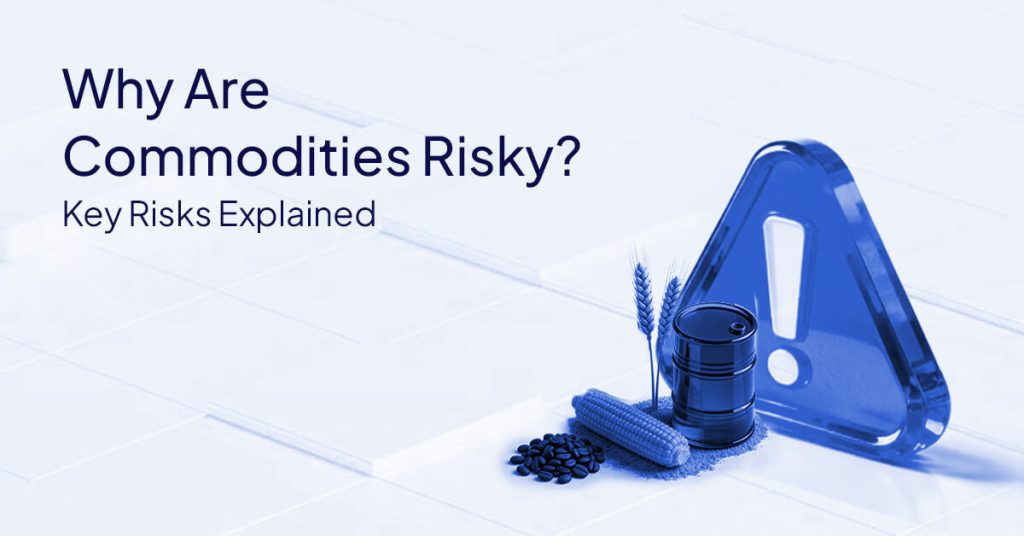
Commodity investments are risky, as prices are subject to abrupt changes due to supply interruptions, fluctuations in global demand, leverage, futures roll expenses, and unexpected events such as geopolitical or weather-related factors. Commodities are not income-generating like stocks or bonds, and returns depend solely on price fluctuations.
These are some of the reasons why commodities are risky:
- Real-world events trigger high price volatility.
- The leverage and margin exposures are in futures-based exposure.
- Roll risk and time-related hidden costs.
- Geopolitical, weather, and currency sensitivities.
Commodities are risky to invest in because of their volatility, leverage, and non-traditional market structures, which can vary widely.
Have you ever wondered why the price of oil or gold can swing wildly in one day while the stock market is relatively quiet?
Commodities may seem incomprehensible and uncertain to many beginners compared to stocks or bonds. This promptly brings us to a universal question: why is it risky to invest in a commodity in the first place?
This guide has been written in simple language, outlining the functionality of commodity markets, the factors that make them risky, and what an investor must know before adding commodities to a portfolio.
What Makes Commodities Different From Stocks and Bonds?
Commodities are raw materials used in production and, as such, do not generate internal cash flows like companies or governments do because your returns depend entirely on price appreciation.
Commodities Are “Price-Driven” Assets
When a person buys a stock, they own a part of a company that (hopefully) earns profits and pays dividends. You are paid interest when you buy a bond. Commodities offer neither.
- No earnings or dividends: There are no dividends or earnings on gold bars. There is no interest in oil barrels.
- Pure price dependence: Profit can only be made by an increase (or decrease, in the case of shorting) in price. This renders the market very speculative and dependent on external markets rather than internal business expansion.
They React Quickly to Supply and Demand
The prices of commodities depend on current demand. Whereas a stock price may remain constant depending on future projections, a commodity price responds immediately to the present.
- Physical limitations: You cannot produce more wheat or copper using your computer. If the supply is low, prices rise immediately.
- Real-time response: A leak in a pipeline or a strike at a large mine can affect prices in minutes, leading to quick movements that are less common in larger equity markets.
Why Are Commodity Prices So Volatile?
The volatility in commodities stems from the inflexibility of supply chains, which make them unresponsive to rapid adjustments to global consumption shocks.
Supply Shocks
Physical commodities have to be mined, grown, or drilled. Disturbances in this regard trigger large price waves.
- Production cuts: Decisions by oil-producing groups to reduce output can cause prices to spike.
- Logistics: The inventory can get stuck in a shipping canal or in a railroad strike, leading to local shortages and high prices.
Demand Shocks
Commodity demand is closely linked to the health of the global economy.
- Economic slowdowns: When manufacturing in economies such as China and the US slows, demand for copper and steel decreases, which in turn pulls down prices.
- Industrial cycles: A recession reduces demand for lumber and base metals by slowing construction.
Geopolitics and Policy
Commodities are international assets; thus, they are sensitive to international relations. Recent reports by international bodies emphasize that trade fragmentation may make commodity markets more volatile.
- Sanctions and Bans: When a major producing country is sanctioned, the product is removed from the global market, raising prices for other products.
- Tariffs: Import taxes can distort the price of goods, which will change the course of trade and prices.
Weather and Seasonality
Some commodities are at the mercy of nature, unlike stocks.
- Agriculture: Brazilian drought can destroy the coffee crop, and excessive rain may delay wheat planting.
- Energy: A freezing winter will raise the demand for natural gas, whereas a mild winter may lead to prices crashing down as a result of excess supply.
Why Is Leverage a Major Risk in Commodity Investing?
Leverage is a major risk in commodity investing because it enables investors to manage huge positions using minimal capital, which magnifies the potential returns and financial losses.
Futures and Derivatives Amplify Outcomes
Most commodity trading is done through futures contracts, which are highly leveraged.
As a case in point, a trader may only require depositing $5,000 (10:1 leverage) to control $50,000 in value of the oil.
- Gains/Losses Magnified: A 5% change in price may lead to a 50% increase or decrease in invested capital.
- Speed of Loss: In volatile markets, this implies that an account can be emptied much more quickly than in an unleveraged stock investment.
Margin Calls and Forced Liquidation
You have a minimum amount of money in your account when you trade on margin (which is funded on credit).
- The Margin Call: When a trade is against you, perhaps you were trading on copper, your broker might insist on the opening of more cash.
- Liquidation: In case you are unable to deposit money, the broker will automatically close your account at a loss. It is a popular way for beginners to lose capital through forced selling. Before proceeding with an instrument, it is essential to review its contract specifications to understand the margin requirements.
What Is “Roll Risk” and Why Does It Matter for Commodities?
Roll risk is a situation in which an investor must sell an expiring futures contract and purchase a more expensive contract, gradually depreciating the value of the investment.
Futures Expiry and Rolling Explained Simply
A futures contract does not last forever and has an expiration date. To remain invested, you have to roll the position. That is, sell an old contract and buy a new one.
- The Cost: In case the new contract is more costly than the old one, you lose a little money (or purchase fewer contracts) each time you roll.
Contango vs Backwardation
These words describe the curvature of the futures curve and have a direct effect on long-term returns.
- Contango (Bad for buyers): Future prices are higher than the existing spot price. In this environment, rolling contracts result in a minor loss on a case-by-case basis. This explains why there are oil ETFs that make money even when oil prices remain stagnant for a year.
- Backwardation (Good to buyers): Future price is below the spot price. Rolling can be used to produce a roll yield or profit.
What Risks Come From Currency and Interest Rates?
Most commodities are priced in U.S. dollars; as the dollar strengthens, they become more expensive for foreign consumers, and their demand decreases.
U.S. Dollar Movements
The relationship between commodities and the USD has been inversely correlated in the past.
- Strong Dollar: The price of commodities rises for holders of other currencies (such as the Euro or Yen), which may reduce global demand and cause prices to fall.
- Weak Dollar: It is usually accompanied by higher commodity prices, as commodities are cheaper for foreign currency purchasers.
Carry and Financing Costs
There is a cost of carry for commodities, which is the cost of storing, insuring, and financing the raw material.
- Interest Rates: As interest rates rise, the cost of financing inventory also increases. This may push prices higher because traders will sell the stock to avoid high holding costs. In line with recent Federal Reserve observations, the continued high interest rates may reduce demand for industrial commodities.
How Can Investors Get Commodity Exposure and What Are the Risks of Each?
Commodities are available to investors physically, via futures contracts, ETFs, or stocks, but each has a different set of risks beyond movements, such as volatility.
Spot or Physical Exposure
The purchase of hard-to-move commodities like gold bars, oil barrels, bushels of wheat, etc., may seem simple, but then it comes down to ground-level issues.
Storage costs money. Insurance adds expenses. Liquidity may be weak; selling physical goods within a short period may require accepting a discount. And the value may be ruined before you sell it due to transportation or spoilage.
Physical ownership is most effective for small, valuable commodities that are easily stored, such as precious metals. Most other people can hardly do it.
Futures-Based Exposure
Futures offer leverage and liquidity but come with various risks in one bag: margin, roll, and exaggerated volatility.
Traders in commodity futures accounts must track positions daily, maintain margins, and be aware of the contract specifications. It is the kind of approach that active players should have, once they can react quickly enough to market moves, not that of passive long-term holders.
Commodity Funds or ETFs
Funds and exchange-traded products provide diversified exposure without direct futures management. However, they bring in tracking error, management fees, and structural constraints.
Most commodity ETFs are based on futures, not physical assets, and are therefore subject to the exact roll costs as previously mentioned.
The 0.5-1% per annum fees might look insignificant, but when compounded over time, they can be very significant, particularly when negative roll returns are added.
Other derivatives, such as swaps, are used to bring back the returns of a commodity by certain funds, introducing counterparty risk, which is the risk of the institution on the other end of the contract not being able to deliver.
Commodity-Linked Stocks
Indirect commodity exposure is provided through the purchase of shares in mining, oil, or agricultural firms. However, commodity price movements can be offset by company-specific risks such as the quality of management, debt levels, or operational efficiency.
It could be a gold mining stock that drops when gold prices are rising, but the company has production problems, is regulated, or has overrun costs. Commodity risk and equity risk are not similar.
Mini-Table: Commodity Risks and What Causes Them
| Risk | What Causes It | What It Can Lead To | Simple Mitigation |
| Volatility | Supply shocks, weather, geopolitics | Rapid, large price swings | Smaller position sizes |
| Leverage | Trading on margin (borrowed funds) | Losses exceeding initial deposit | Use low or no leverage |
| Roll Risk | Futures contracts expiring | Erosion of long-term returns | Avoid long-term holds in “contango” markets |
| Currency Risk | Changes in USD strength | unexpected price drops | Diversify across asset classes |
Table: Ways to Invest in Commodities
| Method | What You Own | Main Risk | Best Suited For |
| Physical | Actual metal/goods | Storage & theft | Long-term savers (Gold/Silver) |
| Futures/CFDs | A contract on price | Leverage & Margin | Active, experienced traders |
| ETFs | Shares in a fund | Tracking error/Fees | Passive investors |
| Stocks | Company equity | Operational failure | Stock portfolio growth |
How Do You Reduce Risk When Investing in Commodities?
Reduction of risk in commodities begins with clarity of purpose, position limits which are strict and realistic expectations concerning volatility.
Position Sizing and Diversification Rules
Do not put more in it than you can afford to lose.
Commodity positions are expected to be a low percentage of the overall portfolio value, which in most cases is 5-15% among retail investors.
Diversify into other types of commodities. Oil, gold, and wheat do not go hand in hand. Dissemination of exposure lessens the effects of any given shock.
Time Horizon and Thesis
Describe whether you are hedging the current risk or are speculating on the price changes.
Hedging, such as a farmer locking in crop prices, has parameters and open doors. Speculation must be under constant check and control.
Short-term trades do not incur roll costs but require additional care.
There are cumulative fees with the contargo drag of long-term hold. Adjust your style to your capacity and skill level.
Risk Controls
Establish predetermined levels of set stop-loss. Predetermine the loss that will trigger a withdrawal, so emotion is not involved.
Review the opinions regularly, once a week in case of active traders, once a month in case of long positions. Markets change. Check once again whether your initial thesis is valid.
Avoid overtrading. All transactions involve money expenses in the form of spreads, commissions, or slips. Overtrading eliminates capital even in the case of successful individual trades.
Traders interested in the risks involved in dealing with commodity markets can access educational resources on capping limits, margin awareness, and exposure to various asset classes through sites such as STARTRADER.
Checklist: Before You Take Commodity Exposure
- State your objective: Are you insuring against inflation, or are you trying to make high-risk speculative returns?
- Select exposure: Select a spot, futures-based, or commodities trading account depending on your level of experience.
- Limit the number of positions to take: Do not risk more money than you are willing to lose.
- Know leverage: Be sure you know the margin you need to keep the trade open.
- Know roll and contango risk: When purchasing a fund or future, what you do is to ensure that the market is not in contango.
- Set a rule for exiting: Set a predetermined price to reduce losses or make a profit.
FAQs
Commodities are risky because they do not generate revenue, respond instantly to supply and demand shocks, and increase losses when leveraged. The prices are at the mercy of the unreliable factors such as weather, geopolitics, and economic cycles. Futures market roll costs can erode returns when spot market prices remain flat.
Internal stabilizing factors, such as earnings, dividends, and management decisions, cushion short-term shocks in stocks. Commodities are sensitive to the physical hitches and international incidents, with no domestic growth to counteract the slumps. Supply is unable to respond quickly, and demand fluctuates with the economy cycle, resulting in steep price changes.
The cost or benefit of swapping the expired futures contracts to new contracts is known as roll risk. In contango markets (where the price of a future is greater than its current price), future rolling forward traps losses. This generates negative returns over time, even when the spot price of the underlying commodity does not decline.
Futures contracts only need a small margin deposit, which is usually 5 -15% of the value of the position. This leverage increases losses and gains. Even with 10% unfavourable price action, 50-100% of your margin can be liquidated forcefully before the position can rebound.
Conclusion
A commodity investment may be used for diversification or inflation protection, but it is a risky investment that beginners should not underestimate.
Volatility, leverage, roll costs, and external shocks are all critical factors to understand before investing.
Under strict limits and clear expectations, commodities can supplement, but not in most cases, traditional investments.
For those interested in learning how such markets swing without financial risk, watching live charts or using a demo account on STARTRADER might be a good place to begin.
Disclaimer: No representation is given, warranty made or responsibility taken about the accuracy, timeliness or completeness of information sourced from third parties. Because of this, we recommend you consider, with or without the assistance of a financial adviser, whether the information is appropriate having regard to your particular circumstances.
Tags


Open Live Account
 Email Address
 Phone Number
Important Notice
STARTRADER does not accept any applications from Australian residents.
To comply with regulatory requirements, clicking the button will redirect you to the STARTRADER website operated by STARTRADER PRIME GLOBAL PTY LTD (ABN 65 156 005 668), an authorized Australian Financial Services Licence holder (AFSL no. 421210) regulated by the Australian Securities and Investments Commission.
Important Notice for Residents of the United Arab Emirates
In alignment with local regulatory requirements, individuals residing in the United Arab Emirates are requested to proceed via our dedicated regional platform at startrader.ae, which is operated by STARTRADER Global Financial Consultation & Financial Analysis L.L.C.. This entity is licensed by the UAE Capital Market Authority (CMA) under License No. 20200000241, and is authorised to introduce financial services and promote financial products in the UAE.
Please click the "Continue" button below to be redirected.


