








 Web Trader MT5









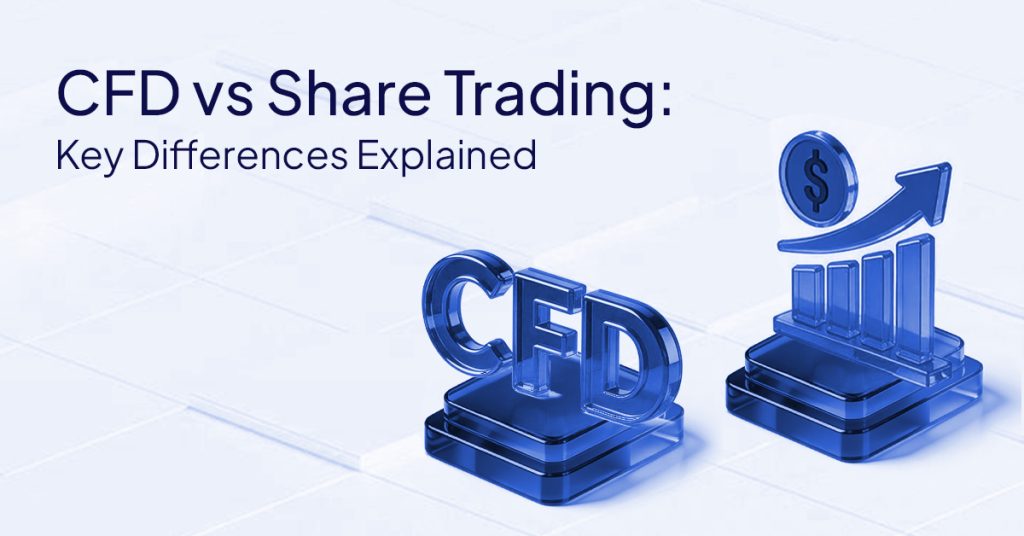
The key notable difference is that share trading involves ownership of a company’s shares. In contrast, CFD trading involves speculating on price movements without actually owning the underlying asset.
Why do traders want to make money out of the downfall of a company, instead of creating success?
The ease of derivatives has also altered how market participants handle financial markets, although traditional investing is aimed at growth.
This guide will break down CFDs vs. share trading to help you determine which instrument fits your financial objectives.
- Note: The financial laws governing CFDs are quite region-specific. For example, CFDs can be readily sourced in the UK, Europe, and Australia, but not for US residents due to SEC regulations. Make sure you follow the rules specific to your jurisdiction.
Quick Answer: The Core Differences
Share trading is the buying and selling of a company’s real stock on a stock exchange, such as the NYSE or the NASDAQ. You are a part-owner of the company; you can receive dividends and vote on corporate matters. Changes in prices and dividend payments are your profit or loss.
CFD trading (Contract for Difference) refers to the process of entering into an agreement based on an asset’s price, without owning the asset. You guess the price will go up or down and frequently leverage them, which increases both the profits and losses. You do not receive dividends and voting rights.
Three core differences:
- Ownership – Shares provide ownership; CFDs do not.
- Leverage – CFDs are typically leveraged; share trading usually is not.
- Risk profile – CFDs are riskier because they involve leverage and can lead to rapidly accelerating losses.
Disclosure: This article is purely educational, and it does not provide investment advice.
| Feature | Share Trading | CFD Trading |
| Ownership | Yes (Stockholder) | No (Contract holder) |
| Leverage | Usually None (1:1) | Often Available |
| Ability to Short | Limited/Complex | Built-in |
| Typical Holding Period | Medium to Long Term | Short to Medium Term |
| Cost Structure | Commissions/Fees | Spreads + Financing |
| Risk Profile | Generally Lower | Generally Higher |
What Is Share Trading, in Simple Terms?
Share trading refers to buying and selling the ownership units of a publicly listed company on a stock exchange.
When you purchase stock (synonymous with stock or equity), you are purchasing the smallest portion of that company. This entitles you to certain rights depending on the type of share you bought.
In the vast majority of cases, common stock consists of a claim to the company’s assets and profits on the equity side.
Such a strategy would usually be linked with investing. Investors purchase shares that they believe the firm will expand over the years or decades.
How Share Profit and Loss Works
When you are trading shares, your loss or gain mainly depends on two factors:
- Capital Gains: When the prices of the shares increase above the price at which you purchased them, then your investment grows. You make this profit on sale.
- Dividends: A large number of successful firms pay out some of their profits to their shareholders in the form of cash. This will give a source of income when the share price is not moving.
In 2025, 64% of U.S. investors held stocks as their core investment holdings, and dividend-paying stocks remain especially popular among long-term investors interested in passive income and capital gains.
What Is a CFD and How Does CFD Trading Work?
A Contract for Difference (CFD) occurs when a financial contract is established between a trader and a broker, and the difference in the value of a given asset is negotiated over the period between opening and closing the trade.
You are buying or selling CFDs, which are contracts specifying how the price of an underlying asset (such as a stock, commodity, or index) will move.
The asset is never purchased or held in store. This is referred to as a derivative because its value is based on the real market.
Leverage is a characteristic of CFD trading. This enables traders to take a prominent position, which is much larger than the amount they deposited to open a position (margin).
An illustration may include this: with a 5:1 leverage, a $1,000 deposit may create a $5,000 exposure in the market.
What “Going Long” and “Going Short” Mean.
The fact that you are dealing with a contract, and not a physical asset, allows you to speculate on both sides of the market easily:
- Going Long (Buying): You open a position when you expect the price to rise.
- Going Short (Selling): You go short (sell) when you think that the price will fall. You make a profit when prices fall, and you lose when prices rise.
Important: Leverage can increase profits but also magnify losses. Some brokers can make you lose more than you invested with them. However, some jurisdictions require negative balance protection; availability depends on the provider and local rules.
What’s the Difference Between CFD Trading vs Share Trading?
The primary distinctions are the ownership of assets, the leveraging of exposure, and the structure of the costs involved in the trade.
When comparing trading CFDs versus share trading, it is crucial to take a look at the price chart. The mechanics of market entry and the risks involved are entirely different.
- Ownership vs. Contract: Shareholders are owners. CFD traders are contract owners of a broker.
- Leverage: Stock trading is usually done using cash (1:1). CFD trading is typically done on a margin, that is, you need to deposit only a small percentage of the trade value.
- Shorting: It is difficult to sell a share that you do not own. Under CFDs, short-selling is as easy as long-selling.
- Holding Period: The holding period of shares is years. Because of the overnight costs, CFDS are usually held for days or weeks.
Side-by-Side Summary
The table below breaks down the differences as practiced to help you visualize the comparison.
Table 1: CFD vs Shares Comparison
| Feature | Share Trading | CFD Trading |
| Ownership | Yes | No |
| Leverage | Rare (Cash accounts) | Common |
| Short Selling | Limited availability | Built-in capability |
| Typical Holding Time | Longer-term (Years) | Shorter-term (Days/Weeks) |
| Typical Costs | Commissions, custody fees | Spreads, overnight financing |
| Risk Level | Moderate | Higher (due to leverage) |
| Who It Suits | Long-term investors | Active traders/Speculators |
To learn more about how trading works, you can check out the CFD vs Share trading learning materials that are offered at STARTRADER.
Do You Own the Asset When You Trade CFDs?
No, in the process of trading a CFD, you do not ever own the underlying asset.
Specific implications occur due to this lack of ownership which include:
- Voting Rights: You do not vote in the Annual General Meeting (AGM) of the company since you are not a shareholder of the company.
- Transferability: It is not possible to transfer the CFD position to a different broker or individual; you have to close the contract with the broker with whom you opened it.
How Corporate Actions May Be Reflected in CFD Pricing
Although you do not own the stock, corporate activities such as dividend payments can affect the prices of CFDs.
When you have a long CFD on a dividend-paying company, you will be expected to receive a cash adjustment in your account. On the other hand, when you are in a short position, you will be debiting that.
How Do Costs Compare for CFDs and Share Trading?
Share trading is usually front-loaded (commissions), whereas CFDs are usually spread and ongoing (financing fees).
It is crucial to understand the fee structure to be profitable. It can absorb margins, particularly for regular traders.
Typical CFD Costs
- Spread: The difference between the sell and buy prices. That is where brokers usually earn commission from free accounts.
- Overnight Financing (Swap): Since you are leveraged (borrowing money to trade), you will be paying interest on the amount you were borrowing as long as you are holding the position after a specific time that day (usually 5 PM EST).
- Commission: Some brokers charge a commission on Share CFDs.
The volume of margin debt (leverage applied by retail investors) in the United States is reported to have hit a record $1.2 trillion towards the end of December 2025, indicating the extent to which retail traders are leveraging.
Typical Share Trading Costs
- Trading Commission: Included is a flat fee or a percentage fee, which is charged when selling or purchasing the stock.
- Custody/Platform Fees: Some brokers will ask you to pay a fee every month (annually) to hold your assets.
- Currency Conversion: When you purchase US stocks using a UK account (say), you incur FX charges.
Mini-Checklist: Fees to Check Before Trading
- Is it a commission based on trade?
- How vast is the spread?
- What is the overnight trading rate? (Crucial for CFDs)
- Are there inactivity fees?
Is CFD Trading Riskier Than Share Trading?
Yes, CFD trading is generally regarded as high risk compared to share trading, mainly because leverage is used.
Research conducted by the UK Financial Conduct Authority (FCA) found that a significant number of retail accounts incur losses when trading CFDs. The distinguishing variable is the rate of capital loss.
The European Securities and Markets Authority (ESMA) reports that retail CFD accounts are losing money at rates of 74-89%, with the overall average loss rate for the largest brokers being 76% as of 2024.
Why Leverage Changes Outcomes
A leverage is a multiplier. Assuming you are trading on a 10:1 leverage, a 1% market movement affects your equity by 10%.
- Share Trading: In case of a stock plummeting by 10%, then you lose 10% of the value of your investment.
- CFD Trading (10:1 leverage): When the underlying decreases by 10%, there is the risk of losing 100 percent of your original margin.
Risk Tools Beginners Should Understand
Traders need to use risk management tools to control these risks.
- Stop-Loss Orders: These automatically sell or buy your trade when the market moves in the opposite direction.
- Position Sizing: This is because you should never risk more than 1-2% of your total account balance on any one trade.
Those interested in watching these tools in action can refer to the STARTRADER market analysis to understand the context of modern market volatility.
Can You Hold CFDs Long Term?
Although technically feasible, long-term retention of CFDs is not particularly effective, as financing costs would be incurred overnight.
Every night you hold an open leveraged CFD position, you pay a financing fee. These charges can easily kill any profits in the course of weeks or months.
When Shares May Be More Practical for Long Holding Periods
Share trading is nearly always the more practical option if you want to invest for six months, one year, or ten years.
After paying the initial commission, the costs are usually not expensive to keep your ownership daily. All you have to do is wait until the business grows by holding the certificate (digitally).
What Account Do You Need for CFDs vs Shares?
A share-dealing account is designed to hold and own, whereas a CFD account is designed to trade on margin and speculate.
The first thing to do is decide between a CFD and a share trading account when implementing your strategy.
What “Share Dealing/Brokerage Account” Usually Means
- Cash-based: You will typically be required to purchase the stock with all the cash.
- Settlement: It can legally take 2 days (T+2) to settle a trade.
- Safety: Assets are often segregated and held in your name or in a nominee account.
What a “CFD Trading Account” Usually Includes
Margin Settings: Settings can be adjusted based on leverage (e.g., 1:10, 1:30) depending on the asset class.
- Instant Execution: Speedy.
- Shorting Capability: The interface enables the Selling feature as readily as the Buying feature.
- Note: Many current brokers offer so-called hybrid accounts, which let you have both types of instruments on the same dashboard, but they are legally separate wallets.
How Do You Decide Which Approach Fits Your Goal?
This choice must depend on the length of your time horizon and degree of risk: shares to grow and CFDs to move around.
It is not a matter of the best tool but rather the tool to use.
Investing vs Active Trading (Decision Mini-Tree)
Share trading is usually more consistent with that objective if you want to build long-term wealth by becoming a company owner.
Long-term investors were concerned with:
- Constructing retirement portfolios.
- Collecting dividend income
- Engaging in business expansion over the years.
- Taxation on long-term capital gains on a favorable basis.
Share dealing offers ownership, does away with daily funding expenses, and even unlimited holding.
CFDs can be appropriate for your strategy if your goal is to take advantage of short-term price fluctuations through active speculation.
Active traders focus on:
- Capturing moves in days and weeks.
- Buying and selling in increasing and decreasing markets.
- Raising returns through leverage.
- Short-term trends and technical analysis.
CFD trading offers built-in shorting, leverage, and flexibility for short-term strategies.
This decision tree is not absolute; every trader uses both instruments to do various tasks. Nevertheless, it offers a starting point you can build on to achieve your primary goal.
Beginner Starting Point
Whereas, when you are new to markets, education is the priority. STARTRADER has many successful traders who start with a demo account, practice trading strategies with virtual money before risking their real capital.
This gives you a chance to experience firsthand the difference between the two trading margins and cash trading.
FAQs
The chief distinction is ownership. Trading is done in the actual stock in share trading, whereas CFDs are contracts that depend on the price movement of the actual stock.
Trading shares is usually regarded as more appropriate for novices, since leverage is not used; therefore, it is easier to comprehend and manage risks. CFDs need more knowledge of margin and risk management.
No. The broker has a contract with you. You are not a direct or voting member or shareholder of the underlying company.
CFDs usually charge an overnight financing fee or a swap fee if you hold the position past the daily settlement time. This daily fee is not usually a part of share trading.
Conclusion
The difference between CFD trading and share trading is as simple as understanding your own market profile.
Share trading offers you the stability and ownership that you require as an investor who wants to accumulate wealth over the years by investing in robust firms.
But when you are a busy trader interested in hedging a portfolio, or speculating on short-term action in both an upward and a downward market, CFDs provide the freedom and leverage of doing it.
It is to be remembered that availability is regional, and all trading is risky. Before opening a position, you need to know the expenses and the risks.
Tags


Open Live Account
 Email Address
 Phone Number
Important Notice
STARTRADER does not accept any applications from Australian residents.
To comply with regulatory requirements, clicking the button will redirect you to the STARTRADER website operated by STARTRADER PRIME GLOBAL PTY LTD (ABN 65 156 005 668), an authorized Australian Financial Services Licence holder (AFSL no. 421210) regulated by the Australian Securities and Investments Commission.
Important Notice for Residents of the United Arab Emirates
In alignment with local regulatory requirements, individuals residing in the United Arab Emirates are requested to proceed via our dedicated regional platform at startrader.ae, which is operated by STARTRADER Global Financial Consultation & Financial Analysis L.L.C.. This entity is licensed by the UAE Capital Market Authority (CMA) under License No. 20200000241, and is authorised to introduce financial services and promote financial products in the UAE.
Please click the "Continue" button below to be redirected.


