








 Web Trader MT5







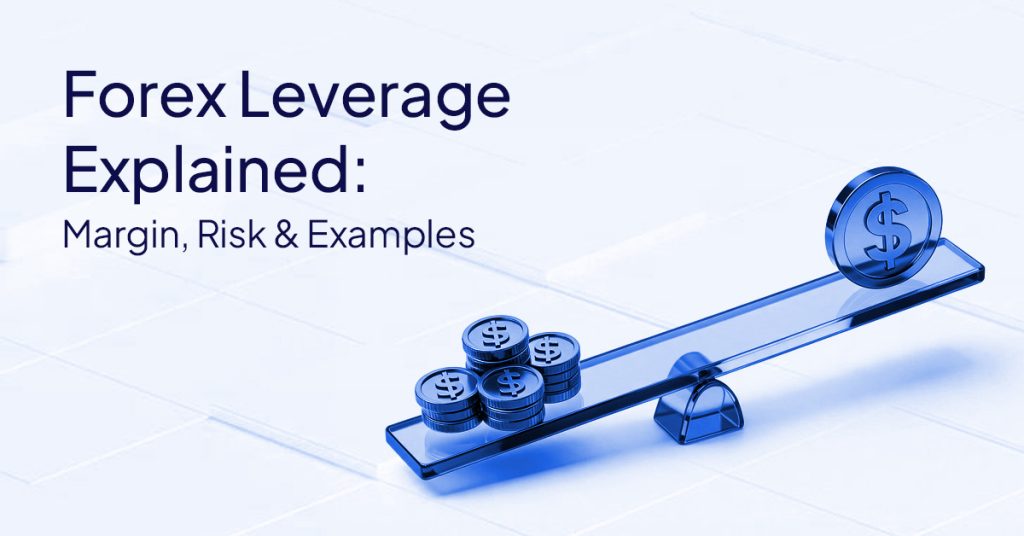
Forex leverage, explained in simple terms, implies that you use little of your own money to manage a very large trading position.
However, what about the fact that the very thing that was meant to increase your purchasing power may wipe out your trading account within a few seconds?
Forex trading is a mind-boggling venture, particularly when one is introduced to terms such as leverage, margin, and exposure in the early stages. This is a simple, plain-language guide for new or intermediate traders to help understand these concepts.
You will get to know how leverage works, why it is applied, and why the risks which are involved are critical. This guide can help you follow these basic mechanics without complex explanations or complicated examples so that you can apply them to your trading experience.
Quick Answer
Forex leverage is a financial tool that enables you to manage a large amount of currency with a low initial capital.
It will be a multiplier, giving you greater market exposure. Although it will enable you to take larger positions and even multiply your profits, it will also increase your potential losses. Leverage is normally expressed as a ratio (e.g., 1:30 or 1:100), which represents how bigger your trade position is in relation to the amount of money needed.
What Is The Meaning Of Leverage In Forex?
Forex leverage is the ability to handle a larger trade size with a smaller amount of initial capital.
Leverage is, in common words, a multiplier to your trading position. Thanks to your broker, you do not have to pay the full amount in the currency; instead, you make a down payment.
- Ratios measure your power to buy: Leverage is always expressed as a ratio. You will often encounter such figures as 1:30, 1:100, or even 1:500. A 1:100 ratio implies that with every dollar that you deposit, you can manage 100 in the currency market.
- An increase in the ratio implies an increase in exposure: The more the second figure in the ratio, the more positions you can open with the same amount of money. This will translate to drastically increased exposure to price movements.
- It is not a sure way to make money: It is imperative to note that leverage simply intensifies results. It will increase your purchasing power, but it does not improve your market accuracy.
The leverage meaning in forex trading is finally about enhancing capital efficiency. You would not need the full value of a cash trade. You would need only a small part, called the margin.
Leverage limits are closely regulated by bodies such as the Commodity Futures Trading Commission (CFTC) due to the potential for it to rapidly amplify financial results.
The CFTC caps US retail forex leverage at 50:1 for major pairs and 20:1 for minor pairs, directly reflecting the regulator’s consumer protection mandate.
How Does Forex Leverage Work In A Simple Example?
Forex leverage is used to fill the difference between your small deposit and the huge standardized contract sizes which are traded in the global currency market.
To actually see how this multiplier effect works in real time, consider the math. There is no need to worry. Computations are easy and necessary for your daily risk management.
A Basic Forex Leverage Example
Suppose you intend to trade US Dollars against euros, but you do not have thousands of dollars to spend.
- Deposit: $100
- Leverage Ratio: 1:100
- Total Position Size: $10,000
- Required Margin: $100
This demonstrates forex trading leverage in some very real-world conditions. You can manage a $10,000 market position with a small deposit of just $100. Your broker provides the remaining $9,900 needed to open the trade.
What Happens When The Market Moves Up Or Down?
Since you hold $10,000 in currency, each price movement is computed using the entire $10,000, not the $100 deposit.
- Assuming that the market shifts in your favor by +1%: 1% on a value of $10,000 will give you $100. You have just earned 100% on your initial investment of $ 100.
- When the market has fallen by -1% against you: A 1% decline on a $10,000 position will translate into a loss of $100. All that you have invested initially is gone.
The slightest price movements can have a significant effect on your account balance due to leverage. Even a 1% shift in the wrong direction will result in the complete loss of the available margin committed to that specific trade.
What Is The Difference Between Leverage And Margin?
Whereas leverage is the multiplier that gives you an increment in your buying capacity, margin is the money that you need to deposit and start the multiplier.
This segment maintains the explanation of forex leverage and margin simply because the two terms are often confused by many beginners. They represent two sides of the very same coin.
What Leverage Ratio Means
The leverage ratio shows the size of your trade relative to your deposit. It is the theoretical multiplier. Assuming a leverage of 1:50, then you have trading power that is fifty times larger than your cash balance.
What Margin Requirement Means
The amount of money required to open and hold a leveraged position, and to maintain it, is called margin. It is neither a fee nor a transaction cost. Rather, consider it as a good-faith security deposit which your broker holds away as long as your trade is open.
When you close the trade, that margin portion is brought back into your available balance, whether you made any losses or not, or whether you had a profit or not.
Mini-Table: Leverage Vs Margin
| Concept | Meaning | Example |
| Leverage | Multiplies your market exposure | 1:100 |
| Margin | The cash deposit required to open a position | $100 deposit for a $10,000 trade |
Why Do Forex Traders Use Leverage?
Traders use leverage because currency prices usually change in microscopic fractions of a cent, and to make significant returns, the trade size has to be large.
Leverage would make it so capital-intensive to play in the forex market without it. One hundred thousand units of currency constitute a standard lot in the forex market. There are very few independent traders who can post a single trade for $100,000 in cash.
- Gain a larger market share: Leverage enables common citizens to engage in currency exchange in the world marketplace, as well as big banks and financial institutions.
- Enhance capital efficiency: You can have the rest of your capital liquid only by committing only a fraction of your capital to margin. This will enable you to invest your balance in other ventures or maintain it as an emergency fund.
- Be involved in low-volatility opportunities: Since major currency pairs (such as EUR/USD) can move by less than 1% per day, leverage allows traders to take advantage of such small price changes.
According to figures from the Bank for International Settlements (BIS), the forex market transacts in trillions of dollars a day, and most transactions depend on leveraged capital to maintain liquidity.
Important Reminder: This is also accompanied by increased downside risk due to increased exposure. The sword cuts both ways.
Why Can High Leverage Be Risky In Forex?
High leverage is risky, as it can rapidly erode the capital you have invested during normal market fluctuations.
The good side is desirable, but the bad side is where uninformed traders are caught. The following is a breakdown of the involved risks.
Faster Losses
Even very small market moves can lead to significant losses. Assuming a leverage of 1:500, even a 0.2% market movement that is adverse to your position will cause the loss of 100% your margin. In unstable markets, a 0.2% shift can occur within seconds.
Margin Calls or Forced Closure Risk.
In case you have a floating loss that is greater than the available margin within your account, you will have a margin call. This indicates that your account balance is critical. If the market keeps falling, the broker’s system will trigger a stop-out or a forced shutdown. Your broker shall automatically sell your active positions to avoid bringing your account to a negative balance.
Emotional Overtrading
An increase in leverage may lead to unplanned decisions and inefficient risk management. Greed can easily overcome traders when they view huge, fast earnings. On the other hand, when they experience high losses, panic will ensue. Such an emotional rush often leads to the so-called revenge trading: traders add more leverage to the trade to recoup lost funds, and this often just blows the account.
How Can Beginners Use Leverage More Carefully?
An inexperienced investor can safely use leverage as a capital-efficiency tool, rather than a lottery ticket for overproportionately large returns.
Risk management is all about responsible trading.
To survive the learning curve, you should have strict rules on the amount of exposure that you are taking.
Start With Smaller Exposure
Limit risk using lower leverage ratios. Your broker is giving you 1:500, but you do not necessarily have to use it. Another popular method used by many traders to ensure a temporary market pullback never stops them out is to manually keep their leverage at 1:10 or 1:20.
Focus On Position Sizing
Take a risk with a little capital at a time. One general rule of thumb for professionals is that they should not run a setup with a risk above 1 to 2% of the entire account balance. Position sizing ensures that your account is not subject to a series of losses.
Use Stop-Loss Rules
Defend your points of exit to limit possible losses. A stop-loss is an automated trade which trades you off at a threshold value. By determining the amount of money you are prepared to lose by the moment you get into a trade by specifying a stop-loss, you take the emotion out of it, and you can decide on the amount of money you are prepared to lose.
Practice On Demo Before Increasing Leverage
Have a feel of what it is like without putting money into it. A STARTRADER demo account will give you time to get a feel for the pace at which leverage trades are conducted in a simulated, zero-risk environment. Trade, manage, and set stop-loss, and manage margin requirements without you ever putting down a penny.
What Should Traders Check Before Using Forex Leverage?
Traders should always use a rigorous risk management checklist to determine their total financial exposure before hitting the buy or sell button.
You must be able to answer the following technical questions before executing a leveraged trade. Not taking this step is the quickest way to create an unexpected margin call.
- Ratio leverage that is being used: Have the exact account or trade multiplier.
- Margins required on the trade: Determine the actual amount of money that will be tied up as a deposit.
- Stop-loss strategy in action: It is important to determine the exact price at which your trade will automatically close if the market is working against you.
- Monitor market volatility: Track economic calendars for key news (such as inflation announcements or central bank rate changes) that may trigger impulsive, violent price action.
- Maximum acceptable loss per trade: This is to ensure that the dollar value to be incurred is in tandem with your 1-2% risk rule.
FAQs
It is a financial tool through which traders can control bigger trading positions with a significantly lower amount of initial capital. It is a multiplier for your purchasing power.
The leverage meaning in forex is the using of the borrowed exposure of your broker as an amplification of the trade size of your real cash capital.
You can trade 10,000 units of currency only at 1:100 leverage. The effect of even very minor price changes on your account balance will be multiplied significantly by this multiplier.
The mathematical multiplier is leverage (e.g., 1:50 or 1:100), while the real cash deposit the broker requires to open a trade using leverage is known as the margin.
Conclusion
Anybody venturing into the international currency market must have a perfect understanding of leverage.
Although it will provide the exclusive opportunity to expand market presence and the possibility of higher returns, it will certainly entail a significantly greater financial risk.
By understanding precisely how leverage and margin interact, and by practicing prudent, disciplined risk management, traders can put leverage to more responsible use.
Assuming you are willing to see how margin and exposure work in real time without risking your own money, consider opening a STARTRADER demo account to practice trading with a safe account.
Tags


Open Live Account
 Email Address
 Phone Number
Important Notice
STARTRADER does not accept any applications from Australian residents.
To comply with regulatory requirements, clicking the button will redirect you to the STARTRADER website operated by STARTRADER PRIME GLOBAL PTY LTD (ABN 65 156 005 668), an authorized Australian Financial Services Licence holder (AFSL no. 421210) regulated by the Australian Securities and Investments Commission.
Important Notice for Residents of the United Arab Emirates
In alignment with local regulatory requirements, individuals residing in the United Arab Emirates are requested to proceed via our dedicated regional platform at startrader.ae, which is operated by STARTRADER Global Financial Consultation & Financial Analysis L.L.C.. This entity is licensed by the UAE Capital Market Authority (CMA) under License No. 20200000241, and is authorised to introduce financial services and promote financial products in the UAE.
Please click the "Continue" button below to be redirected.


