








 Web Trader MT5





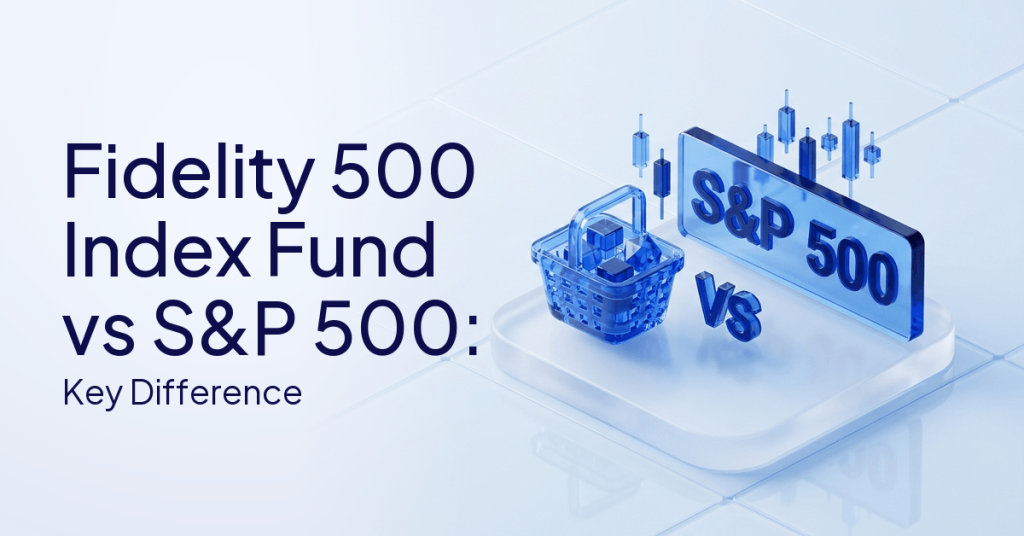
If you’ve ever typed “Fidelity 500 Index Fund vs. S&P 500” into a search bar, you’re probably confused, which is something that happens to a lot of new investors. And to be honest? You aren’t to blame. People talk about investing in a way that makes it harder to understand.
In fact, index funds now hold trillions in investor assets globally, yet many beginners still struggle to distinguish between the funds themselves and the indexes they track.
Here’s the thing — these two terms don’t refer to the same thing, and they’re not really two competing investment options either. One is a product you can actually buy. The other is a measuring stick.
Let’s break it down.
Quick Answer
- The Fidelity 500 Index Fund is an actual investment fund you can buy and hold in your portfolio
- The S&P 500 is a market index, which means it’s a standard, not something you can buy.
- You can’t put money directly into the S&P 500.
- Investors can obtain exposure to the index through funds and ETFs.
- The fund closely follows the index, but it won’t always mirror it completely.
- This is a comparison of a product to a benchmark, not a fund to a fund.
Fidelity 500 Index Fund vs S&P 500: What’s the Real Difference?
The Fidelity 500 Index Fund is an investment product; the S&P 500 is the benchmark it’s built to follow.
Think of it this way: the S&P 500 is like a recipe. It lists the ingredients (companies) and their proportions (weightings). The Fidelity 500 Index Fund is the meal; someone actually went and assembled those ingredients into something you can use.
That is the core difference. Understanding this distinction helps clarify many investing terms
What Is the Fidelity 500 Index Fund?
The Fidelity 500 Index Fund is a type of mutual fund that uses investors’ money to buy stocks in the S&P 500.
The fund does the hard work for you, so you don’t have to choose individual stocks. It automatically divides your money among hundreds of big U.S. firms and different sectors. It also uses a passive strategy, which means it doesn’t aim to beat the market; it merely tries to keep up with it.
This passive approach is commonly used in index investing. Active funds strive to outperform the market, but they don’t always succeed. Index funds try to match it, which is a strategy some investors prefer for long-term exposure.
What Is the S&P 500 Index?
The S&P 500 is a benchmark index that shows how well 500 large, publicly traded U.S. firms are doing, and you can’t buy it directly.
It’s a tool for measuring, not something you can buy and sell. People usually refer to the S&P 500 when they say “the market is up today.” It is used as the standard reference point for U.S. large-cap performance because it accounts for a considerable share of the U.S. stock market’s total value.
You will never see an order form that says “one S&P 500, please.” What you can buy are the funds and ETFs designed to track it.
How Does a Fund Actually Track an Index?
To track an index, a fund tries to copy its holdings and weightings as closely as possible.
The Index Sets the Target
The S&P 500 determines which firms are in the index and how much each one represents. Apple, Microsoft, and Amazon are all in there, with their weights based on market size.
The Fund Follows the Holdings and Weightings
The fund buys similar companies for around the same amounts. This passive copying is what makes index investing easy and affordable.
Why Performance May Be Close, But Not Perfectly Identical
It’s typical for there to be small differences between a fund’s performance and an index’s. They happen because of:
- Costs of running the business and management fees
- Money in the fund that hasn’t been fully invested yet
- There are delays when rebalancing after changes to the index.
Most well-run index funds keep these gaps small, but they do happen. Some investors use “tracking difference” to see how closely a fund tracks its benchmark. Smaller is better.
Can You Invest in the S&P 500 Directly?
No, you can’t invest in the S&P 500 directly because it isn’t a tradable asset.
This is perhaps the most typical mistake that new investors make. When people say, “I invest in the S&P 500,” they usually mean, “I put money into a fund that follows the S&P 500.” When you compare real investment goods, the difference is important.
Here are some ways to obtain exposure to the S&P 500:
- Fidelity 500 Index Fund and other index mutual funds
- ETFs that follow the S&P 500
They both do the same thing. The differences are only in how they’re traded, priced, and structured.
Fidelity 500 Index Fund vs S&P 500: Why Do People Confuse Them?
People get confused because the fund is meant to behave like the index and even shares a similar name.
It’s a fair mix-up. When one item follows another so closely, the lines get indistinct. It’s easy to get confused when financial news uses “S&P 500” to refer to both the index and the funds that track it.
In short, they have similar names and similar performance, but their structures are substantially different.
How Close Should a Fund Be to the Index It Tracks?
A well-run index fund should closely match its benchmark, although slight variations are common and expected.
Benchmark tracking is a way to measure how well a fund performs relative to its underlying index. In an ideal world, the two would move together perfectly. In practice, they don’t do that very often, and that’s not always a bad thing.
There are several reasons why there may be small gaps between a fund and its benchmark. These include the costs of administering the fund, cash that isn’t fully invested at any given time, and the way that the fund rebalances when the index alters its composition. None of these are red flags on their own.
The size of the gap is what matters. A small difference that remains consistent over time generally indicates that the fund is performing its job successfully. A large or growing discrepancy may indicate higher costs, operational inefficiencies, or the fund not following its index as closely as it should.
Investors frequently use a measure called tracking difference to check this. It compares the fund’s real returns to the index over a specified period. The closer that number is to zero, the better the fund is at accomplishing what it says it will.
What Should Investors Compare Instead of Fund vs Index?
Instead of comparing a fund to an index, compare how similar investment products stack up against each other.
Now you might be wondering: okay, so what should I be comparing? Good question. Here are the comparisons that actually make sense:
Fund vs Fund
When comparing among S&P 500 index funds, investors typically review how much they cost, how closely they track the index, and how they are structured. Over time, small changes in cost might add up to big amounts.
Fund vs ETF
A mutual fund and an ETF can both track the same index, but they trade at different prices and require different investment amounts. It’s important to know this before you commit.
Index Fund vs Total Market Fund
This is an interesting one. For example, the comparison between the Fidelity Total Stock Market Index Fund and the S&P 500 isn’t about which one is “better”; it’s about the scope.
A total market fund holds stocks of all sizes, from tiny to large, offering more variety and a slightly different risk profile.
What Should Beginners Check Before Buying an S&P 500 Index Fund?
Before investing in a fund, it is common for investors to review what it aims to do, how much it will cost, and that it fits your schedule.
This is straightforward, but investors may consider reviewing:
- Does the fund clearly say that it follows the S&P 500?
- What is the expense ratio? (Over time, even tiny differences can make a difference)
- How often does the tracking history change?
- Is it a mutual fund or an ETF? Which one may better suit different investment approaches
- Is the investment time frame in line with your own financial goals?
S&P 500 index funds are a core holding for many long-term investors because they provide broad exposure with minimal decision-making. That’s not a guarantee of returns; it’s merely a good place to start for many portfolios.
Frequently Asked Questions
You can invest in the Fidelity 500 Index Fund. It tracks the S&P 500, the benchmark index. One is a product, and the other is a measurement tool.
No, the Fidelity 500 Index Fund is not the same as the S&P 500. The fund follows the index, but they are not the same thing.
No. You invest through funds or ETFs that track it.
Costs, cash holdings, and timing discrepancies produce modest gaps, which is usual for any index fund.
You can compare funds with other funds, ETFs, or total market funds.
Check the fund’s goal, expense ratio, tracking history, and whether it fits with your investment timeframe.
Yes, that comparison is about how well the market is covered, not how well the fund does compared to the benchmark. Total market funds have companies of all sizes, not just large-cap ones.
Final Thoughts
To answer the question of the Fidelity 500 Index Fund vs. the S&P 500, you need to understand the language of investing. When you remove the idea of a benchmark from the things that are created around it, everything else becomes easier to understand.
You will be able to read prospectuses more clearly. You will be able to compare funds more precisely. And you won’t be confused if someone says, “I invest in the S&P 500,” since you’ll know what they really mean.
It’s a modest change in how you think, but it lays the groundwork for making better decisions over time without having to question the essentials every time you come across them.
Risk Disclaimer
This content is intended for general educational purposes only. Certain investment products referenced, such as mutual funds, are not offered by the company. Clients should refer to the company’s official product offering for available instruments.
Nothing in this article constitutes financial advice. Past performance is not a reliable indicator of future results. Always consider your personal financial situation and seek independent professional advice where necessary before making investment decisions.
CFD Risk Warning:
CFDs are complex instruments and come with a high risk of losing money rapidly due to leverage. You may lose more than your initial investment. You should ensure you fully understand how CFDs work and consider whether you can afford to take the high risk of losing your money.
Tags


Open Live Account
 Email Address
 Phone Number
Important Notice
STARTRADER does not accept any applications from Australian residents.
To comply with regulatory requirements, clicking the button will redirect you to the STARTRADER website operated by STARTRADER PRIME GLOBAL PTY LTD (ABN 65 156 005 668), an authorized Australian Financial Services Licence holder (AFSL no. 421210) regulated by the Australian Securities and Investments Commission.
Important Notice for Residents of the United Arab Emirates
In alignment with local regulatory requirements, individuals residing in the United Arab Emirates are requested to proceed via our dedicated regional platform at startrader.ae, which is operated by STARTRADER Global Financial Consultation & Financial Analysis L.L.C.. This entity is licensed by the UAE Capital Market Authority (CMA) under License No. 20200000241, and is authorised to introduce financial services and promote financial products in the UAE.
Please click the "Continue" button below to be redirected.


