








 Web Trader MT5










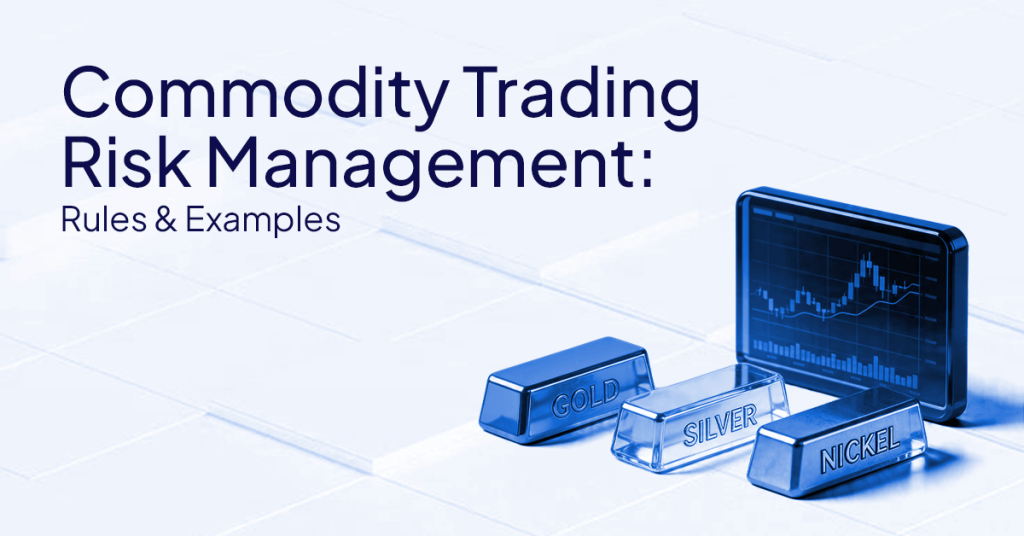
Commodity trading risk management refers to the rules, limits, and procedures that traders implement to ensure their capital is not exposed to market volatility and to reduce losses.
Why is so much of the attention of traders devoted to the question of picking winners when the future of the commodities business rests on managing the losers almost solely?
Although it is thrilling to study the charts of gold or oil, risk control is what makes a trader stay in the game long enough to learn.
This article dissects the fundamental structures of US retail traders and focuses on the practical rules of the job.
Quick Answer: Core Risk Management Rules
Risk management in commodity trading focuses on controlling losses before making a profit. The main rules that are adhered to by experienced traders are:
- Risk Per Trade: Risk only a fixed and small amount of capital per trade.
- Stop-Losses: A hard stop-loss should always be used at a logical invalidation point.
- Position Sizing: Sizing positions according to your risk limit, and not your belief level.
- Exposure Limits: Have a limit on total exposure to correlated commodities (such as Gold and Silver).
- Drawdown Control: Monitor the drawdowns and minimize the size of trades as soon as the losing streak occurs.
What is Risk Management in Commodity Trading?
Risk management in commodity trading is the art of identifying, analyzing, and mitigating potential losses to ensure trading continues for a long time.
Fundamentally, it is a defensive trading strategy for your account. It entails establishing any limits in the degree to which you are prepared to lose on a single deal and the degree of exposure you bear in general.
In the absence of these boundaries, the natural volatility of commodities can result in irreparable losses.
Risk Management vs “Strategy”
Beginners tend to mix their trading strategy with their risk management plan, which are not related to each other:
- Trading Strategy: This is a time when you invest and exit the market. It includes your technical analysis, setups, and indicators.
- Risk Management: This is how to live, should you be wrong about your strategy. It discusses position sizing, stop-loss placement, and capital preservation.
Why is Risk Management Commodity Trading’s Biggest Skill?
Commodity trading risk management is more sensitive than in other markets due to extreme volatility, leverage, and event sensitivity, which combine to magnify every error.
Commodities do not move as well as stocks or forex pairs. Oil moves 5% higher overnight amid geopolitical news. Gold can turn intraday on a single comment from the Federal Reserve.
Natural gas can move 10% in a session when supply is reported. These are not exceptional occurrences; they are common in commodity markets.
According to the CME Group volatility report, energy and metals contracts are consistently among the most volatile instruments across global derivatives markets.
The volatility creates an opportunity, and the whipsaw punishes careless risk-taking at an unusually rapid pace.
Common Reasons Commodity Traders Blow Accounts
- Overleveraging: Excessive leverage, which magnifies small market swings into huge account percentage losses.
- Trading without stops: You wish you could get back on a losing trade, instead of taking a small loss.
- Revenge trading: Employing more trades in order to recover the money at the earliest as soon as one incurs a loss.
Note: Educational statistics provided by the CFTC state that you can lose as much as you can gain on leverage, and, thus, end up with huge losses when compared to your original investment.
What Are the Main Risks When Trading Commodities?
The key risks will be market volatility, over-leverage, liquidity crunch in off-hours and unexpected macroeconomic events.
The knowledge of these particular threats assists in creating a more powerful defense.
- Market Risk: This refers to the risk that the price moves against you. Commodities are usually trendy but have a tendency to take a sharp correction.
- Leverage /Margin Risk: Commodities are commonly traded on margin. Even though this raises the buying power, this will also imply that you can lose a lot of capital even with a slight price fluctuation.
- Liquidity and Spread Risk: When it is time to close the market or when it is a holiday, the market may result in a dry-up of the liquidity. The spreads (the difference between the sell and buy prices) may widen tremendously.
- Event Risk: Immediate volatility can be occasioned by scheduled releases (such as US Inflation data) or unscheduled releases (geopolitical tensions).
Why Gold and Oil Behave Differently
Different commodities have dissimilar risk profiles. Gold has been considered a safe haven and can increase when stock markets decline.
On the other hand, Oil is closely interconnected with economic development and the supply chains in the world.
These drivers are important to know when using such retail trading platforms as STARTRADER to access such markets.
How Much Should You Risk Per Trade When Trading Commodities?
The majority of educational materials recommend committing a small but definite percentage of your account capital to any one trade in order to survive losing streaks.
The number does not exist, but the goal is survivability. When you take on too much risk, a typical losing streak (which is common to all traders) will mathematically make it impossible to recover.
The “Risk Per Trade” Rule
One of the general referents is the 1% to 2% rule. This implies that once you have an account worth 10,000 dollars, you should not lose it to the tune of $100-$200 in a single trade setup. This means that in case of 5 losses in a row, you will still have most of your capital to trade.
The Hidden Risk of Correlated Positions
Risk does not concern itself with a single trade, but rather the overall exposure.
- Multiple Commodities: When you are investing in commodities such as Gold and Silver, you will probably be doubling your risk in the same directional perspective (Precious Metals).
- USD Exposure: The majority of commodities are USD-priced. By betting against the Dollar on more than one pair, you are taking on more correlation risk.
How Do You Size a Position in Commodities Step by Step?
Position sizing is determined by dividing the amount of maximum risk that you have had by the distance to your stop-loss.
Your position size should never be established on the confidence level you have concerning a trade. It has to be a mathematical computation.
The Formula:
- Position Size = Account Risk Amount/Stop Loss Distances
Worked Example
Le’s say you are trading Spot Gold (XAU/USD).
- Account Balance: $10,000.
- Risk Rule: 1% ($100 risk).
- Entry Price: $2,050.
- Stop-Loss Level: $2,045 (Distance = $5).
- Calculation: 100 Risk/5 Distance = 20 Ounces (or 0.20 Lots).
Here, when the price reaches your stop-loss then you lose what you planned, which is just $100.
Where Should You Place a Stop-Loss in Commodity Trades?
A stop-loss ought to be at that certain point in the market when your trade notion becomes null, and not at a random dollar value.
It is an error to place a stop-loss too tightly since you desire to trade a greater size. Price structure is what the market is all about, not how much you have in your account.
Common Stop-Loss Placement Concepts
- Below/Above Swing Points: This is the position of the stop that is placed slightly above or below the recent high or low.
- Beyond Key Levels: This means the stop should not be placed within a major support or resistance area.
- Volatility-Aware: Relying on an indicator of mean movement (such as ATR) to make sure that the stop is beyond normal market noise.
Mistakes to Avoid
- Stops being too close: Stops which are too close in the volatile market, such as Crude Oil, tend to get stopped out before the move occurs.
- Widening stops: Do not move a stop-loss to avoid a loss. This nullifies your position-sizing calculations and adds risk.
Which Commodity Trading Risk Management Strategies Actually Reduce Drawdowns?
Some effective strategies include setting a daily loss limit, reducing position size during downturns, and focusing on a single market.
The rules should trigger an alert when things are going wrong, rather than when they are going right, to support effective commodity trading risk management strategies.
Maximum Loss Per Day or Week
Set an account circuit breaker. For example, when you lose 3% of your account in one day, you will stop trading for 24 hours. This would eliminate emotional decision-making.
Risk Scaling After a Losing Streak
When you have a drawdown (that is, when you lose 5% of your total balance), then definitely halve the amount of risk you take in any single trade (for example, 1% to 0.5%) until your performance comes back to normal.
One-Market Focus Rule
Investing in a single commodity, such as Gold or Natural Gas, will enable you to become familiar with its own volatility patterns and daily cycles, which will reduce the chances of being spread too thin.
Trade Plan Checklist
A physical checklist will eliminate impulse trades. When a setup does not satisfy all the conditions, the trade will be skipped.
How Do You Build a Commodity Trading and Risk Management Plan?
A solid plan captures your market selection rules and particulars, risk parameters, entry criteria, and post-trade review procedures.
When you come up with your strategy of trading in commodities and how to manage your risks, your plan becomes your business plan. It eliminates confusion during a heated situation.
6-Part Plan
- Traded Markets: Be specific on what you trade (for example: “XAU/USD only and WTI oil only).
- Timeframe and Session: Determine when you trade (e.g., New York Session, 8:00 AM – 11:00 AM EST).
- Entry and Exit Criteria: Short guidelines on how to induce a trade.
- Fundamental Risk Policies: Your largest risk per trade, largest daily loss, and correlation.
- Rules News and Events: What you do when you open trades at significant economic releases (e.g., Close all positions 15 minutes before FOMC).
- Review Process: At which point will you review your trade journal?
The First 30-Trades Process
As a beginner, one useful practice is to commit to 30 trades on a demo account, which the bottom line being the perfect application of your risk rules, whether it is a profit or a loss. This develops the discipline habit.
Next Step: You can test using these risk parameters without incurring financial risk on a STARTRADER demo trading environment.
What Metrics Should You Track to Improve Risk Control?
The traders ought to monitor the drawdown percentage, average risk-to-reward ratio, and win rate to objectively assess their risk performance.
Key metrics
- Drawdown: The percentage decrease in the equity peak of your account or portfolio.
- Win Rate: The percentage of profitable trades.
- Average Loss vs. Average Win: You have to make sure that your winning is bigger than your losing on average.
- R-Multiple: The relationship between the amount that you have made and the amount of the initial risk (for example, a 2R trade made twice its amount of risk).
- Expectancy: This is the average in long-run profit (or loss) that you expect to receive on a trade.
Simple Risk Journal Fields
To keep up with this, you have to keep a journal to note:
- Setup type
- Stop-loss distance (in pips/points)
- Position size
- Outcome (in R-multiples)
- Screenshot of the chart on the entry and exit levels.
Risk Management Tables and Checklists
Table 1: Risk Controls Cheat Sheet
| Rule | What it Prevents | Example Setting (Generic) | When to Adjust |
| Max Risk Per Trade | Blowing up on one bad trade | 1% of Account Balance | Lower it during a losing streak. |
| Max Open Positions | Overexposure/Correlation risk | Max 2 simultaneous trades | Reduce if markets are highly correlated. |
| Daily Loss Limit | Emotional/Revenge trading | 3% of Account Balance | Keep consistent; do not increase. |
| News Filter | Volatility spikes/Slippage | No entry 15 min before High Impact news | Adjust based on market sensitivity. |
Table 2: Stop-Loss Placement Guide
| Stop Type | Best Used When | Pros | Cons |
| Structural | Trending markets | Logic-based; hard to hunt | Can be wide, requiring a smaller size. |
| Volatility (ATR) | Choppy/Ranging markets | Adapts to market noise | Can be hit during sudden spikes. |
| Fixed Point | Scalping (Short-term) | Easy to calculate | Ignores market context/structure. |
Checklist: Before Placing a Commodity Trade
- The setup fits the criteria of my written plan.
- Stop-loss is put at a logical invalidation point (not arbitrary).
- My risk limit determines the size of the position.
- The nearest major event risk (High Impact News) is a month away.
- The overall exposure across all open trades is within my capability.
- Trade is recorded with a reason and a screenshot of the chart.
FAQs
Commodity trading and risk management refer to trading volatile commodities such as gold, oil, or agricultural products with position size, stop losses, and exposure limits in order to limit losses. It prioritizes capital preservation over profit maximization and makes drawdown decisions in line with established policies to avoid emotional decisions.
A survivable risk per trade enables you to survive 10-20 consecutive losses without the loss of either a large amount of money or much psychological harm. A small percentage is used by many experienced traders, allowing 20+ losing trades before the major account is impacted, but the exact percentage depends on risk tolerance, account size, and trading frequency. It is all about consistency, taking the risk-per-trade the same, no matter how much one is convinced.
Position size = (Account risk in dollars) divided by (stop-loss distance in dollars per contract). The first step is to determine your maximum possible loss on the trade (such as $100). Second, calculate the distance between your entry and your stop-loss in dollars per contract (assume $500). Finally, divide: $100 ÷ $500 = 0.2 contracts. In case you cannot trade fractional contracts, you have to either change your stop distance or use smaller contract sizes, such as micro contracts and mini contracts.
Beginners ought to initiate stops at price points at which their trade concept is confirmed incorrect under support on long trades, over opposition on short trades. Arbitrary distances should be avoided, such as 50 pips or round numbers that have no structural meaning. The bar that is hit must be a real invalidation: when that is hit, your thesis has failed, and you are out. Begin with broader stops on volatile commodities and reduce position size to maintain constant dollar risk.
Conclusion
The value of commodity trading is there, although volatility should be respected. Risk management is not a backup system; it is the foundation of any professional trader.
When you follow strict guidelines for position sizing, stop placement, and exposure, you stop gambling and start trading.
It is important to remember that the market will never disappear tomorrow. It is your main business to make sure that your capital is present as well.
You can visit the educational trading resources on STARTRADER if you want to check market conditions or test your commodity trading risk management parameters.
Tags


Open Live Account
 Email Address
 Phone Number
Important Notice
STARTRADER does not accept any applications from Australian residents.
To comply with regulatory requirements, clicking the button will redirect you to the STARTRADER website operated by STARTRADER PRIME GLOBAL PTY LTD (ABN 65 156 005 668), an authorized Australian Financial Services Licence holder (AFSL no. 421210) regulated by the Australian Securities and Investments Commission.
Important Notice for Residents of the United Arab Emirates
In alignment with local regulatory requirements, individuals residing in the United Arab Emirates are requested to proceed via our dedicated regional platform at startrader.ae, which is operated by STARTRADER Global Financial Consultation & Financial Analysis L.L.C.. This entity is licensed by the UAE Capital Market Authority (CMA) under License No. 20200000241, and is authorised to introduce financial services and promote financial products in the UAE.
Please click the "Continue" button below to be redirected.


