








 Web Trader MT5









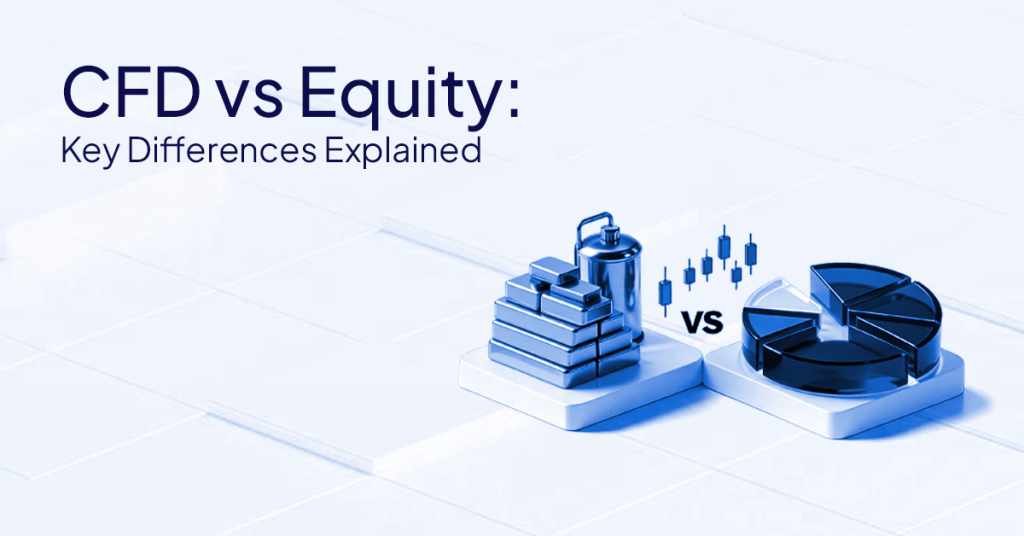
Two people can be “trading the same stock” and doing completely different things. One owns shares. The other holds a CFD. Same company, same price feed, but entirely different instruments, different risks, and different outcomes when things go sideways.
Traders assume CFDs and equities work the same way because they track the same price. They don’t. The differences affect your costs, your rights, your risk exposure, and how long you can realistically hold a position.
This guide clearly unpacks everything. Keep reading to understand CFD vs Equity, the differences between them.
Quick Answer
- Equity means owning actual shares with dividends and voting rights, with no leverage required.
- A CFD tracks the share price without giving you ownership; you trade the price movement using margin.
- CFDs use leverage, which magnifies gains and losses on top of what you have deposited.
- Shareholders receive cash dividends, whereas CFD traders receive a contractual adjustment in lieu.
- The CFDs are easy to short, whereas direct equities are difficult and costly to short.
- Equity swaps are financial instruments and are not structurally similar to retail CFDs.
- The right choice depends on your timeframe, risk tolerance, and goals
What Does “Equity” Mean in Trading?
In the context of cfd vs equity, equity means one specific thing: shares, which are an actual ownership interest in a listed company.
Equity as Shares/Stock Ownership
Buy equity, and you become a part-owner of that business with real, legal rights attached.
That means you get dividends when the company pays them, voting rights on certain decisions, and a stake that grows as the business grows. You’re not just watching a price move; you own something.
The trade-off is simple: you pay the full price upfront, no leverage, no financing charges, no margin calls. Your downside is limited to what you put in.
What Is a CFD and How Does It Relate to Equities?
A CFD (contract for difference) is a derivative that tracks the price of assets like equities, forex, and commodities.
You and your broker agree to exchange the difference in price between when you open a position and when you close it. The asset itself never changes hands.
You Trade Price Movement, Not Ownership
A CFD gives you one thing: exposure to price. Nothing else comes with it.
If the share goes up, your CFD profits. If it drops, you lose. But you’re never a shareholder, so, no rights, no dividends in the traditional sense, no ownership claim.
This is the foundation of the entire CFD vs. equity trading debate, and it’s the distinction everything else flows from.
Equity vs CFD: What’s the Core Difference?
In the equity vs CFD comparison, ownership is the dividing line; shares give you a real stake, while a CFD gives you price exposure and nothing more.
Ownership and Shareholder Rights
Shareholders have legal rights. CFD traders have a contract.
Own shares and you can vote, receive company reports, and engage in rights issues. Hold a CFD on the same stock, and none of that exists. With CFD, you’re only a counterparty to a trade, not a co-owner of a company.
Dividends
Shareholders receive actual cash dividends, while CFD traders receive an adjustment. It looks similar, but it isn’t the same.
Long CFD positions typically receive a cash credit mirroring the dividend. But legally it’s a contractual adjustment, not a dividend. And if you’re short, that amount gets debited from your account.
Leverage and Margin vs Fully-Paid Investing
Shares cost what they cost, but CFDs let you control a much larger position with a fraction of that capital.
Let’s say a share costs $100 and the margin is 10%. You open the position with $10, but profit and loss move on the full $100 exposure. The same mechanism that can double your gain can double your loss.
With shares, you can’t lose more than you invested. With CFDs, you can.
How Do Costs Compare Between CFDs and Equities?
The cost structures are fundamentally different in spread, overnight financing, brokerage fees, and more, and which works out cheaper depends entirely on how you trade.
Spread/Commission vs Brokerage Fees
Equity trades usually involve a brokerage commission, typically a fixed fee or a percentage of the transaction. CFDs typically use a spread model, where the cost is baked into the gap between the buy and sell price.
For short-term trades, that spread can be competitive. For longer holds, spread plus daily financing charges can quietly erode returns.
Overnight Financing
This is the one that catches people off guard most often.
Every night you hold a leveraged CFD open, a financing charge applies. A few days? Barely noticeable.
A few months? It compounds into a meaningful drag on returns, one that simply doesn’t exist if you own the shares outright.
Non-Trading Fees to Watch
Both instruments can carry inactivity charges, currency conversion costs, and withdrawal fees.
If you trade infrequently or hold accounts in multiple currencies, they’re worth checking before committing to any provider.
How Does Risk Differ Between CFDs and Equities?
CFDs carry more risk than equities because leverage means the same price move hits your account much harder.
Leverage Risk and Margin Calls
With shares, your worst case is losing what you paid for them. With a CFD, a sharp move against you can wipe out your deposit and then some. If your account drops below the required margin level, you’ll face a margin call; deposit more funds immediately, or positions start closing automatically.
Gap Risk and Fast Markets
Both instruments are exposed to gaps, but leveraged CFD positions feel them far more acutely.
A gap happens when a market reopens significantly away from where it closed after earnings or surprise news. Stop losses aren’t guaranteed protection here because price can jump clean past your set level, leaving you with a loss well beyond what you planned for.
Counterparty/Issuer Risk
When you own shares, your exposure is to the company. With a CFD, there’s an extra layer, like a counterparty risk. Your position is a contract with your broker, and if the broker runs into serious financial trouble, that matters.
Regulation and client fund segregation are worth verifying before trading CFDs with any provider.
How Is Short Selling Different in CFDs vs Equities?
Shorting shares directly is genuinely complicated, while shorting via a CFD is as simple as placing any other trade.
To short through traditional equity markets, you need to borrow shares, sell them, and buy them back later at a lower price, which involves borrowing fees, availability issues, and real logistical friction.
With a CFD, there’s no borrowing. You open a sell position and profit if the price falls. It’s one of the clearest practical advantages CFDs have over direct equity.
When Might Someone Choose Equity vs a CFD?
It comes down to three things: how long you plan to hold, whether ownership matters, and how comfortable you are with leverage.
Longer-Term Ownership vs Short-Term Speculation
Equity makes sense for someone building long-term wealth; accumulating shares, collecting dividends, letting compounding work over years with no financing costs eating into returns.
CFDs make more sense for shorter-term price movements; going long or short, moving in and out of positions relatively quickly, using leverage to make smaller capital work harder. The overnight financing cost that’s irrelevant over a few days becomes a serious problem over months.
Equity Swap vs CFD: What Changes?
Both provide equity exposure without direct ownership, but they exist in entirely different worlds.
What an Equity Swap Is
An equity swap is an agreement between two parties to exchange cash flows; one based on the return of a stock or index, the other based on a fixed or floating interest rate.
One side gets the equity performance. The other gets a predictable rate-based return. No shares change hands; it’s a way to gain or transfer equity exposure synthetically.
Contract Structure (OTC Terms) vs Standardised Retail CFD Experience
Equity swaps are bespoke, negotiated contracts. Retail CFDs are standardised products with terms set by the broker.
A swap can be fully tailored; custom notional amounts, durations, and payment structures. A retail CFD works within whatever framework the broker provides. Less flexibility, but far less complexity.
Who Typically Uses Swaps
Equity swaps are institutional tools used by hedge funds, asset managers, and investment banks. Not retail traders.
The minimum sizes, ISDA documentation requirements, and counterparty relationships make equity swaps completely impractical for individual traders. If you’re comparing cfd vs equity swap as a retail participant, the honest answer is: swaps aren’t your tool. CFDs are the accessible version of the same concept.
CFD vs Equity: Comparison Table
| CFD | Equity (Shares) | |
| Ownership | No, price exposure only | Yes, you own the shares |
| Leverage/Margin | Yes, trade on margin | No, full payment required |
| Costs | Spread + overnight financing | Brokerage commission |
| Holding Period | Typically short-term | Short or long-term |
| Dividends | Contractual adjustment | Cash dividend paid |
| Voting Rights | No | Yes |
| Short Selling | Simple, open a sell position | Complex, requires borrowing |
| Risk Profile | Higher, leverage amplifies losses | Lower, loss limited to investment |
| Typical Use Case | Speculation, hedging, tactical trades | Long-term investing, income |
If You’re Deciding Between CFDs and Equities, Ask:
- What’s my timeframe? Overnight financing makes CFDs expensive to hold long-term
- Do I need ownership? Dividends, voting rights, and compounding require actual shares
- How do I feel about leverage? CFDs amplify gains and losses; equity doesn’t unless you borrow
- How sensitive am I to cost? Financing costs on CFDs compound over time
- Can I manage margin? A margin call requires fast action; equity ownership doesn’t
Glossary
- Equity: This is an ownership stake in a company that includes a portion of ownership and the right to dividends and voting rights.
- CFD (Contract for Difference): This is a derivative product that tracks the price of a third-party product, enabling one to gamble on price changes without owning the product.
- Leverage: The ability to place a position larger than your deposit.
- Margin: The amount that one needs to borrow to open and maintain a leveraged position.
- Financing/Overnight Cost: This is the charge incurred per day on leveraged CFD positions held after the market has closed.
- Dividend Adjustment: A credit or debit applied to a CFD account when the underlying share issues a dividend.
- Equity Swap: It is an institutional derivative in which one party gets equity returns or index returns instead of a fixed or floating rate payment.
Frequently Asked Questions
A: Equity means owning shares with real legal rights and cash dividends, while a CFD gives you price exposure to the same share without ownership, using leverage and margin, with financing costs that apply every night the position stays open.
A: No, an equity CFD is a contract tracking the share price; the underlying shares never change hands, and you hold no shareholder rights of any kind.
A: Not in the traditional sense; long CFD positions receive a cash adjustment mirroring the dividend amount, but it’s a contractual credit rather than an actual dividend, and short positions have the equivalent deducted.
A: Generally, yes. Leverage amplifies both gains and losses, meaning CFD losses can exceed your initial deposit, whereas equity losses are capped at what you paid for the shares.
A: An equity swap is a private agreement where one party receives the return of a stock or index, and the other receives a fixed or floating interest payment, used almost exclusively by institutional investors to gain equity exposure without buying shares.
A: No, a cfd vs equity swap comparison shows CFDs are standardised retail products on broker-defined terms. In contrast, equity swaps are custom institutional contracts that require significant minimum sizes and formal legal documentation, making them inaccessible to most retail traders.
A: Yes, you simply open a sell position and profit if the price falls, with no need to borrow stock or deal with the cost and complexity of traditional short selling.
Final Thoughts
Equity and CFDs aren’t rivals; they’re different instruments built for different jobs. One gives you ownership, while the other gives you price exposure. That single distinction answers most of the questions people have when comparing the two.
If long-term wealth building through ownership and dividends matters to you, shares are the instrument. If you want to trade price movements in both directions on shorter timeframes, CFDs offer that. Just go in with your eyes open on the financing costs, the margin requirements, and the fact that leverage cuts both ways.
Risk Disclaimer
CFDs are complex instruments and carry a high risk of losing money rapidly due to leverage. Equity investment is also risky, including the risk of capital loss. This article is purely educational and is not financial or investment advice. It is always advisable to do your own research and use a professional financial consultant before deciding to make any investment.
Tags


Open Live Account
 Email Address
 Phone Number
Important Notice
STARTRADER does not accept any applications from Australian residents.
To comply with regulatory requirements, clicking the button will redirect you to the STARTRADER website operated by STARTRADER PRIME GLOBAL PTY LTD (ABN 65 156 005 668), an authorized Australian Financial Services Licence holder (AFSL no. 421210) regulated by the Australian Securities and Investments Commission.
Important Notice for Residents of the United Arab Emirates
In alignment with local regulatory requirements, individuals residing in the United Arab Emirates are requested to proceed via our dedicated regional platform at startrader.ae, which is operated by STARTRADER Global Financial Consultation & Financial Analysis L.L.C.. This entity is licensed by the UAE Capital Market Authority (CMA) under License No. 20200000241, and is authorised to introduce financial services and promote financial products in the UAE.
Please click the "Continue" button below to be redirected.


