








 Web Trader MT5











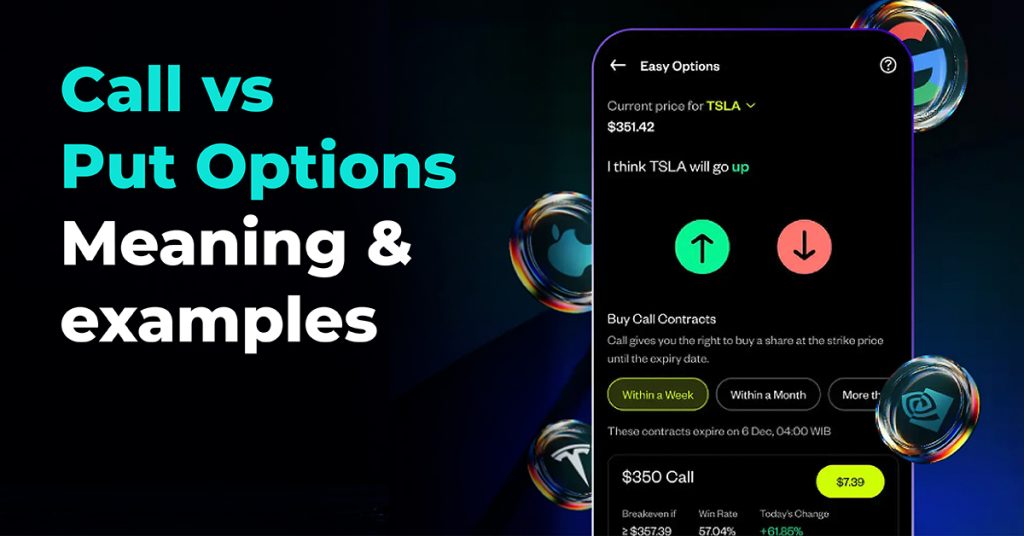
A call option allows you to buy a stock at a fixed price before a specific deadline. A put option gives you the right to sell at a fixed price.
You think a stock will go up. Your friend believes that it is going to crash. What if you could go short and long on the things you predict without actually purchasing the stock?
That’s where call and put option contracts come in. These are like special tickets that give you options in the stock market.
The call option meaning is simple. It entitles you to purchase a stock at a certain price in the future. Think of it as a coupon that allows you to buy something at today’s price, even if costs increase.
The put option does the opposite. It gives you the right to sell a stock at a specific price, later. It’s like having insurance on the possibility that prices will fall.
This article will explain how these work with real examples and show you the important differences between them.
What Is a Call Option?
A call option gives you the right to buy a stock at a predetermined price (strike price) before a specific expiration date.
It’s like having a coupon that allows you to buy a stock for a set price, even if the actual price gets higher.
Consider it a bet that a stock will go up. You pay a small fee in advance, in exchange for the right to buy later.
Here’s a call option example:
- Tech company stock trades at ₹200. You think it will jump soon. You purchase a call option with a strike price = 210 and a premium = 5.
- If the stock reaches a value of ₹230, you make money. You can buy at ₹210 and sell at ₹230. That’s 20 profit less the 5 you paid. Net gain: ₹15 per share.
- If the stock remains below ₹210, you lose only the premium you paid of Rs 5.
This call vs put option difference shows that calls work when prices go up. Call and put option strategies have opposing functions in trading.
What Is a Put Option?
A put option gives you the right to sell a stock at a predetermined price (strike price) before a specific expiration date. You get the right to sell at a fixed price, even if the stock crashes.
Think of it as protection against falling prices. You pay a fee up front for this safety net.
Here’s a put option example:
- You own Global Motors stock at ₹500 per share. Worried about bad earnings news, you buy a put option with a ₹490 strike price, paying ₹8 premium.
- If the stock drops to ₹450, your put option saves you. You can still sell at ₹490 instead of the market price of ₹450.
- If the stock rises to ₹530, you lose only the ₹8 premium you paid. Your stocks are worth more, so that’s good news.
This call vs put option difference shows that puts protect you when prices fall. Call and put option contracts work in opposite directions.
Call vs Put Option – Key Differences
The main difference between call and put options is market direction: calls profit when prices rise, puts profit when prices fall.
Knowing the call vs put option difference is necessary. While they are both kinds of options, they have opposite market views and functions.
Here’s a basic comparison table to make the difference between a call and a put option crystal clear:
| Feature | Call Option | Put Option |
| Definition | A contract giving the right to buy an asset. | A contract giving the right to sell an asset. |
| Buyer’s Right | Right to buy at the strike price. | Right to sell at the strike price. |
| Seller’s Obligation | Obligation to sell at the strike price. | Obligation to buy at the strike price. |
| Profit Scenario | Profits when the asset price rises above the strike price. | Profits when the asset price falls below the strike price. |
| Use Case | Speculating on a price increase (Bullish). | Speculating on a price decrease (Bearish) or hedging a portfolio. |
Quick Call Option vs Put Option Example
If you believe Nifty 50 is going to increase from 23,000 to 24,000, you would purchase a call option. If you believe the Nifty 50 will go from 23,000 to 22,000, you would buy a put option. This is the basic difference between a call and a put option.
How Call and Put Options Work in Trading
Every options contract contains three key elements: strike price, premium, and expiration date. These factors become either the determinant of the profitability of your trade. It is essential to know how they interrelate before you make any trade.
- The strike price is your agreed-upon price point. For calls, it’s what price you can buy at. For puts, it’s how much you can sell at. This number dictates whether you will make money or not with your option.
- The premium is what you pay up-front for the option. This cost is based on how the stock is moving, how much time is left, and how volatile the market feels. According to NSE’s Market Pulse, Nifty 50 option premiums averaged ₹50–₹200.
- The expiration date is your deadline. You must use your option by this date, or it disappears completely. Your premium gets lost if you don’t act in time.
Call and put option meaning in share market context becomes clearer when you see how these pieces fit together. Options are derivatives, which means that they are based on underlying stocks or indexes.
When traders look at an option chain call and put display, they see all the available strikes and expiration dates in organized rows. This helps people to compare different choices and select what fits their expectations.
These three elements combine to form the call and put option explained framework that governs all trades in this market.
Examples of Call and Put Options
Some traders also use options as part of swing trading strategies, holding them for short-term price moves over a few days. Let’s work through some call and put option example scenarios:
Call Option Example: Staking on a Rise
Think of Reliance Industries trading at Rs. 2800 per share. You think the good news is coming and expect the price to jump next month.
You decide to purchase a call option having the following information:
- Strike price: ₹2,850
- Expires in one month
- Premium cost: ₹40 per share
- Lot’s size: 250 shares (normal for Reliance)
Your total investment is ₹40 × 250 = ₹10,000. This is the most you can lose in any case.
Fast forward one month. Reliance stock has risen to ₹2,930. Your option is now valuable as the market price is above your strike price.
Here’s how your profit is broken down:
- Gross profit per share: ₹2,930 – ₹2,850 = ₹80
- Net profit per share = (80 – 40), where 80 Rs are your sale value, 40 Rs are the premium that you paid = 40
- Total profit: ₹40 × 250 = ₹10,000
You doubled your money as you controlled 250 shares for just Rs 10,000 in place of buying them outright for Rs 7 lakhs.
Put Option Example: Insurance Against Falls
Now imagine this call and put option with example scenario. You are holding 50 shares of TCS at the price of Rs 3,800 per share. Recent market volatility concerns you, and you want protection.
You purchase a put option, and the following terms apply:
- Strike price: ₹3,750
- Expires in two months
- Premium cost: ₹60 per share
- Your cost: ₹60 × 50 = ₹3,000
This premium is like insurance you pay up-front.
Unfortunately, there is bad news for the IT sector. TCS falls to Rs 3,600 before your option expires.
Without the put option, your 50 shares would have lost 200 rupees each (3,800 – 3,600). That’s ₹10,000 in total losses.
But it’s your put option that saves the day. You can sell your shares at 3750 instead of 3600. This avoids an additional loss of ₹150 per share.
Your protection math looks like this:
- Loss avoided: ₹150 × 50 = ₹7,500
- Premium paid: ₹3,000
- Net benefit: ₹7,500 – ₹3,000 = ₹4,500
The put option greatly decreased your portfolio damage during the downturn.
Call and Put Option Strategies
A call and put option strategy is a way of managing risk while targeting specific outcomes in the market.
The following are three ways to begin that involve call and put option buying and selling:
- Covered Call: You hold a stock and sell a call against it. For example, if you own Reliance at Rs . 2,500, you sell a call at Rs . 2,600. You get a premium, but gains are limited to Rs . 2,600. This creates extra income, but it also limits your upside in case the stock does jump.
- Protective Put: You buy a put option on stocks that you already own. For example, you own TCS at a price of Rs. 3,000 and purchase a put with a strike at Rs. 2,900 as protection in case the stock price moves lower.
- Long Straddle: You buy a call and a put on the same stock. This works when you expect big price moves but don’t know which direction to go. You pay double premiums, so the stock has to move a lot to be profitable.
Before attempting the strategies above, it helps to practice in a stress-free environment. Platforms like STARTRADER provide real-time markets where you can test their strategies and gain confidence before risking capital.
Call and Put Option Risks & Common Mistakes
If your option doesn’t gain any value before it expires, it will be worthless — and you will lose the entire amount you paid upfront to buy it. Time works against you, too. Every day that goes by, your option loses value, even if the stock price remains the same.
Market swings also influence the price of options in ways that you may not expect.
A SEBI investor report shows that over 90% of Indian option traders lose money. This is primarily a result of poor timing and overleveraging.
Common call and put option mistakes include buying options that expire too soon and putting too much money into risky trades.
Call and Put Option in India
Call and put options in India trade primarily on NSE and BSE, with Nifty 50 and Bank Nifty index options seeing the highest volumes.
The largest action occurs with the Nifty 50 and Bank Nifty index options. Some large company stocks also have active options trading.
Indian options are not the same as buying actual stocks. Each contract is for a fixed number of shares. Most expire by the week or month.
It was estimated that Nifty 50 options represented over 40% in 2024 of the total derivatives turnover on the NSE.
When your option expires, you don’t get real stocks. Instead, you are paid cash depending on profit or loss. This makes trading simpler.
Many websites are now explaining the call and put option meaning in Hindi to enable more people to grasp these concepts in their preferred language.
FAQs
A call option gives you the right to buy an asset at a set price, while a put option gives you the right to sell an asset at a set price.
Neither is “better.” A call option is used when you expect the price to go up (bullish), and a put option is used when you expect the price to go down (bearish).
Yes, this is a strategy known as a straddle or a strangle. It’s used when you expect a large price movement but are unsure of the direction.
In simple terms, Call = Right to Buy, and Put = Right to Sell.
Conclusion
Calls allow you to stake on stocks to rise, puts allow you to speculate on stocks going down, or to protect what you already own.
These tools give you more options to play the market than buying and selling stocks. But they come with risks too. You could lose all of the money you pay up front.
So, start out by watching how real options move in relation to stock prices. Knowledge is better than guessing each time. Take your time and learn before you trade.
Create a free demo account on STARTRADER to practice call and put strategies using virtual money. You get to work with real-world experience without the risk of putting your own capital at stake as you learn what strategies best suit you in trading.
Tags


Open Live Account
 Email Address
 Phone Number
Important Notice
STARTRADER does not accept any applications from Australian residents.
To comply with regulatory requirements, clicking the button will redirect you to the STARTRADER website operated by STARTRADER PRIME GLOBAL PTY LTD (ABN 65 156 005 668), an authorized Australian Financial Services Licence holder (AFSL no. 421210) regulated by the Australian Securities and Investments Commission.
Important Notice for Residents of the United Arab Emirates
In alignment with local regulatory requirements, individuals residing in the United Arab Emirates are requested to proceed via our dedicated regional platform at startrader.ae, which is operated by STARTRADER Global Financial Consultation & Financial Analysis L.L.C.. This entity is licensed by the UAE Capital Market Authority (CMA) under License No. 20200000241, and is authorised to introduce financial services and promote financial products in the UAE.
Please click the "Continue" button below to be redirected.


