








 Web Trader MT5










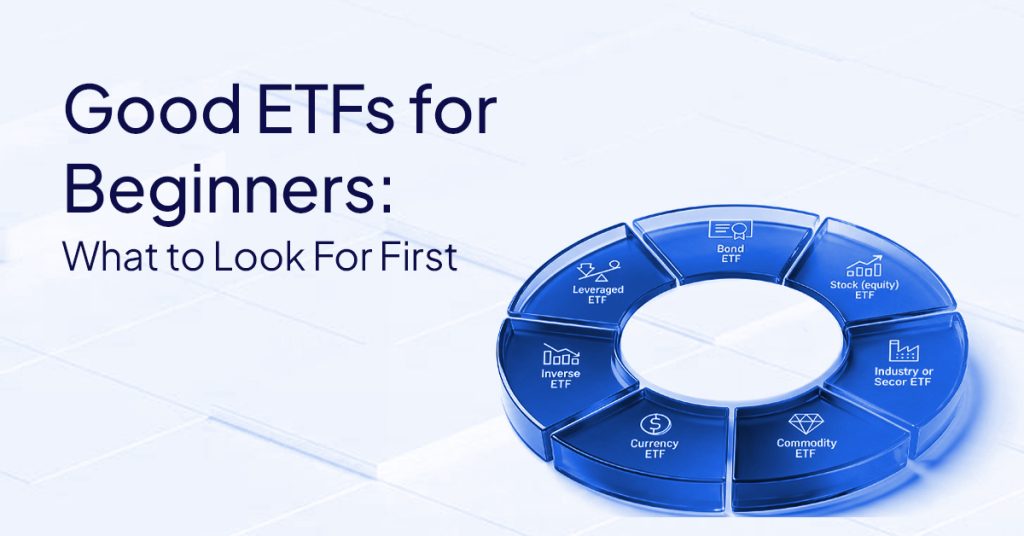
Good ETFs for beginners are designed to make investing easy, accessible to everyone, and less risky for those just starting. Beginners can use exchange-traded funds (ETFs) to invest in a wide range of assets at once, rather than picking individual stocks.
This makes it easier to choose “winning” companies while still benefiting from market growth. The most important thing is to know which ETFs are easy for beginners to use and why they are a smart place to start.
In this guide, you’ll learn what makes a solid ETF for beginners, how they help you manage risk, and what to look for when you build your first investment portfolio with confidence.
Quick Answer
- Good ETFs for beginners are typically those that track broad, well-established market indices.
- They instantly diversify by holding hundreds of different assets in a single fund.
- New investors should look for funds with low expense ratios so that management fees don’t eat into their gains.
- High liquidity is important since it makes it easy to buy or sell the fund during market hours.
- People prefer simple, clear structures to complicated or “leveraged” funds that are riskier.
- It’s important to think about the long term because even funds that are spread out can change with the market.
What Makes Good ETFs For Beginners?
Good ETFs for beginners are very transparent investments, offer a wide range of investment types, and have a clear, easy-to-grasp goal.
An ETF, or Exchange-Traded Fund, is a single security that holds a group of stocks, bonds, or other assets. For someone who is just starting, “good” usually means “suitable,” meaning the fund shouldn’t be overly focused on a single area. Instead, it should be a sample of a bigger economy, giving you a smoother ride than a single stock would.
Passive funds that simply track the performance of a specific index are generally a good choice for beginners. These are easier to grasp because the criteria are set in stone. You’re not relying on a single fund manager but on the success of numerous enterprises as a whole.
A new investor can focus on the habit of saving instead of the stress of constantly analyzing the market by choosing simplicity over complexity.
What Should Beginners Look For In The Best ETFs For Beginners?
When looking for the best ETFs for beginners, investors should consider how well they diversify, their goals, costs, liquidity, and ease of understanding.
Broad Diversification
A diversified fund protects you from losing all your capital if one firm or industry goes down. You lower your “single-company” risk by putting your money into hundreds of different companies.
To protect themselves from localized downturns, beginners can look for funds that invest across a wide range of industries, such as healthcare and technology.
Simple Fund Objective
The fund’s aim should be straightforward enough for anyone to explain in one sentence. If the fund’s strategy includes complicated derivatives or “betting against” the market, it probably isn’t a starter fund. The best solutions for beginners usually match the performance of a well-known benchmark.
Cost Awareness
Beginner-friendly funds usually have low expense ratios. This means that more of your money can stay invested. Over twenty or thirty years, even a little variation in annual fees might add up to a lot of money. New investors should look at management costs and choose those with the least overhead.
Liquidity And Ease Of Trading
If there is a lot of trading going on, you may quickly get in or out of a position at a price that is close to the real market value. If a fund isn’t well-known or isn’t traded very often, it could be hard to sell your shares when the market goes down.
High-volume funds that see millions of shares change hands every day are the safest for beginners.
Lower Complexity
People who are still learning about the market should avoid “leveraged” or “inverse” instruments. These complicated products are meant for short-term trading, and if you hold them for more than a day, they can lose value quickly. Stick with “long-only” funds that own the assets they track.
Why Are Simple ETFs Often Better Starter Choices?
Simple ETFs are often the best first ETFs because they are clear and don’t carry the hidden risks of specialized or “themed” investments.
Narrow-theme funds, such as those focusing solely on “Electric Vehicles,” may sound like a good idea, but they are quite unstable. The fund could lose significant value if that sector has to comply with new rules.
A simple, broad-market fund avoids this by investing in thousands of companies. This way, if one niche crashes, the whole investment doesn’t go down.
Fewer moving parts also mean fewer surprises. It’s easy to see how a big index is doing when an ETF tracks it. This openness gives beginners more confidence, as they can easily see how the global economy’s health affects their portfolio’s value.
How Can A Beginner Compare ETFs Before Buying?
When you compare funds, you need to look beyond the ETF’s name. You also need to look at its internal costs, concentration, and long-term goal.
What The ETF Holds
Reviewing the “top ten holdings” shows you where most of your money is going. If an ETF says it is “diversified” yet 25% of its value is in only two companies, you are more at risk with those two companies than you think. A good fund for beginners will have its weight spread more evenly across many names.
How It Fits A Long-Term Goal
Every investment in your portfolio should have a “job,” whether it’s for retirement or a fund for when things go wrong. Beginners should consider whether they can handle the fund’s past volatility over the time frame they plan to hold it. Most starter selection strategies prefer consistency over short-term spikes.
What Costs Apply
Examine the “expense ratio” and any “bid-ask spreads” to calculate the total cost of ownership. While the expense ratio is the annual fee, the spread is the difference between the buying and selling price. Both should be as low as possible to ensure your investment remains efficient.
How It Fits A Long-Term Goal
Every investment should have a “job” in your portfolio, whether it is for retirement, a house deposit, or a rainy-day fund. Beginners should ask themselves if the fund’s historical volatility is something they can handle over their intended time horizon.
Do Young Investors Look For Different ETF Features?
Young investors often prioritize capital appreciation because they have more time to recover from market downturns.
When looking for the best ETFs for young investors, people generally focus on “Growth” funds. A 20-year-old may not need their money for 40 years, so that they can handle the stock market’s higher volatility in exchange for historical growth.
Older investors, on the other hand, may want to invest in “Bond” funds to keep what they currently have safe.
Young investors still need to know how much risk they can handle, though. Even with a long time horizon, a 30% loss in your account’s value is still worrisome. Because of this, a young person’s portfolio should still be built on a foundation of many different, easy-to-understand funds.
What Types Of ETFs May Be Easier For Beginners To Understand?
Broad-market and large-cap diversified funds are the easiest to understand because they include well-known, globally recognized names.
Broad-Market ETFs
These funds track the stock market across a country or even the whole world. They are the best “set it and forget it” tool since they show the productivity of thousands of businesses all at once. Because their performance is linked to the overall direction of the global economy, they are straightforward to understand.
Large Diversified Index-Based ETFs
Funds that track the largest 500 or 1,000 companies in a major economy are generally considered stable starter options.
These funds hold the “blue-chip” companies—the brands you likely use every day. Because these companies are well-established and highly regulated, they are often less volatile than smaller, unproven startups.
Why Narrow-Theme And Complex Strategy ETFs Can Be Harder
Niche funds make investing harder since you have to be right about a certain trend. If you buy an “AI ETF,” for instance, you are wagering that AI will be the main driver of growth. Compared to a general market fund, this needs more research and monitoring than a beginner might be ready for.
What Should Beginners Avoid When Choosing An ETF?
New investors should steer clear of funds they don’t fully understand and avoid chasing “hype” themes that promise huge returns.
- Chasing Hype: Just because a sector did well last month doesn’t indicate it will keep doing well. A classic mistake for beginners is to buy at the top of a trend.
- Ignoring Liquidity: When you need the money, it could be challenging to sell small, specialty funds. Always make sure the fund is actively traded.
- Over-Complexity: You probably shouldn’t own the fund yet if you can’t describe how it earns money in thirty seconds.
Are All Beginner ETFs Low Risk?
There is no such thing as a totally safe ETF. All investments in the market are vulnerable to changes in the economy as a whole.
Diversifying your investments reduces the risk of a single company going out of business, but it doesn’t eliminate “systematic risk,” the risk that the whole market will go down. If the world goes into a recession, even the best beginner ETFs will lose value.
The good thing about it is that it is set up to rebound with the economy over the long run, not that it never goes down.
What Should A Beginner Check Before Buying An ETF?
Before committing your capital, use this checklist to ensure the fund aligns with a beginner-safe strategy.
- Expense Ratio: Is the charge for a broad-market fund less than 0.25%?
- Name of the Index: Is the fund following a well-known, established index?
- Number of Holdings: Does the fund own many assets (ideally hundreds)?
- Trading Volume: Does this fund trade millions of dollars per day?
- AUM: Is the fund big and stable (Usually over $100 million)?
Frequently Asked Questions
A good beginner ETF tracks a broad market index, is easy to understand, and includes a wide range of stock types.
To lower your risk, look for a low expense ratio, strong trading liquidity, and a wide choice of underlying holdings.
Yes, because broad ETFs provide you with a look at the whole economy, while narrow-theme funds are more unstable.
Young investors frequently choose growth-oriented funds because they have a long time horizon, but they should still maintain a diversified core.
They are less risky than individual stocks because they are spread across many companies, but they can still decline with the market.
Final Thoughts
Choosing the right ETFs for beginners takes discipline and the ability to think long-term. New investors can take part in the expansion of the global economy without the stress of day trading by focusing on broad-market exposure and keeping costs low.
There is always some risk involved in investing, but an index-based ETF is one of the safest ways to generate wealth over time because it is organized and open.
To be successful, you need to pick a good strategy and adhere to it through every market cycle.
Compliance / Risk Disclaimer
This information is meant for educational purposes and is not investment advice. Trading is risky and may not be right for all investors. You can lose part or all of the money you put in at first. Make sure you know what the risks are and seek help if you need it.
Tags


Open Live Account
 Email Address
 Phone Number
Important Notice
STARTRADER does not accept any applications from Australian residents.
To comply with regulatory requirements, clicking the button will redirect you to the STARTRADER website operated by STARTRADER PRIME GLOBAL PTY LTD (ABN 65 156 005 668), an authorized Australian Financial Services Licence holder (AFSL no. 421210) regulated by the Australian Securities and Investments Commission.
Important Notice for Residents of the United Arab Emirates
In alignment with local regulatory requirements, individuals residing in the United Arab Emirates are requested to proceed via our dedicated regional platform at startrader.ae, which is operated by STARTRADER Global Financial Consultation & Financial Analysis L.L.C.. This entity is licensed by the UAE Capital Market Authority (CMA) under License No. 20200000241, and is authorised to introduce financial services and promote financial products in the UAE.
Please click the "Continue" button below to be redirected.


