








 Web Trader MT5








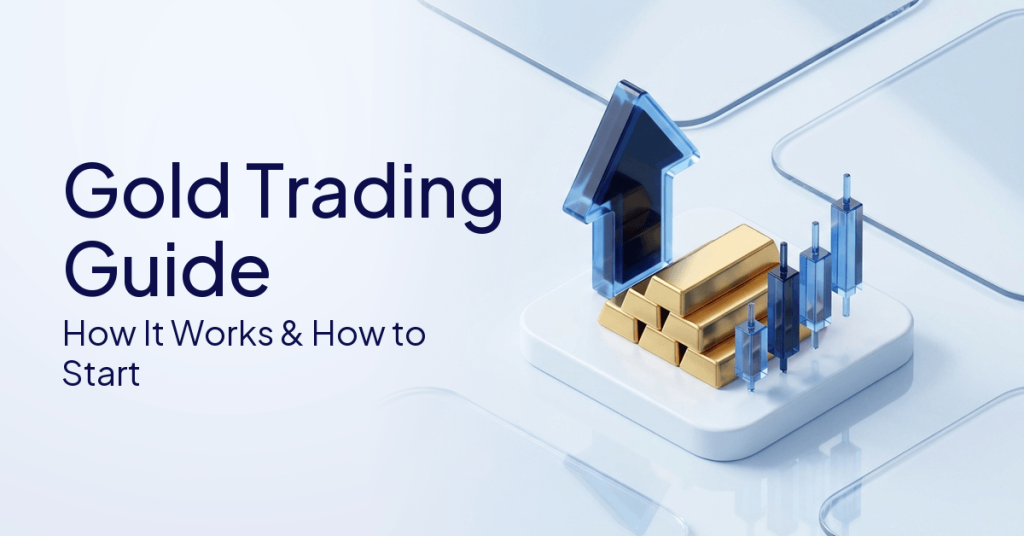
Whether you are a beginner trader or an experienced one, gold trading lets you make a prediction on the price direction of one of the most-watched financial instruments in the world.
But what is it about this ancient metal that makes it such a powerful weapon in today’s digital marketplaces?
Gold trading involves the buying and selling of gold-related financial products such as spot gold, futures contracts, Contracts for Difference (CFDs) or Exchange-Traded Funds (ETFs) to profit from price movements. Physical bars or coins take time to buy but modern trading allows traders to react to the happenings of the world at a faster pace.
Gold is a magnet for traders. It has been a safe haven for hundreds of years and it has deep market liquidity and global consistent demand. Gold prices are also closely linked to other economic factors like inflation, interest rate decisions and the value of the US dollar.
This guide will walk you through the whole process of trading gold. You will learn about the symbol XAUUSD, the most popular trading instruments, the best time to trade the market for liquidity, the key terms for beginners and the practical first steps you need to take in order to navigate the market safely.
Quick Answer
Gold trading is the buying and selling of gold-linked instruments for the purpose of speculating on changes in the price of gold.
Traders can trade gold via spot gold, futures, CFDs or ETFs. Gold is traded by retail traders, institutions and hedgers for liquidity, diversification and market exposure. Price volatility and the use of margin leverage can significantly increase trading risk.
What Is Gold Trading?
Trading gold means buying and selling instruments connected to gold with the aim of profiting from movements in the market price of gold.
It is the speculation on gold price movements, rather than the delivery of physical gold bars, bullion or coins. Modern financial markets enable traders to profit from price changes entirely electronically.
If a trader thinks the price of gold will go up because of world events, they may purchase a “long” position. If they believe the price will fall, they can do the opposite and open a “short” (sell) position. The result of the trade is determined by the difference between the position’s open and close prices.
What XAUUSD Means
The word “gold” on its own is rarely seen on trading platforms. Instead, you’ll see the ticker symbol XAUUSD. This is the international market symbol for gold in US dollars.
“XAU” shall mean 1 troy ounce of gold measured by international standards. “USD” shall mean the US Dollar. So when you see the XAUUSD quote, it is the number of US dollars you will have to pay for 1 troy ounce of gold.
How Gold Is Traded In Financial Markets
There are a number of ways to trade gold, each with its own set of mechanisms, costs, risks and access rules. Common ways are spot gold, gold futures, gold CFDs and gold ETFs.
Gold Spot is the purchase of gold for immediate delivery at the prevailing market prices. Gold futures are agreements to purchase or sell gold at a set price at a later date.
Gold CFDs enable traders to speculate on the price movement without owning the actual underlying asset, often on margin. Gold ETFs are exchange-traded funds that track the price of gold or hold physical gold assets.
Who Trades Gold?
Gold is traded on a very diversified market. Retail traders are trading from home trying to catch short term price movements. Hedge funds and investment banks trade huge volumes to implement sophisticated macroeconomic strategies.
Central banks also have gold in their reserves of national currency, and trade in it. Also, commercial buyers such as jewelry companies and electronics manufacturers buy gold to hedge against future price increases that would affect their production costs.
Why Do Traders Choose Gold?
Traders choose gold because it is liquid, a global market, heavily followed and a safe haven in times of market uncertainty, thus attractive.
Gold As A Safe Haven Asset
Gold is traditionally a safe-haven asset. A safe haven is an investment that is thought to retain or appreciate in value during uncertain market conditions. Investors and traders often turn to gold in times of economic uncertainty, geopolitical stress or large drops in broad stock markets. There’s no credit risk with gold and it can’t be printed like fiat currency, which is why it is a favored place to store capital when confidence in traditional financial systems falters.
High Liquidity And Global Demand
Gold is one of the most actively traded commodities across the globe. High liquidity means there are always sellers and buyers around. This enables traders to take and get out of positions more quickly without causing huge price disruptions. Traders have worldwide demand and extended trading hours, but spreads and volatility will depend on the time of day, as the global market for gold trades almost 24 hours a day out of different financial hubs.
Gold As An Inflation Hedge
Gold is generally viewed as a good hedge against inflation by market participants. When inflation rises the value of paper money (such as the US dollar or the Euro) falls. Gold is traded in dollars, and when the dollar goes down, gold prices tend to go up. Some traders keep a close eye on inflation reports and the Consumer Price Index (CPI) because higher inflation can boost demand for gold. But it is important to remember that gold does not always rise in inflationary times, it is just one of many factors.
Is Gold Good For Trading?
For many new investors, the question is whether gold is a good asset to have in their portfolio. It really depends on the individual. Gold can be a good fit for traders who have a good grasp of market volatility, macroeconomic drivers, technical analysis and solid risk management. But it may be totally inappropriate for over-leveraged traders or those trading without a plan. Read our guide to find out is gold good for trading to find out more about this.
How Does Gold Trading Work?
Trading gold is essentially opening a position on an instrument that is related to gold itself and closing it based on the price movement.
Step 1: Choose A Gold Market
You need to find out which gold market is better suited to your strategy before you place a trade. Traders can trade spot gold, gold CFDs, gold futures or ETFs. Beginners should have an in-depth knowledge of the specific instrument they are trading as contract sizes, leverage limits and trading hours vary greatly between them.
Step 2: Analyze Gold Price Movement
Traders don’t go into the market blind. They are looking at price charts to find trends, areas of support and resistance. Fundamental traders also consider external factors such as the strength of the US dollar, inflation numbers, Federal Reserve interest rate expectations, geopolitical events and central bank buying data. Traders look at technical chart patterns and fundamental news to make better decisions.
Step 3: Open A Buy Or Sell Position
When an analysis is made the trader opens a position. In case the analysis points to an increase in the prices of gold, the trader will make a “buy” order or a long position. If the analysis shows that gold prices are expected to fall, the trader places a “sell” (short) order. Trading platforms with derivative products like CFDs enable traders to easily open long and short positions.
Step 4: Monitor Bid, Ask, And Spread
If you look at a trading platform there are two prices for gold, the bid and the ask. The “bid” is the price you can sell for, the “ask” is the price you can buy for. The difference between these two numbers is called the spread. The spread is basically the cost of the trade . Traders should be aware that spreads can widen during periods of low liquidity or major news events.
Step 5: Close The Position
A trade remains open until the trader closes the position or until it is closed automatically when a Stop Loss or Take Profit level is reached. The trade’s bottom line, the profit or loss, is determined solely by the difference between the opening price and the closing price. Traders should also consider trading costs, which can include spreads, brokerage commissions and overnight financing charges (swaps).
The Gold Trading Process
| Step | Action | What Happens |
| 1 | Choose An Instrument | Select spot gold, CFDs, futures, ETFs, or another gold-linked market. |
| 2 | Analyse The Market | Review charts, news, economic data, and gold price drivers. |
| 3 | Open A Position | Buy if expecting a rise or sell if expecting a fall. |
| 4 | Manage The Trade | Monitor spread, margin, price movement, and risk. |
| 5 | Close The Position | Profit or loss depends on the price change and trading costs. |
Compliance Reminder: Trading gold with CFDs carries a high level of risk. CFDs are complex instruments and carry a high risk of losing money rapidly due to leverage. The steps above are for educational purposes only and are not investment advice or a guarantee of profits.
Learn how to trade gold XAUUSD in forex to better understand the details of placing trades on currency and precious metals platforms.
What Instruments Are Used In Gold Trading?
Traders can get exposure to gold through spot gold, gold futures, gold CFDs, ETFs and other gold-linked markets.
Spot Gold
Spot gold is gold that is bought and sold for delivery and settlement at the current market price. In the retail market, spot gold prices are quoted in XAUUSD almost always. It is popular because it tracks the real-time pricing of physical gold constantly and provides tight spreads during major market hours without the complexities of contract expiration dates.
Gold Futures
Gold futures are exchange-traded contracts that are standardized. When you trade futures, you are agreeing to buy or sell a certain amount of gold at a fixed price on a future date. The most famous reference is the GC contract on the COMEX exchange. In addition, trading futures requires knowledge of contract size, expiration date (rollover), margin requirements and specific exchange rules. CME Group data shows gold futures are enormous in daily volume and are dominated by institutional players.
Gold CFDs
Gold Contracts for Differences (CFDs) are a type of financial derivative that allow traders to bet on the price movements of gold without actually owning the physical commodity. When you trade a CFD you are trading the difference between the open and close price of the contract. CFDs are popular among retail traders because they allow traders greater flexibility in position sizing and the use of leverage. But if you keep CFD trades open overnight, you may incur financing costs called swap fees.
Gold ETFs
Gold Exchange Traded Funds (ETFs) are funds that are traded on stock exchanges. They offer you indirect access to gold. Some ETFs physically hold gold bullion in vaults while others track gold indices or hold portfolios of gold mining stocks. ETFs are more suited for traditional, long-term investors who want to diversify their portfolio than for active day traders who look to profit from intraday volatility. Reports from the World Gold Council show that global gold ETFs remain the most popular way for mainstream investors to gain exposure.
Instrument Comparison
| Instrument | How It Works | Who It Suits | Key Risk |
| Spot Gold | Tracks current gold market pricing, often quoted as XAUUSD. | Traders who want direct gold price exposure. | Volatility and spread changes. |
| Gold Futures | Standardised contracts traded on futures exchanges. | Experienced commodity traders. | Contract expiry, margin, and roll risk. |
| Gold CFDs | Derivatives based on gold price movement without ownership. | Retail traders who understand leverage. | Leverage can magnify losses. |
| Gold ETFs | Exchange-listed funds linked to gold or gold assets. | Investors seeking indirect exposure. | Fund costs and tracking differences. |
If you are a trader who likes to trade on the regular exchanges, then it is important that you know the exact times of the gold futures trading hours.
What Are The Best Times To Trade Gold?
Liquidity and session overlap as well as market news and your trading strategy are often associated with the best time to trade gold.
Gold Trading Hours Overview
Gold is a global asset and the gold market is active nearly 24 hours a day, five days a week. Trading hours for gold may vary slightly depending on the specific instrument and the broker’s platform. Most XAUUSD and spot gold markets are open from Sunday evening to Friday evening (US time), with a short daily maintenance period (usually about 45-60 minutes) for exchanges and liquidity providers to reset.
London Session
The London trading session is a busy time for gold. As the world’s physical gold clearing and precious metals trading hub, London has historically had strong liquidity in this session. The liquidity is also helped by the fact that the London session overlaps with the major European market hours. This creates a busy environment for price discovery and trend formation.
New York Session
The New York session is just as important, because gold is priced in US dollars. This session is often the scene of sharp moves in gold prices, driven by key US economic data such as Non-Farm Payrolls (NFP), Consumer Price Index (CPI) data, Treasury yields updates and Federal Reserve announcements.
London And New York Overlap
The best time for many active day traders to trade gold is during the overlap of the London and New York sessions. This is the window (typically 8:00 AM to 12:00 PM EST) when the major European and North American financial centers are simultaneously open.
The overlap coincides with the highest volume of the day, which means tighter spreads and higher volatility in the market, creating the best opportunities for short-term price movements. This very specific time frame of high liquidity is usually in sync with other traders on platforms like MT5 or those who are following gold trading in India.
What Key Terms Should Beginners Know About Gold Trading?
Knowledge of key terms such as XAUUSD, spot gold, gold CFD, gold futures, bid/ask spread, leverage, margin, safe haven and pip value is necessary for trading and operating in the gold market.
Newbies can avoid costly mistakes if they familiarize themselves with the language used on trading platforms and financial news sites.
Gold Trading Glossary
| Term | Simple Definition |
| XAUUSD | The standard market ticker symbol representing gold priced against the US dollar. |
| Spot Gold | The current market price for gold traded for near-immediate delivery and settlement. |
| Gold CFD | A Contract for Difference; a derivative allowing you to trade gold price movements without owning the metal. |
| Gold Futures | A standardized contract to buy or sell gold at a set price on a specific future expiration date. |
| Bid/Ask Spread | The difference between the highest price a buyer will pay (bid) and the lowest price a seller will accept (ask). |
| Leverage | A tool that allows traders to control a large position size using a smaller amount of upfront capital. |
| Margin | The required amount of money a trader must have in their account to open and maintain a leveraged position. |
| Safe Haven | An asset expected to retain or increase in value during times of economic turbulence or market panic. |
| Pip Value | The monetary value of a single unit of price movement (a pip) in a gold trade, which varies by lot size. |
What Are The Benefits Of Gold Trading?
The main advantages of trading gold are high liquidity of the market, around-the-clock availability and an opportunity to diversify a portfolio.
- High Liquidity: The market is very liquid, with millions of ounces of gold traded every day. High liquidity generally translates to tighter spreads (meaning lower trading costs) and the ability to execute orders immediately at the price you want during active trading sessions.
- 24-Hour Market Access: Traditional stock exchanges have opening and closing times, whereas the spot gold and CFDs markets trade almost 24 hours a day, five days a week. This enables traders in different time zones to react to news from all over the world as it happens.
- Diversification Potential: Gold historically does not correlate with equity markets. Gold can be a welcome addition in a trading portfolio for hedging against stock market downturns.
- Wide Range of Instruments: The wide choice of instruments available from spot markets to futures and ETFs provides traders with a vehicle that fits their account size, time horizon and risk tolerance perfectly.
Compliance Note: The benefits listed above are the mechanical advantages of the gold market. There is no guarantee of profit. Trading in gold is a risky business and should not be taken as investment advice.
What Are The Risks Of Gold Trading?
The main risks of gold trading are high price volatility, losses amplified by leverage and gaps in liquidity during off-hours.
- Price Volatility Driven by Macro Events: Gold is highly sensitive to macroeconomic information. Central banks’ unexpected remarks, the geopolitical wars or fast changes of the US dollar can lead to sudden big jumps in prices. Volatility presents opportunities for trading and surprise stop loss triggers.
- Leverage Amplifying Losses: You can trade gold CFDs with leverage on retail platforms. Leverage can increase profits, but it can increase losses as well. If you are highly leveraged, a small move against you in price can wipe out your account balance in no time.
- Liquidity Gaps During Off-Peak Hours: Off-peak trading, especially the time between the close of the US session and the opening of the Asian session, sees a sharp drop in market volume. Illiquid markets tend to have wider spreads and may experience “price gapping, when a price jumps from one level to another without trading in between.
- Emotional Trading: Gold’s quick price action often causes novices to overtrade or abandon strategies out of fear or greed.
Risk Management
| Risk | What It Means | How To Manage It |
| High Volatility | Prices can swing dramatically based on global news. | Use strict Stop Loss orders and monitor economic calendars. |
| Leverage Risk | Losses are magnified when using margin on CFDs. | Keep leverage low and position sizes small relative to account equity. |
| Liquidity Gaps | Spreads widen and prices jump during quiet hours. | Avoid opening new trades during daily market rollover periods. |
| Overtrading | Trading too frequently due to emotional reactions. | Stick to a tested trading plan and set daily loss limits. |
Risk Warning: CFDs are complex instruments and come with a high risk of losing money rapidly due to leverage. Never invest money you can’t afford to lose. Not investing advice.
How Can Beginners Start Gold Trading?
For beginner traders who want to start trading gold, it is important to learn about the market, select the right instrument and practice risk management on a demo account.
Patience and a systematic approach are the cornerstones of your gold trading journey. Here is a practical step-by-step learning path:
- Learn how XAUUSD and Gold Markets Work: Know what affects the gold price before risking capital. Watch the correlation of gold and the US dollar, see the economic data releases hit the charts.
- Pick the Right Instrument: Whether you want to trade spot gold, CFDs or futures. For most beginners the easiest way in is the spot gold or CFDs, as you can have flexible position sizing, but you need to know the costs involved.
- Learn About Margin and Leverage: If you decide to invest in derivative instruments, then you need to know how margin works. Know precisely how much of your account balance is exposed to risk in a trade and how a price movement will impact your available equity.
- Practice on a Demo Account First: Most platforms provide free demo accounts with virtual money. Test your technical analysis, place trades and get used to the layout of the platform. All of this without any financial risk, thanks to this environment.
- Start Small and Manage Risk: When you graduate to a live account, start with the smallest possible position size (like micro-lots). Never risk more than 1-2% of your overall account on a single trade.
Reminder: Remember that CFD trading is a risky business. This information is for educational purposes only and does not constitute a recommendation to buy or sell any securities.
What Common Mistakes Should Beginners Avoid In Gold Trading?
If you are a beginner, trading gold can be much better when avoiding common traps such as over-leveraging and ignoring market hours.
This is something beginners do, even though they know the theory. They are caught in the traps. Catching these mistakes early will save you capital.
- Ignoring Gold Trading Hours: Most newbie traders make the mistake of trading gold at any time of the day. Trading usually means paying higher spreads for little price movement in the Asian session where there is little liquidity.
- Over-Leveraging CFD Positions: Newbies get attracted to use the maximum leverage available to them to make huge profits in no time. There is no room for the natural ebb and flow of market prices, and margin calls come fast.
- Confusing Trading with Investing: Trading Intraday XAUUSD is a whole different ballgame and mindset than buying physical gold as a 10-year investment. Traders must be ready to take a quick loss as opposed to riding out losing positions hoping for a rebound over time.
- Chasing Price Moves Without a Strategy: Buying gold because you see a big green candle on the chart is a recipe for disaster. Entries should be based on a pre-defined trading plan and not the fear of missing out (FOMO).
- Not Understanding Price Drivers: Buy gold on a technical chart pattern but ignore a major Federal Reserve interest rate announcement and you could lose a lot of money.
Beginner Mistakes and Prevention
| Mistake | Why It Happens | How To Avoid It |
| Trading in low liquidity | Ignoring global market session times. | Focus trading during the London/New York session overlap. |
| Over-leveraging | Greed and a misunderstanding of margin math. | Use a position size calculator and cap risk at 1-2% per trade. |
| Holding losing trades | Confusing short-term trading with long-term investing. | Always set a hard Stop Loss before executing the order. |
| Chasing the market | Emotional reactions to sudden price spikes (FOMO). | Wait for price pullbacks to your defined support/resistance zones. |
| Ignoring fundamental news | Relying 100% on chart patterns without checking the news. | Check a global economic calendar every morning before trading. |
FAQs
Gold trading is the buying and selling of financial instruments that are based on the price of gold, in order to make a profit. Instead of buying physical bullion, traders can speculate on the market electronically by buying instruments such as spot gold, gold CFDs and gold futures.
To start gold trading for beginners, understand the market and the factors that affect gold prices. After that, select the appropriate trading instrument and open a demo account to practice trading without taking any financial risks. Once you’ve learned about margin and risk management, you can transition to a live account with tiny position sizes. Trading carries a high level of risk.
XAUUSD Gold price quote in U.S. Dollar To trade XAUUSD you need to open an account with a platform like MT4 or MT5. You look at the charts, decide how much you want to trade and click buy if you think the price will go up or sell if you think the price will go down. Then you close out the position later to take your profit/loss.
In the past, the best time to trade gold has been during the overlap between the London and New York trading sessions (roughly 12:00 PM to 4:00 PM GMT / 8:00 AM to 12:00 PM EST). During this period, trading volume is at its highest, resulting in the most significant volatility and tightest spreads.
Gold trades nearly 23 hours a day, 5 days a week. The market opens Sunday evening and closes Friday afternoon (EST). There is usually a brief daily maintenance break of about an hour, but exact times differ among exchanges and brokers.
Gold prices are primarily driven by macro factors. The price direction of gold is determined by a number of factors such as the strength of the US dollar, inflation data, geopolitical instability, demand for central bank gold reserves and decisions on interest rates from the Fed.
Spot gold trading is trading gold at the current market price, in real-time, for immediate settlement. Futures are settled on a particular date in the future, while the spot market (usually traded as XAUUSD) shows live prices as they happen.
Conclusion
Gold trading is an exciting way to participate in one of the world’s most active financial markets.
By buying and selling instruments such as spot gold, CFDs or futures, traders can speculate on global economic shifts without having to deal with physical assets.
Your first real milestone is understanding how the market works. As a novice, building a strong foundation means knowing the most optimal times to trade, how to read XAUUSD price action and being familiar with the unique benefits and hazards of each trading instrument.
Most importantly, the surest way to survive long term in the markets is to apply strict risk management and embrace continuous education.
Once you get the hang of the basics covered here and want to explore the interplay of technical analysis and market timing, your next step should be to investigate proven gold trading strategies.
Want to put into practice what you have learned? You may want to start by opening a risk free demo account on STARTRADER to get used to XAUUSD charts, test your leverage knowledge and practice placing trades under live market conditions. Disclaimer: CFDs are complex financial instruments and carry a high risk of losing money rapidly due to leverage. You should ensure you fully understand the risks involved and carefully consider whether you can afford to take the high risk of losing your money before trading.
Tags


Open Live Account
 Email Address
 Phone Number
Important Notice
STARTRADER does not accept any applications from Australian residents.
To comply with regulatory requirements, clicking the button will redirect you to the STARTRADER website operated by STARTRADER PRIME GLOBAL PTY LTD (ABN 65 156 005 668), an authorized Australian Financial Services Licence holder (AFSL no. 421210) regulated by the Australian Securities and Investments Commission.
Important Notice for Residents of the United Arab Emirates
In alignment with local regulatory requirements, individuals residing in the United Arab Emirates are requested to proceed via our dedicated regional platform at startrader.ae, which is operated by STARTRADER Global Financial Consultation & Financial Analysis L.L.C.. This entity is licensed by the UAE Capital Market Authority (CMA) under License No. 20200000241, and is authorised to introduce financial services and promote financial products in the UAE.
Please click the "Continue" button below to be redirected.


