








 Web Trader MT5











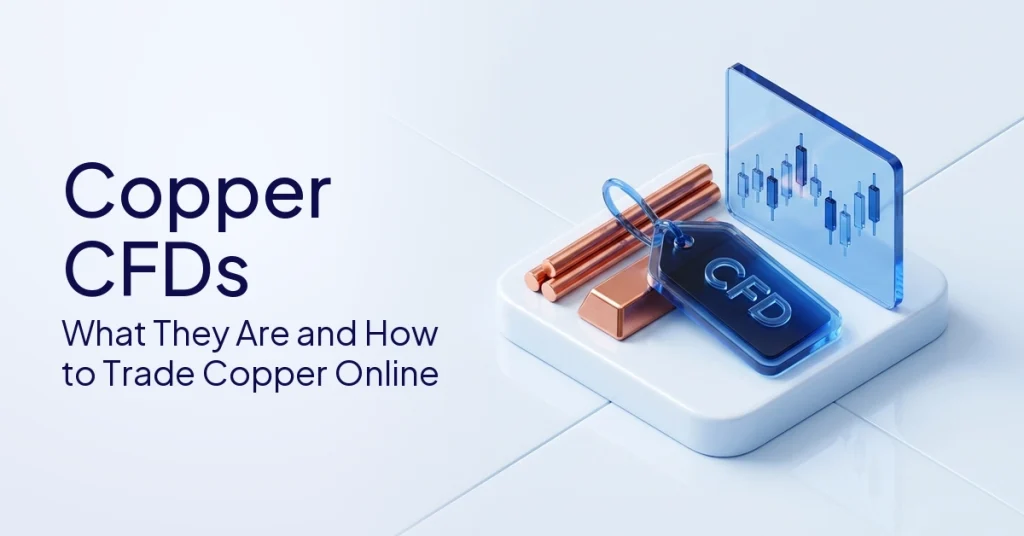
Online traders can speculate on the movement of the copper price with a copper CFD without ever having to own, store or take delivery of the physical commodity.
Have you ever wondered how global infrastructure projects affect the financial charts on your screen? Copper is an industrial base metal and essential to modern infrastructure. The price movement of this metal is traded online with a CFD on copper.
Its symbol may be Copper, XCUUSD, HG, or a futures-based symbol, depending on the platform. CFDs can be used to go long or short, so a position can be taken whether the trader expects the price to rise or fall. Exposure can be increased with leverage but it will dramatically increase risk.
This guide covers what it means, what drives the price, how to trade it, the basics of charts and the risks involved. It will help you understand how to trade gold CFDs and explore industrial metals.
Quick Answer
Copper CFDs are contracts that track the price movement of copper but do not grant ownership of the underlying asset. To trade Copper online, a trader would normally open a supported account, search for Copper, XCUUSD or a related symbol and open the chart. They select an order type, the size of the trade, add risk management where possible, and monitor and close the trade. Trading these contracts carries price, leverage, margin, and execution risk.
What Is A Copper CFD?
A copper CFD is a contract that allows traders to speculate on the price movement of copper without owning physical copper.
A copper CFD follows the price of copper. The trader does not buy cathodes, copper bars, or stock in warehouses.
Rather, the position result is based on the difference between the opening and closing prices of the contract before any applicable commission or overnight financing charges are applied.
For those who are wondering what a CFD is: it is an agreement between the trader and the provider to exchange the difference in an asset’s price between opening and closing the position.
What You Own
You do not own copper metal, but rather a contract position. There is no physical delivery, storage, transportation, or warehouse handling.
Common Copper Symbols
Copper symbols are platform and product structure dependent. It could be Copper, XCUUSD, a copper CFD, HG or a copper futures-based CFD.
Note: HG is the familiar symbol for COMEX copper futures. Standard futures are quoted in dollars and cents a pound, but CFD specifications will differ between providers. Not all platforms will have the same contract size, tick size or price source.
Long And Short Exposure
A position can be long, giving exposure to rising prices, or short, giving exposure to falling prices. This is a product feature rather than a recommendation.
Leverage And Margin
Leverage and margin are often involved in CFD trading. Margin is the amount required to open and maintain a position and acts as collateral for the trade. Leverage allows you to control a position larger than the amount deposited as margin. As a result, leverage can amplify both gains and losses and is an important risk factor to consider. The margin used for a position may be lost if the trade moves against you, and additional costs or requirements may apply depending on the product and trading conditions.
What Moves The Copper Price?
The main factors driving copper prices are industrial demand, global manufacturing activity, the US dollar and supply disruptions.
Chinese Industrial Demand
China is a major consumer of copper. Prices are heavily influenced by changes in construction, manufacturing and power grid activity. Power grid investment has in recent years helped offset weakness in real estate, although the balance between these sectors can shift over time and neither can be assumed to continue at the same level.
Global Manufacturing Activity
Copper is used for wiring, machinery and electronics and is therefore associated with manufacturing and construction. Market analysis should consider these factors that can influence copper price drivers.
US Dollar Strength
Copper is generally quoted in US dollars. A stronger dollar can put pressure on dollar-priced commodities and a weaker dollar can provide support, but that is not assured.
Supply Disruptions
Prices react to port delays, weather, and mining strikes. Major mine closures can remove hundreds of thousands of tonnes off global supply forecasts and may significantly affect market sentiment.
Energy Transition And Electrification
Copper is widely used in electric vehicles and renewable energy systems. These are among the factors that may support longer-term copper demand.
Why Copper Is Called “Doctor Copper”
Market watchers refer to it as “Doctor Copper” because its demand often signals the health of global industrial activity.
Copper CFD Price: How Is It Quoted?
Copper CFD quotes are generally off the market price of copper, but the exact quote convention and lot size vary by platform.
On the futures markets copper is usually quoted in U.S. dollars per pound. However, the exact quote and contract size of a copper CFD will depend on product design and specifications.
Why Product Specifications Matter
Always check the specifications of the platform before trading. Verify the symbol name, price quote, contract size, tick size, spread, margin requirement, trading hours and overnight financing.
No Universal CFD Contract Size
The size of a CFD is not always the same as a futures contract unit. There is not a single fixed lot size for all providers.
How To Trade Copper As A CFD: Step By Step
Trading copper CFDs typically involves account creation, platform login, symbol selection, order execution and trade monitoring.
Step 1: Open A Trading Account
You need to have a supported CFD, forex or multi-asset account with copper available.
Step 2: Complete Verification
Usually identity verification is needed for live trading. Demo access may be provided for practice.
Step 3: Fund The Account If Trading Live
You need funds deposited into the account for live trading.
Step 4: Search For Copper Or XCUUSD
Depending on the platform, copper may be listed under metals or commodities.
Step 5: Open The Copper Chart
When you open the chart you are shown price movement and basic tools.
Step 6: Choose Buy Or Sell
A buy position is generally used when you expect the price to rise, while a sell position is generally used when you expect the price to fall.
Step 7: Choose Trade Size
Your margin and exposure will depend on your trade size.
Step 8: Set Stop Loss And Take Profit If Needed
These order fields allow you to specify your intended exit conditions, subject to the applicable order terms and market conditions.
Step 9: Review The Order
Check the symbol, order type, trade size and spread and margin requirement before confirming.
Step 10: Monitor And Close The Position
Watch price movement, margin level and floating profit or loss. If your margin level falls below the required level, positions may be closed automatically.
| Step | Action | Beginner Note |
|---|---|---|
| 1 | Open account | Use a supported trading setup |
| 2 | Complete verification | Usually required for live trading |
| 3 | Fund account | Only needed for live trading |
| 4 | Search Copper or XCUUSD | Check metals or commodities list |
| 5 | Open chart | Review copper price movement |
| 6 | Choose order type | Buy, sell, market, or pending order |
| 7 | Choose trade size | Affects exposure and margin |
| 8 | Add SL and TP | Do not use random levels |
| 9 | Review order | Check all details before confirming |
| 10 | Monitor position | Watch price, margin, and risk |
Reading The Copper CFD Chart
A copper CFD chart displays the price movement over time and assists traders in seeing trends, volatility, support, and resistance.
What A Copper CFD Chart Shows
The copper CFD chart displays price action for selected timeframes, usually in the form of candlesticks, bars or lines.
Price Display
Copper may be quoted in U.S. dollars per pound (Other providers may use a different convention). Please refer to the product specification.
Candlestick Basics
Each candle shows price movement for a time period. The body shows the open and close. The wick shows the high and low.
Support and Resistance
Support is a zone where price previously found buying interest. Resistance is an area where the price has previously faced selling pressure.
Trend and Volatility
Copper prices can be volatile around macro data, market news and supply-related headlines.
Risks Of Trading Copper CFDs
Trading copper CFDs is subject to market, leverage, margin, volatility, spread, overnight-cost and execution risks.
Leverage Risk
Leverage can magnify both profits and losses. A small price movement can have a significant impact on the account because profits and losses are generally based on the full position value rather than the margin deposited. Risk management is important, as is applying appropriate risk controls and logic constraints in automated trading systems.
China Macro Risk
Prices are sensitive to Chinese industrial data and infrastructure investments.
Supply Shock Risk
Sharp moves occur due to mining strikes, shipping problems, and inventory adjustments.
Volatility Risk
Copper, an industrial commodity, is sensitive to changes in global growth expectations.
Spread And Execution Risk
Low liquidity causes wider spreads. Execution may be delayed or may not occur.
Overnight Financing Risk
If you hold a position overnight you will be charged swaps dependent on the setup.
No Ownership Risk
If you are comparing CFD trading with investing, you don’t own physical copper underlying the CFD.
Copper CFDs Vs Physical Copper And Copper Futures
CFDs differ from physical metal and futures in that they offer contract-based price exposure directly through a trading platform.
Copper CFD Vs Physical Copper
With CFDs you are speculating on the price and do not own the underlying. Physical copper gives you ownership but is challenging to store because it is bulky.
Copper CFD Vs Copper Futures
Futures are traded on an exchange and have standard specifications. CFDs are platform-based and have provider-specific specifications, and are often easier to access but carry counterparty risk.
| Feature | Copper CFD | Physical Copper | Copper Futures |
|---|---|---|---|
| Ownership | Contract exposure only | Own actual metal | Futures contract exposure |
| Physical Delivery | No | Yes | Possible |
| Contract Specs | Platform-specific | Weight and purity-based | Exchange standardised |
| Leverage | Often available | Not normally used | Usually margin-based |
| Storage | No physical storage | Storage needed | Usually not for speculators |
| Expiry | May not have fixed expiry | No expiry | Has contract expiry |
| Main Risk | Leverage, counterparty risk | Storage, theft | Contract size, expiry |
Common Mistakes Beginners Make With Copper CFDs
Beginner traders often underestimate the macro sensitivity of copper, contract specifications, and the dangers of leverage.
Mistakes Checklist
- Assuming a CFD means you own physical copper.
- Not checking the specific copper symbol carefully.
- Confusing platform CFDs with exchange-traded futures
- Assuming all platforms are using the same contract size.
- Ignoring the increased risks of leverage and margin.
- Not checking the spread and the costs of overnight financing.
- Trading around the major macro news without knowing the volatility.
- Ignoring China-related industrial demand signals.
- Treating copper as if it were gold, with no idea of its industrial uses.
- Using the demo account as proof of guaranteed live performance.
FAQs
A copper CFD is a contract that follows the copper price movement without physical ownership. The result depends on the difference between the opening and closing prices before any applicable commission or financing charges.
Symbols differ per platform. They might be using Copper, XCUUSD, HG, or some other futures symbol. Always check the product specifications
Chinese industrial demand, global manufacturing, the US dollar, mining supply, inventories and energy-transition demand all impact prices.
It is used widely in construction, power and transportation. Its demand is often influenced by shifts in global industrial activity.
Yes, CFDs can be used for short exposure, enabling traders to speculate on declining prices. This is a feature rather than a suggestion.
Conclusion
Copper CFDs offer online exposure to the price of copper, but traders should understand the product, drivers of the price, and risks before trading.
The contracts allow traders to speculate on the price of copper without having to own the metal itself. Copper is an industrial commodity and its price is heavily dependent on China, global manufacturing, the US dollar, mining supply and energy-transition demand.
If you are exploring this market you should be aware that CFD specifications are different from provider to provider and that symbols such as XCUUSD or HG have different behaviours depending on your platform.
Copper prices can be volatile around news events and leverage can easily amplify losses. Always check product specifications thoroughly prior to entering into a trade.
Learn more about commodities and CFD education guides at STARTRADER to know about copper, gold, silver, CFD risk and online commodity trading before opening live positions.
CFDs are complex financial instruments and carry a high risk of losing money rapidly due to leverage. You should ensure you fully understand the risks involved and carefully consider whether you can afford to take the high risk of losing your money before trading.
A copper CFD is an agreement between you and the provider. It gives you no ownership of, or entitlement to, physical copper, and you are exposed to the provider’s ability to meet its obligations under the contract. Margin is collateral against your position, not a fee, and it can be lost in full. If your margin level falls below the required level, positions may be closed automatically. Financing charges apply to positions held overnight. Contract size, tick size, quote convention and price source are set by the provider and differ between platforms.
This content is provided for educational and informational purposes only. It does not constitute investment advice, financial guidance, or a recommendation to trade any financial instrument.
Tags


Open Live Account
 Email Address
 Phone Number
Important Notice
STARTRADER does not accept any applications from Australian residents.
To comply with regulatory requirements, clicking the button will redirect you to the STARTRADER website operated by STARTRADER PRIME GLOBAL PTY LTD (ABN 65 156 005 668), an authorized Australian Financial Services Licence holder (AFSL no. 421210) regulated by the Australian Securities and Investments Commission.
Important Notice for Residents of the United Arab Emirates
In alignment with local regulatory requirements, individuals residing in the United Arab Emirates are requested to proceed via our dedicated regional platform at startrader.ae, which is operated by STARTRADER Global Financial Consultation & Financial Analysis L.L.C.. This entity is licensed by the UAE Capital Market Authority (CMA) under License No. 20200000241, and is authorised to introduce financial services and promote financial products in the UAE.
Please click the "Continue" button below to be redirected.


