








 Web Trader MT5











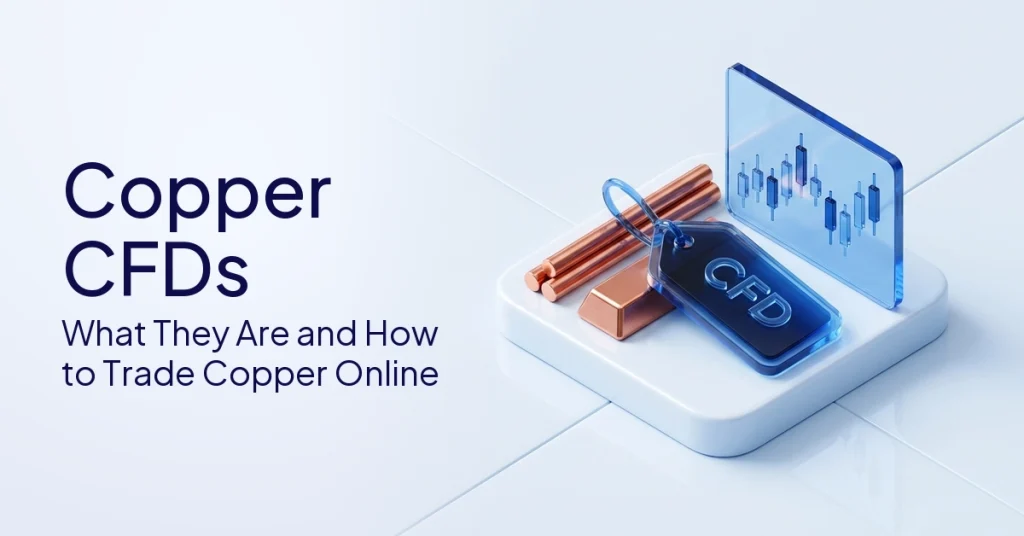
There are several ways to gain exposure to copper prices, including copper CFDs, copper ETFs, mining stocks, futures and physical copper. Copper CFDs allow traders to speculate on rising or falling copper prices without owning the underlying metal.
Why consider copper CFDs alongside traditional investments? Copper is essential to the world’s manufacturing and clean energy infrastructure. If you want to know how to invest in copper, you need to distinguish between short-term trading and long-term portfolio holding.
CFDs are based on price movements. On the other hand, ETFs and stocks are traded through normal brokerage accounts. Physical bullion, however, suffers from considerable difficulties of storage and resale.
The right approach really comes down to your financial goals, risk tolerance and timeline. Let’s determine this in the subsequent sections of this article and learn how to buy copper for investment.
Quick Answer
There are five primary ways for retail buyers to gain exposure to copper, each suited to different financial strategies. CFDs or futures are used by short-term traders to speculate on price action. Long-term investors tend to use ETFs or mining stocks through stockbrokerages. Physical copper bullion is available in bars or coins, but requires planning for storage and insurance costs.
Why Do Investors Buy Copper?
Copper is of interest to investors because of its widespread industrial use and its role as a good predictor of the health of the global economy. It is a good conductor of heat and electricity.
Its sensitivity to economic conditions is why the metal is nicknamed “Doctor Copper”. If you’re looking at alternative investments outside of the traditional stock and bond markets, it’s important to understand how volatile the market behavior can be.
Copper As An Industrial Metal
Copper is a good conductor, strong and pliable. Its physical properties make it indispensable in the infrastructure, machinery and manufacturing sectors around the world.
Why Copper Is Linked To Economic Activity
Copper demand is often seen as a barometer for the health of construction, power networks, electronics, transport and manufacturing.
Because of this broad industrial reliance, market watchers often refer to the metal as “Doctor Copper,” with copper prices regarded as a leading indicator of economic health or decline.
This metal is viewed by many as a key part of alternative investments when diversifying away from traditional equities.
Key Demand Areas
The demand for key energy minerals is growing rapidly, driven partly by grid investments. The core demand areas include:
- Building construction and electric wiring
- Power transmission grids
- Consumer electronics, industrial machinery
- Transportation and electric vehicles
- Renewable energy installations
- Data centres and grid expansion
Supply And Demand Context
Market prices are always being affected by changes in demand and mining supply disruptions. According to the International Energy Agency, clean energy technologies are the most rapidly expanding segment of global mineral demand.
Main Ways To Invest In Copper Online
To access copper online, you can use trading platforms or stock brokerages to access financial instruments linked to the metal.
It depends on what you want. Direct price exposure, part-ownership of a company, or holding the physical metal.
Quick Methods Table
| Method | What It Gives Exposure To | Ownership | Main Consideration |
|---|---|---|---|
| Copper CFDs | Price movement | No physical ownership | Leverage, margin, spreads, execution risk |
| Copper ETFs | Price or related securities | Fund units | Fund structure, tracking error, fees |
| Mining Stocks | Producing companies | Company shares | Operational risk, management, market sentiment |
| Physical Copper | Actual metal | Direct ownership | Storage space, insurance, resale discounts |
| Copper Futures | Standardised contracts | Contract exposure | Advanced complexity, contract size, rollover |
Note: Traders that want flexible price action usually use derivative contracts. Those building long-term portfolios, by contrast, tend to prefer stock-market funds or mining shares.
Copper CFD Trading: How To Buy Copper Through CFDs
CFD trading on copper enables you to speculate on the price movement of copper either way without having to own the underlying metal.
A Contract for Difference (CFD) is based on the market price as it happens with the financial result being the difference between the entry and exit levels.
To understand the benefits of CFD trading you need to understand how derivative products work.
What A Copper CFD Means
When you trade a CFD you are not buying physical copper. Instead you agree to trade the price difference of the asset from open to close.
Copper Symbols On Trading Platforms
You should be able to find copper on your platform under ticker symbols such as XCUUSD, Copper, or a futures-based ticker. Symbols are named differently depending on the provider.
How Copper CFD Trading Works
For beginners and seasoned traders alike, the process generally follows these steps:
- Open a CFD or Multi-Asset Trading Account with STARTRADER.
- Complete a full identity verification for trading on a live account.
- Deposit money into the account securely.
- Check for copper under commodities or metals.
- Analyze trends by opening the price chart.
- Buy or sell depending on your view of the market.
- Choose your desired trade size.
- Use risk management strategies such as stop-loss or take-profit orders.
- Please review all margin requirements, spreads, and order details.
- Monitor the position live and close it when you want.
Long And Short Exposure
CFDs provide the flexibility of two-way market access:
- Long Position: Exposure to the upside in copper.
- Short Position: Exposure to falling copper prices.
This flexibility is a feature of the derivatives product, not a market recommendation.
Leverage And Margin Risk
Leverage is a key feature of CFD trading. It allows you to open larger positions with a smaller initial deposit. However, leverage can amplify both potential gains and losses, and losses may exceed your initial deposit.
If the market moves against you and your account equity falls below required levels, margin pressure can force you to close positions.
How To Buy Copper ETFs
Copper ETFs provide simple exposure to copper prices through the stock market, while futures contracts or mining companies can be accessed through regular brokerage accounts.
An Exchange-Traded Fund (ETF) is a pooled capital fund that tracks an underlying metal index or equity basket.
What A Copper ETF Is
ETFs are listed on public stock exchanges and traded like a company share. An ETF on copper can be structured to hold the actual commodity, futures or mining shares.
Why Some Investors Use ETFs
Many investors use ETFs for practical reasons:
- Easier access via standard brokerage accounts.
- No need to manage or hold physical copper.
- No direct CFD leverage applied in standard ETF ownership.
- Suitable for investors who prefer traditional exchange-traded products.
- Depending on the structure of the fund, they may be held for long-term portfolio purposes.
Before investing capital in a metals ETF, it’s essential to understand its structure, much like understanding how to trade silver online.
What To Check Before Choosing An ETF
Check the expense ratio, daily liquidity and what the fund tracks. Learning to trade silver online gives you a useful background for comparing exchange-traded metal products.
Indian investors need to look for what copper related funds or global investing facilities are available via Indian brokerages with an eye on local regulations and currency rules.
How To Buy Copper Through Mining Stocks
Investing in copper mining companies provides indirect exposure to the metal, but also involves the usual corporate growth potential and operating risks.
Mining shares are a proxy for the underlying exploration, extraction and processing business.
What Copper Mining Stocks Are
Those are shares in companies that own copper mines. Their financial performance relies on the extraction and sale of refined copper to industrial buyers.
Why Mining Stocks Are Different From Copper Itself
Mining company share prices do not perfectly track spot prices. The results are very sensitive to production costs, debt, quality of management and the geopolitical stability in the region.
The U.S. Geological Survey regularly updates on the impact of concentrated mine production on mineral supply chains.
Pros And Cons Table
| Potential Advantage | Key Risk |
|---|---|
| Easy to buy through standard stock exchanges | Does not provide pure commodity price exposure |
| Offers potential dividends and business growth | Subject to company-specific operational failures |
| Requires zero physical storage or security costs | Share prices may fall even if copper prices rise |
How To Buy Physical Copper For Investment
Retail buyers can purchase physical copper in the form of bars, rounds or coins and own the metal outright and directly.
But buying physical copper for investment involves several significant logistical challenges.
Physical Copper Options
You can buy bullion bars, collectible coins, industrial rounds or scrap metal. Warehouse storage receipts are also available from some specialized dealers.
Why Physical Copper Is Less Practical
Precious metals generally have a higher value per unit of weight than copper. Physical copper can require considerable storage space and may require suitable storage facilities. It costs money to ship, insure, and fabricate into retail products.
What To Check Before Buying Physical Copper
Verify the product’s purity, weight accuracy, seller reliability, and overall storage and resale costs before purchase.
Best Use Case Framing
Physical copper makes sense for investors who are focused on real assets or collectibles, but it is rarely an effective way to grow a general retail portfolio.
Copper Futures: A More Advanced Route
Copper futures are standardised exchange contracts used primarily by commercial hedgers and institutional traders to fix prices for delivery.
The contracts are agreements to buy or sell copper at some future date.
What Copper Futures Are
Futures are used by industrial producers extensively in managing price risk and provide regulated market pricing.
Why Futures May Not Suit Beginners
For beginners, copper futures trading is too complicated because of large contract sizes, strict margin requirements, expiration dates and rollover mechanics.
Traditional futures contracts are not usually preferred by standard retail traders, who prefer simpler and more flexible ways of getting exposure.
What Drives The Copper Price?
Copper prices are reacting in real time to global manufacturing data, Chinese industrial demand, currency valuations and physical mining supply. Knowing these core dynamics can help traders navigate commodity volatility.
1. Global Manufacturing Activity
Industrial output strength is driving consumption for wiring, electronics and construction, which tends to support prices.
2. Chinese Industrial Demand
It is the world’s largest consumer of industrial metals and global price movements are largely driven by shifts in Chinese construction, manufacturing and grid investments.
3. US Dollar Strength
Commodities are priced in US dollars, so a stronger dollar makes copper more expensive for international buyers and can decrease demand around the world.
4. Supply Disruptions
Global output can be quickly curtailed by labor strikes, extreme weather, maintenance at smelters and energy shortages. Warehouse inventory levels are correlated with spot price volatility.
5. Inventories And Market Expectations
The market sentiment shifts quickly according to the exchange warehouse stock levels and future economic projections.
Copper Vs Gold And Silver: What Is Different?
Copper is almost entirely an industrial growth asset, whereas gold and silver trade heavily on precious metal narratives.
Copper Vs Gold
Copper is directly associated with economic growth. On the other hand, gold is a safe-haven asset and thus sensitive to inflation expectations, interest rates, and macro risk.
Copper Vs Silver
Both are used in industry, but silver is still a very precious metal, while copper is a pure industrial base metal.
Practical Comparison Table
| Metal | Main Market Identity | Common Price Driver |
|---|---|---|
| Copper | Industrial base metal | Manufacturing growth, construction, electrification |
| Silver | Hybrid precious/industrial | Industrial demand, dollar strength, gold correlation |
| Gold | Safe-haven monetary metal | Macro risk, interest rates, inflation expectations |
Risks To Know Before Buying Copper Exposure
Each approach to the copper market has its own financial, structural and operational risks that need to be managed in a disciplined manner.
- Commodity prices are characterized by sharp, unpredictable volatility.
- CFDs are leveraged and therefore have a higher risk of capital loss and margin calls.
- ETFs have management fees and may also have tracking error.
- Shares in mining companies have operational, labour and geopolitical risks.
- Retail premiums on physical copper are high and liquidity is thin.
- Futures contracts are complex in terms of expiry and rollover risks.
- Currency swings can eat into international returns.
- Industrial metal demand is directly affected by a slowing global economy.
- Sharp price movements are caused by supply shocks.
- There is no way to trade copper that guarantees you’ll make returns.
FAQs
You can get exposure to copper through CFDs, ETFs, mining stocks, futures contracts or physical metal bars and coins. Check price, liquidity and ownership mechanics before you decide.
Yes, there are online trading platforms and brokerages that allow you to trade copper derivatives or equities. The majority of retail activity is exposure to price via CFDs or funds, as opposed to physical delivery.
Trading tickers vary by platform. Typical symbols are XCUUSD for spot CFDs, HG for COMEX futures or simply Copper for multi-asset brokers.
Copper provides exposure to industrial growth and electrification themes, but carries high price volatility. Whether it’s right for you depends on your personal timeline and risk tolerance.
Copper is nearly 100% reliant on industrial consumption and construction. Gold is primarily a store of value and a safe haven during times of crisis.
Conclusion
There are a number of ways to get exposure to the copper market, but each has its own ownership, liquidity, costs and risks.
Copper remains an essential industrial metal, closely tied to world economic activity and the development of modern infrastructure. CFDs offer flexible price exposure to the market without the hassle of physical ownership for those who want to access the market.
ETFs offer straightforward fund-based access and mining stocks provide equity and company-specific dynamics. Physical copper offers direct ownership but obvious logistical challenges for storage and resale.
Futures contracts are still best left to the pros. Copper prices are likely to continue to be driven by manufacturing cycles, Chinese demand, US dollar movements, supply disruptions and inventory levels.
Whatever the method, no approach guarantees returns. Open a STARTRADER live account today and start trading on multi-asset platforms. Learn more about the dynamics of trading the commodity markets.
CFDs are complex financial instruments and carry a high risk of losing money rapidly due to leverage. You should ensure you fully understand the risks involved and carefully consider whether you can afford to take the high risk of losing your money before trading.
A copper CFD is an agreement between you and the provider. It gives you no ownership of, or entitlement to, physical copper, and you are exposed to the provider’s ability to meet its obligations under the contract. Margin is collateral against your position, not a fee, and it can be lost in full. If your margin level falls below the required level, positions may be closed automatically. Financing charges apply to positions held overnight. Contract size, tick size, quote convention and price source are set by the provider and differ between platforms.
This content is provided for educational and informational purposes only. It does not constitute investment advice, financial guidance, or a recommendation to trade any financial instrument.
Tags


Open Live Account
 Email Address
 Phone Number
Important Notice
STARTRADER does not accept any applications from Australian residents.
To comply with regulatory requirements, clicking the button will redirect you to the STARTRADER website operated by STARTRADER PRIME GLOBAL PTY LTD (ABN 65 156 005 668), an authorized Australian Financial Services Licence holder (AFSL no. 421210) regulated by the Australian Securities and Investments Commission.
Important Notice for Residents of the United Arab Emirates
In alignment with local regulatory requirements, individuals residing in the United Arab Emirates are requested to proceed via our dedicated regional platform at startrader.ae, which is operated by STARTRADER Global Financial Consultation & Financial Analysis L.L.C.. This entity is licensed by the UAE Capital Market Authority (CMA) under License No. 20200000241, and is authorised to introduce financial services and promote financial products in the UAE.
Please click the "Continue" button below to be redirected.


