








 Web Trader MT5











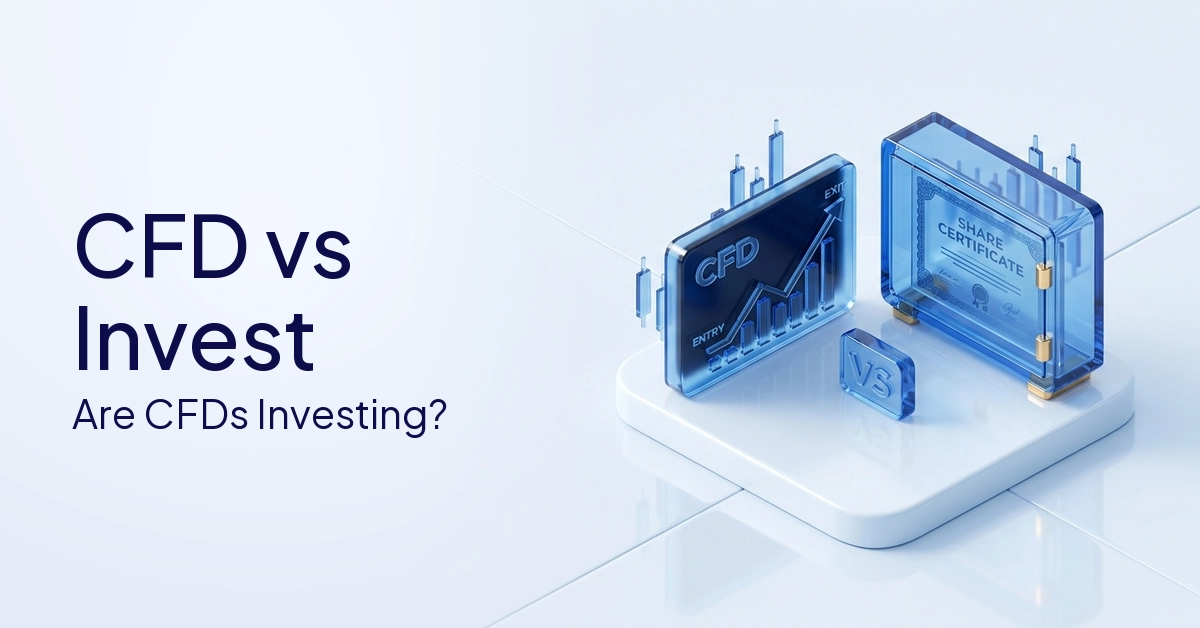
No, CFDs do not mean investing; they are just trading instruments that offer market exposure without owning the underlying asset.
Have you ever thought about why it is fundamentally different to purchase a stock on the one hand and a derivative contract on the same company on the other?
Most beginners get into the financial markets with the aim of finding an answer to the CFD vs invest debate, hoping that investing any money in any financial market is an investment.
Traditional investments entail buying and holding real-world assets, such as stocks, ETFs, or bonds, in the long term to grow. On the other hand, CFDs are all about speculation on short-term price movements, using borrowed money.
This guide will break down the structural differences, underlying risks, and use cases, so you can get a sense of which direction aligns with your goals. Note that this content is educational and should not be taken as investment advice.
Quick Answer
CFDs are not investments but rather short-term trading instruments. Investment is usually the legal ownership of physical assets to achieve long-term compounding growth. CFDs focus on speculation about immediate price movements and use high leverage to increase market exposure.
What Does “Invest” Mean Compared with CFD Trading?
Investment involves buying a real asset to be held over a long period, whereas CFD trading is a contract to sell or buy the difference between an asset’s value.
Investing
Investing refers to the acquisition of a financial asset with the aim of generating a steady income stream over time. When you buy stocks, ETFs, or bonds, you become the legal owner of a portion of that object. You are physically in possession of the asset in your bond portfolio.
Investing is usually aimed at long-term creation of wealth. Investors depend on the market’s overall growth, the interest earned on compounding, and passive income in the form of dividends. Having time in the market is preferred to trying to time the daily market movements accurately.
CFDs
A Contract for Difference is a financial derivative. It is a contract between a retail trader and a broker to enter into the difference in an asset’s price from the time the contract opens until it closes. Not even once do you ever own the underlying asset.
CFD traders do not invest in long-term portfolio construction. Instead, they try to exploit short-term price changes. It all depends on proper forecasting of whether a market price will increase or decrease within a compressed time period.
Invest vs CFD: What Do You Actually Own?
Investing involves owning a physical asset and its legal rights, whereas in a CFD, it is simply a speculative digital contract.
Ownership Rights vs Contract Exposure
Traditional investment provides you with unique shareholder privileges. By purchasing physical shares of a publicly traded company, you usually have the right to vote at its annual general meeting. You also have a legal entitlement to a fair percentage of the company assets.
CFDs do not confer any ownership rights at all. You are just taking a position on the directional movement of the market price. You do not have a say in the corporate affairs, control boards of companies, and cannot claim underlying business assets.
What Happens in Dividends and Splits with CFDs
When you own a dividend-paying stock, the company itself transfers cash into your investment account. The physical number of shares is adjusted in real time to reflect corporate activities, such as a stock split.
In the case of CFDs, a broker hand-calculates the dividend updated to reflect such corporate occurrences. When you have a long buy CFD, the cash equivalent of the dividend balance is credited to your account. In case you have a short (sell) position, the dividend value is directly debited from your account.
| Feature | Traditional Investing | CFD Trading |
| Asset ownership | Yes — you own the asset | No — contract only |
| Voting rights | Yes (equities) | No |
| Dividends | Direct payment | Cash adjustment (not a dividend) |
| Use of leverage | Rarely (margin accounts) | Standard feature |
| Short selling | Complex / limited access | Straightforward — go short easily |
| Overnight costs | Generally none | Financing fees apply |
Difference Between CFD and Investing: Leverage Changes Everything
The most crucial difference between CFDs and investing is leverage, which artificially amplifies prospective returns and prospective losses.
Margin, Leverage and Liquidation Risk
CFDs are leveraged products in essence. All you have to do is to put up a small fraction of the total trade value, otherwise called margin and open a huge position. Traditional investing typically involves paying the entire unleveraged value of the asset upfront.
This margin requirement causes extreme forced liquidation risk. When the market runs against your CFD position, the account can be subject to a balance that is lower than the necessary margin requirement.
The broker will automatically close your trade to prevent any further loss. An in-depth report by the European Securities and Markets Authority (ESMA) found that high leverage greatly increases the rate of depletion of retail accounts compared to unleveraged investing.
Why Small Moves Can Cause Big Profit or Loss Swings
Using high leverage greatly increases your real market exposure. A slight fluctuation in the underlying asset price causes a much larger fluctuation in your CFD account balance. This provides a risky, volatile atmosphere.
In the traditional investment market, a partial decline in the worth of the asset merely leads to an equal proportional decrease in your portfolio that can be managed. Leveraged CFDs may wipe out and ruin your entire initial deposit in a very short period of time if the market moves against you.
- Mini Case Study: Suppose you have $1,000. Under the traditional way of investing, a 5% decrease in the asset results in a mere 50% loss. At 10:1 leverage on a CFD, however, every 5% decrease would go to waste as a loss of $500. Half of your entire account will be wiped out immediately.
Cost Comparison Without Focusing on Price
The standard fees charged in traditional investments are long-term holding fees and initial commissions, whereas the main fees in CFD trading are continuous spreads and daily financing costs.
Spreads and Commissions
Both CFDs and traditional investments incur inherent trading expenses. Traditional brokers usually levy a fixed commission or a low percentage per transaction. Most current platforms have transitioned to zero-commission models and now depend on other revenue streams.
The spread is the primary source of revenue for CFD brokers. The difference between the contract’s sell and buy prices is called the spread. The wider the spread, the greater the cost of entering the trade. Through STARTRADER educational trading hubs, you will be able to test the impacts of different cost structures on strategies.
Overnight or Financing Fees vs Long-term Holding Costs
Long-term holding of a traditional investment incurs virtually minimal maintenance expenses. You may be charged a small management fee each year if you invest in pooled funds or ETFs. CFDs attract daily overnight finance charges.
Since you are conducting business on margin, you are, in effect, borrowing money straight from the broker. In case you have a CFD position beyond the market close at the end of the day, a small interest charge is debited on your account.
| Cost Type | Traditional Investing | CFD Trading |
| Upfront Fees | Standard commissions or zero-fee | Built into the bid/ask spread |
| Ongoing Costs | Annual management fees (for funds) | Daily overnight financing fees |
| Shorting Costs | High borrowing fees and restrictions | Built seamlessly into the spread |
CFD Trading vs Investing: When People Use Each.
Passive investors tend to invest in the long term to accumulate wealth using traditional investments, whereas active investors tend to use CFDs for aggressive short-term investments.
Short-term Speculation and Hedging
Active market participants favor CFDs to exploit swift intra-day market fluctuations. They particularly use technical analysis to forecast the short-run trends. Participants can also easily profit from falling markets through friction-free short selling with CFDs.
CFDs are also a great hedging instrument for current portfolios. When you are the owner of a physical stock portfolio but expect a short-term crash in the market, you can open a short CFD position. This would offset possible losses in your physical portfolio without compelling you to sell your real assets.
Long-term Wealth Building and Diversification.
The investment is the cornerstone of long-term financial planning. It helps secure capital against inflation over the decades. Real investors apply a buy-and-hold strategy to comfortably ride out short-term market volatility.
Sustainable wealth creation is pegged on long-term ownership of various assets. This tactical process is extremely patient. It is also centered on economic value rather than a daily price chart obsession.
A Middle Ground: ETFs for Broad Exposure
Exchange-Traded Funds (ETFs) can be considered a very efficient midway. They pool the funds of many people and invest in a diversified portfolio of assets. ETFs are actively traded on regular exchanges as individual stocks.
Their market exposure is diversified and wide without the excessive risks of leveraged derivatives. The ETFs are typically considered the best place to start a passive, stable investment strategy.
Risk and Suitability: Which Approach is Safer For Beginners?
The concept of unleveraged investing is universally considered the safest for beginners, as it avoids margin calls and slower market dynamics.
Common Beginner Mistakes
CFD trading has numerous advantages and disadvantages. For example, beginners always vastly underestimate the devastating effect of leverage. It does not take long to ruin an account with overtrading on a single trade.
As the Financial Conduct Authority (FCA) statistics indicate, most retail client accounts incur capital losses when they engage in uneducated, undisciplined trading of leveraged derivatives.
The other common mistake is coming into the market without a well-developed risk management strategy. Operating without stop-loss orders is a certainty to failure. It is also not helpful to take position sizes that are way larger than the account balance.
Practical Risk Rules
Risk management is very important to any financial venture. Setting a policy also shields your capital against emotional choices.
- Limit exposure: Take no more than 1-2% of your total account equity as risk on any one trade.
- Use protection: It is always important to use a strict stop-loss order to limit possible losses.
- Cap daily losses: Have a daily limit of bad losses so that you are forced to walk away on a bad streak.
Regulation and Availability: What to Check.
CFD laws differ widely across countries, with governments focusing on consumer protection amid the potential severe risks of leveraged derivatives.
Why CFDs May Be Restricted in Some Regions
Retail CFDs face heavy scrutiny by global regulators. Due to their extreme complexity as financial instruments, numerous jurisdictions impose strict limits on the maximum allowable leverage.
To avoid systemic losses, some countries have prohibited retail participants from engaging in them completely. These extreme restrictions are there simply to protect consumers.
Regulatory bodies want to protect inexperienced market participants before they fall and lose their money in a very short time.
Compliance Note: Always Verify Local Rules
It is important to note that you should always be familiar with the financial policies that apply in your country of residence. Make sure that you have used a financial platform that is well-licensed and approved by your local regulatory authority.
It is imperative to read the risk disclosure statements required by financial institutions. Understanding your domestic legal system will significantly increase the security of your capital.
When you are willing to venture into a structured, controlled environment, you might want to examine what is available at STARTRADER to see how it fits into your learning experience.
FAQs
CFD is only a trading instrument. They mean trading in the short run with borrowed funds, and investing is owning a product physically to grow in the long run.
The principal difference between CFDs and investing is reduced to the absence of actual ownership and the use of leverage. Investing provides an underlying asset and rights of a legal shareholder, whereas a CFD simply represents a leveraged contract which shows the changes in prices without any asset transfer.
It is technically possible, but very inefficient and quite costly. CFD companies charge daily overnight financing costs for holding leveraged positions, and this can drain your capital over months or years.
No, CFDs are not paying direct, legal dividends. Brokers are, however, using automated dividend adjustments to your account value in order to reflect the corporate action of the underlying stock mathematically.
Conclusion
CFDs and traditional investments serve different financial purposes and involve different mental approaches. Investing involves building real assets, fostering long-term economic development worldwide, and creating sustainable wealth in a safe, long-term manner.
CFDs, on the other hand, are highly leveraged, high-speed instruments used to speculate on short-term market moves without owning the asset. Knowledge of these firm boundaries eliminates costly beginner mistakes.
You need to align the approach you have chosen with your financial objectives, time horizon, and emotional risk aversion. It would always be prudent to have a well-rounded education foundation before putting any capital at risk in the live markets.
Tags


Open Live Account
 Email Address
 Phone Number
Important Notice
STARTRADER does not accept any applications from Australian residents.
To comply with regulatory requirements, clicking the button will redirect you to the STARTRADER website operated by STARTRADER PRIME GLOBAL PTY LTD (ABN 65 156 005 668), an authorized Australian Financial Services Licence holder (AFSL no. 421210) regulated by the Australian Securities and Investments Commission.
Important Notice for Residents of the United Arab Emirates
In alignment with local regulatory requirements, individuals residing in the United Arab Emirates are requested to proceed via our dedicated regional platform at startrader.ae, which is operated by STARTRADER Global Financial Consultation & Financial Analysis L.L.C.. This entity is licensed by the UAE Capital Market Authority (CMA) under License No. 20200000241, and is authorised to introduce financial services and promote financial products in the UAE.
Please click the "Continue" button below to be redirected.


