








 Web Trader MT5









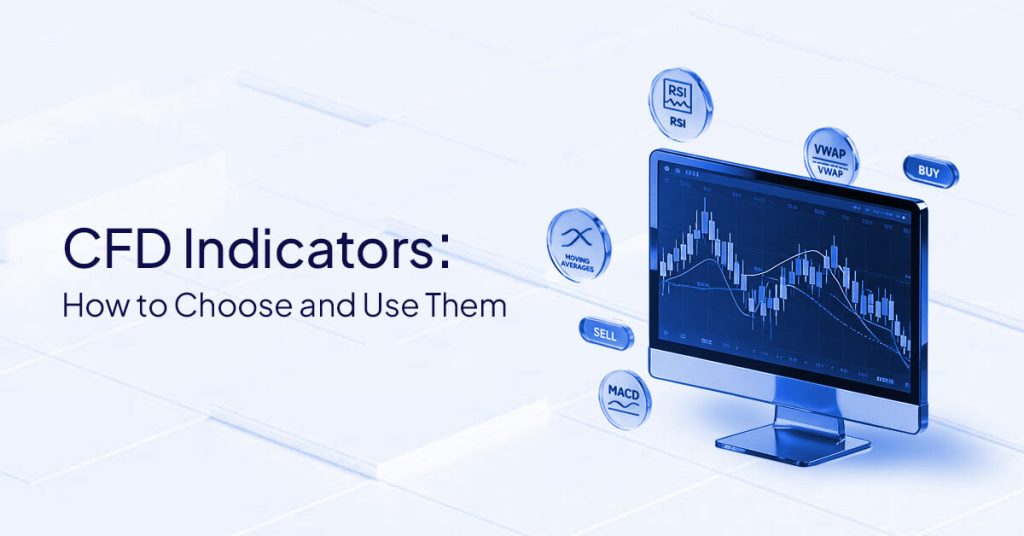
CFD indicators are chart-based analytical tools applied to price charts to help traders understand market behaviour, trends, momentum, volatility, and potential support or resistance levels.
But there are hundreds of tools in the market, how will you know which ones actually slash through the market noise?
Such tools are computed based on past trading data and presented as graphs on trading websites. They help traders identify patterns or situations that may affect their future decisions. Most traders use a combination of various CFD indicators to develop a systematic market analysis strategy.
The way various indicators operate and how they relate to each other can help explain price moves more effectively. Indicators must, however, be regarded as tools of analysis rather than strategies in themselves. Their signals should be considered in the context of the market as a whole and with robust risk management.
No indicator can be sure of results, and contradictory signals are an inherent aspect of charting. This guide discusses key indicators in CFD markets and how to choose them based on your objectives. We will also discuss practical examples of setups used and how to test these tools on platforms such as MT4 and MT5.
Quick Answer
CFD indicators are trading tools used to analyze price charts and help traders understand market behavior, including trends, momentum, volatility, and potential support and resistance levels.
These are tools computed from past price information and displayed graphically on trading platforms, which traders use to organize their market observations.
Most traders use two or three indicators, which are combined to form a systematic analysis method. This type of knowledge can make reading price charts easier, as you can understand how the various indicators operate and interact. Having said that, indicators are strategy tools rather than strategies by themselves. Their signals should be considered in relation to market circumstances and risk management.
What Are CFD Technical Indicators?
CFD technical indicators are mathematical calculations derived from historical prices and volume data to help traders predict future market trends.
Indicator vs Strategy
You should know that the distinction between an indicator and a strategy is obvious. The indicators are merely analytical tools that provide data points on the prevailing market situation.
A trading strategy, on the other hand, is a system in its entirety. It is a mix of signals and stringent regulations on market entry, exit, and risk management.
Why Indicators Can Conflict
Various indicators are used to gauge completely different market traits. This is why traders often encounter conflicting signals on the same chart.
For example, a trend indicator may signal that the market is moving upwards. In contrast, a momentum oscillator may indicate that the asset is overbought and poised to reverse. Both tools are mathematically accurate, but they measure different things.
How Traders Avoid Indicator Conflicts
Traders do not get involved in such conflicts since they use complementary tools rather than overlapping ones. The most common way to visualize a combination of three momentum oscillators on a single chart often leads to confusion rather than clarity.
It is important to make your analysis simple and straightforward. According to a financial markets report, algorithmic and technical tools are best used with non-overlapping market variables.
Types of Indicators Used in CFD Trading
Traders classify indicators into trend, momentum, volatility, and volume tools to measure certain properties of price action.
Trend Indicators
These are the tools that are used to determine the general market trend. They also iron out the temporal price movements to indicate the greater direction.
Examples of these include Moving Averages and the MACD. They come especially in handy in markets that are showing definite higher highs or lower lows.
Momentum Indicators
Momentum indicators measure price movements in terms of speed and strength. They help determine whether a trend is gaining momentum or decelerating.
They are Stochastic oscillators and the RSI. These tools tend to swing between certain levels in an effort to signal the possibility of a turn.
Volatility Indicators
These indicators measure the extent and frequency of price changes. They adjust to market conditions, taking on a broad form during periods of high and low prices and narrowing to a small scale in quiet seasons.
They can be the Average True Range (ATR) and the Bollinger Bands. They play important roles in establishing attainable stop-loss orders.
Support and Resistance Tools
The tools assist in defining possible price limits within which the market has had difficulties in penetrating in the past. They lay the psychological battleground between the sellers and buyers.
These are pivot points and Donchian-style channels. These concepts help traders identify logical entry and exit points.
“Volume” Tools
Such indicators aim to gauge the strength of trading behind a price change. Nonetheless, the differences are also important given the underlying market data, and we will discuss them later.
| Indicator Category | What It Measures | Common Examples |
| Trend | Direction of the market | Moving Averages, MACD |
| Momentum | Speed of price changes | RSI, Stochastic |
| Volatility | Size of price swings | ATR, Bollinger Bands |
| Boundaries | Historical turning points | Pivot Points, Channels |
How to Choose Indicators For CFD Trading
To choose the appropriate indicators for trading CFDs, it is necessary to align the mathematical tool directly with your market purpose.
Match Indicator to Trading Objective
Your charting tool should align with what the market is doing now. Trend-following analysis uses tools such as moving averages to ensure you remain on the right side of the trend.
On the other hand, the range trading analysis has the advantage of oscillators, which indicate the extremity of overbought and oversold periods. Volatility tools are frequently used to verify that a new move has momentum behind it and to detect breakouts.
Timeframe Alignment
Traders usually use a single time frame when making their trade decisions. Nevertheless, verification over a longer period will help provide a clearer picture of the market.
For example, an indicator may signal an uptrend on a 15-minute chart, but a 4-hour chart may show the price approaching major resistance. Having timeframes aligned with the market flow will ensure you do not go against the market.
Keep Indicator Selection Simple
One trap is using too many indicators. A chart with too many lines on it causes analysis paralysis.
Take a small group of tools that indicate utterly different areas of the market. Our trading education resources could help you learn more about building a balanced approach.
Moving Averages For CFDs
Moving averages smooth out past price fluctuations in data, helping traders quickly see the overall market trend.
Common Moving Average Types
The Simple Moving Average (SMA) is a computed average of the price in a given number of periods in equal measure. It offers a smooth, steady line that responds slowly to abrupt price increases.
The Exponential Moving Average (EMA) places greater weight on recent prices. This ensures that it responds to new information in the market much faster, a characteristic that most short-term traders enjoy.
What Moving Average Crossovers Indicate
When a faster-moving average intersects a slower one, there might be a change in trend direction. Indicatively, when a short-term EMA crosses over a long-term SMA, it tends to indicate an uphill trend.
Crossovers, however, are severely restricted in sideways markets. When prices retrace back and forth, they may give several signals, which are commonly known as whipsaws.
Practical Use in Trading Analysis
Moving averages are very useful as a filter of the trend at the base. When the price is above the moving average, traders may be interested only in buying.
They can also be used to determine pullbacks in trends. Prices tend to return to a significant moving average, then resume their main path.
RSI For CFDs
Relative Strength Index (RSI) is used to assess the rate and direction of price fluctuation with the view of determining the existence of overbought or oversold conditions.
RSI Signals Explained
RSI is measured on a scale of 0 to 100. Historically, readings of 70 and above indicate that an asset can be overbought, whereas readings of 30 and below indicate that an asset is oversold.
Nevertheless, the levels need to be interpreted in a contextual manner and not by rules. During a strong uptrend, it can take a long time for an asset to stabilize or become overbought.
RSI Divergence
Divergence is a notion of price and a signal that runs in the opposite direction. As an example, when the price forms a higher high whilst the RSI forms a lower high, it is bearish divergence.
This deviation can be a pointer that positive momentum is wearing out. Although it may be a strong cautionary measure, it is limited and may not necessarily create an automatic turnaround.
Common Beginner Mistake
One common mistake is entering trades based solely on extreme RSI readings during strong trends. When a market is assumed to turn around simply because the RSI has reached 80, it often results in frustrating losses.
MACD for CFDs
The MACD blends momentum and trend-following to help traders identify changes in market direction and strength.
Components of MACD
There are three major visual components of the MACD. The MACD line measures the difference between two exponential moving averages, typically a 12-period and a 26-period EMA.
The signal line is a smoothed moving average of the MACD line. Lastly, the histogram will represent the distance between the MACD and signal lines.
Interpreting MACD Signals
Crossing the MACD line at the signal line may indicate an early change in momentum. The extending or narrowing of the histogram also indicates that the trend is becoming stronger or weaker.
Trend continuation confirmation is the most appropriate application of this tool. The movement averages and the MACD line moving in the same direction are an added advantage, as this provides a superior analytical base.
Bollinger Bands and ATR for CFDs
The Bollinger Bands and the Average True Range (ATR) map market volatility to help traders adjust their risk management to the prevailing environment.
Bollinger Bands
The Bollinger Bands are made up of a simple moving average with upper and lower bands made up of standard deviations. The idea is based on the expansion and contraction bands.
When bands narrow, volatility is low, and a breakout usually follows. Understanding volatility cycles will play a significant role in your trading environment.
Average True Range (ATR)
The ATR only considers the average change in price over a predetermined duration, and does not give much attention to the direction of the trend. The CME Group records that volatility metrics are vital to adjusting to changing markets.
A fundamental risk-control use of ATR is to apply it to position sizing and stop placement. When the ATR is high, traders tend to set wider stops and reduce position sizes.
Volume Indicators in CFDs: What to Know
CFD volume indicators provide a simple proxy for market participation because they are based on tick activity rather than the number of contracts actually traded.
Why Volume Data Varies Across Asset Classes
The actual volume data is the figure of the number of shares or contracts which have been traded. This can easily be followed in the exchange-traded markets, such as equities or futures.
Nevertheless, the forex or spot metal CFDs trade in the decentralized markets. As there is no central exchange, it is not possible to tally all individual global transactions in real-time.
Tick Volume vs Exchange Volume
Due to this decentralization, charting platforms use a tick-based volume metric. Tick volume is the number of times that a price has changed or ticked in a given time interval.
Although it is not similar to centralized volume reporting, tick volume is also a highly correlated proxy. A high tick volume tends to indicate high market activity and liquidity.
When Volume Signals May Be Misleading
Since tick volume is based on the liquidity provider’s data feed, market data sources may differ slightly. An increase in tick volume at one broker would be different from another.
Thus, it is crucial to achieve volume analysis and the transparency of the price structure. Price action must be confirmed by volume and not determined by it.
Simple Indicator Combinations
It is a combination of complementary indicators that helps filter out false signals and provides a more organized, logical way to analyze the market.
Set up A: Trend filter + Momentum Confirmation.
The purpose of this setup is to buy or sell against the prevailing trend until the localized pullback occurs.
- EMA Trend filter: 50-period EMA, used to decide on direction (only to buy when the price is above the EMA).
- RSI for momentum: Watch until the RSI falls to around 30-40 to value on a pullback.
- ATR for stop distance: Place the stop-loss 1.5 times the current ATR below the entry point.
Setup B: Range Analysis
This setup is designed to consolidate markets that lack any sideways trends.
- Bollinger Bands: These are used to define the upper and lower bounds of a price range.
- RSI: The aim is to identify reversals in price by monitoring the RSI to enter overbought zones whenever the price reaches the upper Bollinger Band.
Set up C: Trend Continuation
This is a tactic aimed at exploiting a well-established trend.
- Moving-average filter: Price must move above a slow-moving average.
- MACD confirmation: MACD histogram should cross the zero-line, indicating a new wave of momentum.
Note: The following are illustrative examples of structural concepts (they are not strategies to be followed).
How to Add and Test Indicators on MT4/MT5
The analytical tools can be easily attached, customized, and backtested on both the MT4 and the MT5 platforms to help traders refine their chart analysis.
Adding Indicators on Charting Platforms
To insert an indicator on MT4 or MT5, go to the indicators menu, then select the indicator category of your choice. You can also easily change the settings that include periods, colors, and line thickness at this point.
After configuring your chart as a template, you can save it and use it regularly on other assets. None of these templates can be customized without the help of the platforms offered by STARTRADER.
Backtesting Basics
Manual chart review is necessary before using any tool. Go through historical data to get the picture of the indicator’s performance on various market stages.
Replay-style testing plugins can also be used, or, easier said than done, forward testing can also be performed in demo environments. Virtual money testing can help gauge how real markets behave when forward markets are not moving.
Maintain a Trading Journal
Simply keeping a trading journal is one of the quickest ways to improve. You must strictly document your entry cues and the precise readings of the indicators that are in place when you enter.
Recording your trade performance and experience can show you which tools work with your particular market style.
Common Mistakes with CFD Indicators
This is the most common mistake traders make: they overload their charts with unnecessary indicators that give contradictory information.
Using Too Many Indicators
When there are too many indicators, analysis becomes confusing. With five lines on a chart, a trader will always have an excuse not to take a valid setup. Keep charts clean.
Constantly Changing Settings
Most traders do curve fitting when they lose. When a 14-period RSI fails on a trade, they will use a 10-period RSI in the hope that it will do better. An ever-evolving setting prevents you from fully grasping the statistical advantage of a tool.
Ignoring Volatility and Trading Costs
Indicators do not reflect transaction costs, such as spreads or overnight holding costs. A high-speed crossover plan may look like a real beauty on a mathematical graph, but it does not take long to lose an account when volatility and expenses are not factored in.
Trading Every Signal
The last one is to trade all signals out of context. An indicator is not a command; it provides information. Any simple line crossing on a chart will always be subordinated by the significance of circumstances and market conditions, such as, economic news or time of day.
FAQs
CFD indicators are tools used on CFD price charts to help interpret trends, momentum, volatility, and market activity.
The most popular indicators are the moving averages, the RSI, MACD, Bollinger Bands, and ATR, which measure various facets of the market activity.
Most traders use two or three complementary indicators to ensure that the charts do not have signals that contradict one another.
Indicators function the same way across various assets, though the nature of each market can influence how they manifest (such as volatility and liquidity).
Conclusion
Traders can learn how to read CFD indicators and better understand price behaviour to structure their chart analysis. Indicators give you a clear visual depiction of trend, momentum, volatility, and possible support or resistance levels to enable you to structure your market observations systematically.
The indicators, however, are tools of analysis, not solutions by themselves. You should never use their signals solely because they should be considered in the context of a wider market, over time, and within a rigorous risk-management framework.
You can also create a more systematic market analysis method by picking a handful of complementary tools and testing them with a charting program like MT4 or MT5. If you are willing to test such analytical tools in a safe environment, consider opening a demo account to see live market data.
Tags


Open Live Account
 Email Address
 Phone Number
Important Notice
STARTRADER does not accept any applications from Australian residents.
To comply with regulatory requirements, clicking the button will redirect you to the STARTRADER website operated by STARTRADER PRIME GLOBAL PTY LTD (ABN 65 156 005 668), an authorized Australian Financial Services Licence holder (AFSL no. 421210) regulated by the Australian Securities and Investments Commission.
Important Notice for Residents of the United Arab Emirates
In alignment with local regulatory requirements, individuals residing in the United Arab Emirates are requested to proceed via our dedicated regional platform at startrader.ae, which is operated by STARTRADER Global Financial Consultation & Financial Analysis L.L.C.. This entity is licensed by the UAE Capital Market Authority (CMA) under License No. 20200000241, and is authorised to introduce financial services and promote financial products in the UAE.
Please click the "Continue" button below to be redirected.


