






 Web Trader MT5











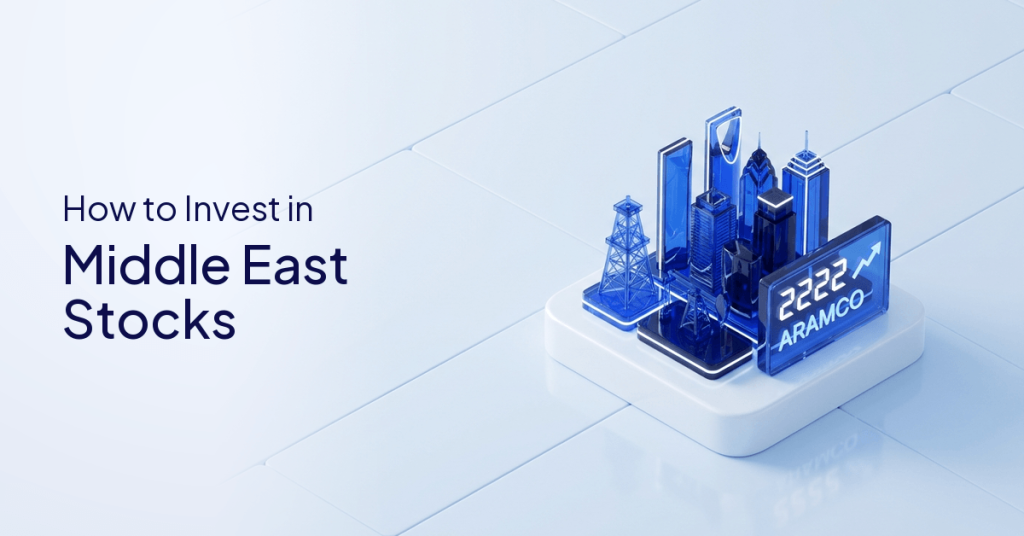
To gain exposure to Middle East equities, you need to get through a number of independent exchanges across the region rather than one unified market.
How is the move from oil dependency to tech-driven economies transforming investment opportunities in the Arab world?
There is not one stock exchange in the Middle East like those in North America or Europe. The region comprises several independent markets in countries such as Saudi Arabia, United Arab Emirates (UAE), Qatar and Egypt.
With the Middle East seeing the emergence of strong banking sectors, rapid infrastructure growth and massive economic diversification programs as dominant energy markets, international investors are increasingly looking for how to invest in stocks to gain exposure to these areas.
This guide covers the main stock markets in the Middle East, how international investors can access them, and the key things to consider before allocating capital.
Quick Answer
Investing in Middle East stocks means exposure to stock exchanges in countries such as Saudi Arabia, the UAE, Qatar, and Egypt. Depending on market regulations and availability, international investors can access these markets via direct exchange access, MENA-focused ETFs or companies with international listings.
What Are The Main Middle East Stock Markets?
Stock exchanges in the Middle East range from emerging markets known worldwide to frontier markets with specific growth potential.
Major financial centres in the MENA (Middle East and North Africa) region include several options. Global index providers classify these markets differently, depending on their level of economic development, size of market and accessibility. Some are classified as emerging markets while others are considered frontier markets.
Saudi Exchange (Tadawul)
The Saudi Exchange (Tadawul) is the region’s largest and most liquid stock exchange. It includes companies from a broad range of sectors, with huge representation in energy, banking and telecommunications. Due to its size and regulatory framework, it has a large weighting in global emerging market indices. For investors looking for deep regional exposure, the Saudi stock market usually comes at the top because of its size.
Dubai Financial Market (DFM)
The Dubai Financial Market is one of the foremost public exchanges in the UAE. Its very focus is on companies in banking, real estate and infrastructure. The DFM is considered to be a proxy for Dubai’s global tourism and commercial hub and is highly sensitive to international travel and demand for real estate.
Abu Dhabi Securities Exchange (ADX)
Another major exchange in the UAE is the Abu Dhabi Securities Exchange, which is gaining increasing global visibility. It includes a number of state-backed big-cap companies, especially in the financial, industrial and energy sectors. The ADX continues to grow its international footprint by drawing foreign institutional capital.
Qatar Stock Exchange (QSE)
The Qatar Stock Exchange is an important market in the Gulf. It names major companies in natural gas extraction, banking and logistics. The QSE is the main gateway for investors seeking to benefit from Qatar’s rich natural resources exports and its infrastructure development.
Egyptian Exchange (EGX)
The Egyptian Exchange is one of the older, more economic diverse exchanges in the region. The EGX is a mix of consumer goods, construction and basic materials companies, while energy dominates the Gulf markets. It is a frontier market classification, meaning higher growth potential and higher risk.
| Exchange Name | Country | Market Classification | Core Sectors |
| Tadawul | Saudi Arabia | Emerging Market | Energy, Banking, Telecom |
| ADX | UAE (Abu Dhabi) | Emerging Market | Financials, Energy, Industrials |
| DFM | UAE (Dubai) | Emerging Market | Real Estate, Banking, Logistics |
| QSE | Qatar | Emerging Market | Natural Gas, Banking, Telecom |
| EGX | Egypt | Frontier Market | Consumer Goods, Construction |
Important Concepts to Know:
- Emerging Market: The economy of a country that is in the process of becoming an advanced one, with increasing market liquidity and regulatory maturity. Global index providers like MSCI use strict criteria for emerging market classification based on ease of capital flows and limits on foreign ownership.
- Frontier Market: A market that is more developed than the least developed countries but less accessible and smaller than traditional emerging markets.
How Can International Investors Access Middle East Stocks?
International investors can invest in Middle East markets via direct broker access, exchange-traded funds focused on the region or globally listed depositary receipts.
Direct Exchange Access
International brokers that provide international market execution can give some international investors access to Middle East exchanges. But direct access is not always easy to come by. To trade on markets such as the Saudi Exchange, foreign investors need to meet certain eligibility and regulatory requirements. This is more for institutional players as retail investors typically have strict qualification criteria to purchase shares directly on local exchanges.
MENA-Focused ETFs
Options on Exchange-Traded Funds that track MENA stocks would offer a broad-based regional exposure, without the regulatory restrictions of owning the underlying shares. The easiest way for retail investors to do this is through funds that pool assets from the region. A MENA stock ETF allows an investor to purchase a basket of the region’s best companies in one trade through normal brokerage accounts (including those in Saudi Arabia, the United Arab Emirates and Qatar).
ADRs And Dual-Listed Stocks
Some of the region’s largest companies have international listings or American Depositary Receipts (ADRs) that trade on global exchanges in New York or London. This gives an indirect access to Middle East markets through normal domestic brokerage accounts.
What Sectors Are Prominent In Middle East Markets?
Middle East stock markets have a heavy weighting in energy and financial services, but economic diversification is rapidly broadening the real estate, telecommunications and technology sectors.
Energy
The oil and gas industries are the backbone of many Middle-east economies. The market is dominated by state-owned energy giants, and their downstream service providers. These equity markets are therefore very sensitive to the global supply and demand for fossil fuels.
Financial Services
Banks and financial institutions are very important in the region. Regional banks fund large-scale infrastructure projects and manage large amounts of local capital. Financials often carry the heaviest weight in MENA equity indices.
Real Estate And Infrastructure
Construction and property development are very important, especially in the UAE and Saudi Arabia. Strong population growth and government-backed mega projects ensure a steady demand for commercial and residential real estate developers listed on local bourses.
Telecommunications
Telecom providers are critical drivers of regional growth and digital connectivity. These companies tend to have a presence across a number of countries in the MENA region, offer consistent dividend yields and are well-placed to benefit from young, tech-savvy demographics.
Economic Diversification Initiatives
Many Middle East economies are moving proactively to diversify away from oil into sectors such as tourism, logistics and technology. Countries are investing huge sums of capital into sectors outside of oil to develop sustainable economies of the future. International development assessments suggest that sovereign wealth funds have a major role in regional markets by injecting liquidity, supporting domestic initial public offerings (IPOs) and co-investing in strategic infrastructure.
What Should You Consider Before Investing?
Investors need to consider the region’s specific factors like currency movements, geopolitical issues and liquidity before investing in Middle East equities.
A different analysis approach is needed for valuing emerging market stocks compared to investing in developed western markets.
- Currency and Foreign Exchange Risk: Local currencies are subject to fluctuations against foreign currencies. Some Gulf states have their currency pegged to the US Dollar for stability, while other currencies in the region are floating freely, and can see high volatility.
- Market Regulation and Legal Systems: Countries have different market regulation and legal systems. Market moves can be unexpected due to geopolitical events in the wider region.
- Liquidity Risk: Some exchanges, especially frontier markets, may have less trading volume than developed markets. This makes it harder to get in or out of large positions without moving the stock price.
- Oil Price Sensitivity: Global energy price changes remain a major factor in regional economies and markets. Extended declines in oil prices can impact government spending and consequently influence corporate earnings.
- Portfolio Diversification: Middle East equities can act as a strategic diversification in a wider international portfolio. These markets often move independently of US or European equities and can change the risk profile of an investment strategy.
FAQs
The Saudi Exchange (Tadawul) is widely considered the largest and most liquid stock exchange in the region with a multi-trillion dollar market cap driven heavily by state-backed energy and financial corporations.
Yes, but access requirements and rules depend on the exchange and investor status. In the UAE, direct foreign investment is generally permitted through licensed brokers. Saudi Arabia has certain qualifications for foreign institutional investors, making it difficult to access the market directly.
This varies from country to country. Major markets like Saudi Arabia, UAE and Qatar are termed as emerging markets due to high liquidity and regulatory standards. Others are considered frontier markets like Egypt and Oman.
Yes. There are some ETFs which give diversified exposure to MENA equities. These funds tend to aggregate investments in the largest regional exchanges and offer a simple entry point for international retail investors.
Conclusion
When you invest in Middle East stocks you are not investing in one single unified market but rather in multiple regional exchanges, primarily across Saudi Arabia, the UAE, Qatar and Egypt.
Investors can get exposure via direct exchange access through international brokers, region-focused ETFs or internationally listed companies via depositary receipts. Before the capital is invested, one has to know the market structure, sector composition and regional risks (like oil price sensitivity and currency fluctuation).
The importance of broad diversification when adding emerging and frontier market equities to an international portfolio should be emphasized since these regions operate differently from developed Western markets. By studying these areas, investors can gain a better understanding of the global marketplace, such as through educational materials and platforms like STARTRADER.
Disclaimer: This content is for educational purposes only and does not constitute investment, financial, or legal advice. CFDs are complex instruments and carry a high risk of rapid money loss due to leverage. Emerging market investments involve additional risks including currency fluctuations, limited liquidity, and regulatory changes. Any references to regulations or market structures are general in nature and subject to change. Seek independent professional advice before making any investment decisions.
Tags


Open Live Account
 Email Address
 Phone Number
Important Notice
STARTRADER does not accept any applications from Australian residents.
To comply with regulatory requirements, clicking the button will redirect you to the STARTRADER website operated by STARTRADER PRIME GLOBAL PTY LTD (ABN 65 156 005 668), an authorized Australian Financial Services Licence holder (AFSL no. 421210) regulated by the Australian Securities and Investments Commission.
Important Notice for Residents of the United Arab Emirates
In alignment with local regulatory requirements, individuals residing in the United Arab Emirates are requested to proceed via our dedicated regional platform at startrader.ae, which is operated by STARTRADER Global Financial Consultation & Financial Analysis L.L.C.. This entity is licensed by the UAE Capital Market Authority (CMA) under License No. 20200000241, and is authorised to introduce financial services and promote financial products in the UAE.
Please click the "Continue" button below to be redirected.


