








 Web Trader MT5








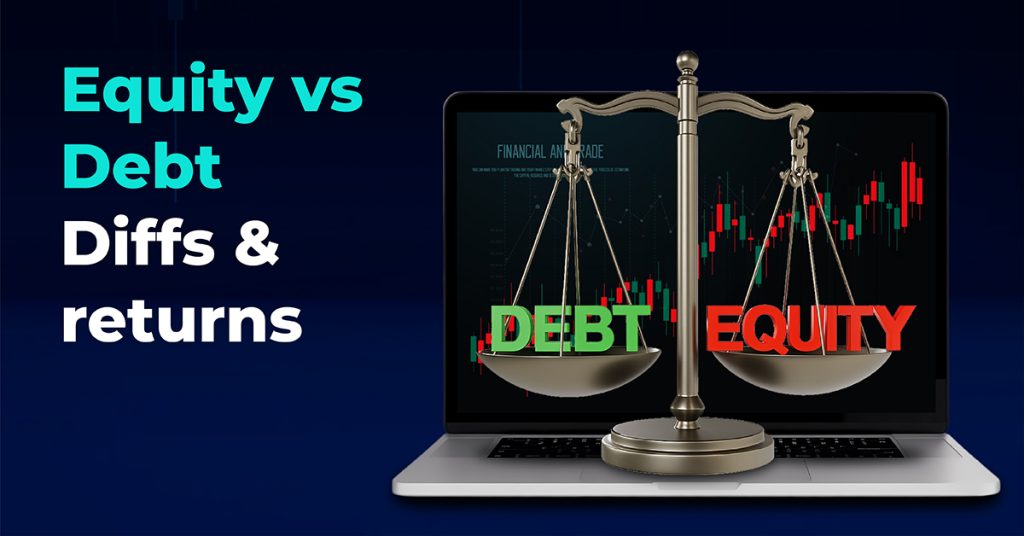
The difference between equity and debt is one of the first things every investor and business owner needs to understand. These two terms represent the most common ways to invest and to raise money. If you’re exploring equity vs debt mutual funds or trying to grasp equity financing vs debt financing, this guide will simplify it for you.
Equity basically means ownership, while debt means lending. Equity involves buying shares and, as a result, becoming a part-owner of a company. On the other hand, debt involves borrowing money for both interest and principal repayment. These two options have their pros and cons, but it all depends on your goals.
In this article, we’ll compare equity vs debt across investing, financing, and securities. You’ll also see when each works best, risks to consider, and real-world examples.
Quick Answers
- The main difference between equity and debt is that equity means owning something, while debt means lending money.
- Equity returns aren’t set in stone and can increase over time, but the risks are higher. Debt returns are more stable, and they don’t rise as much.
- Debt mutual funds are helpful for short-term stability, whereas equity mutual funds are appropriate for long-term growth.
- Equity finance involves selling shares to raise capital, whereas debt financing consists of obtaining money through loans or bonds.
- Debt markets trade bonds and other related instruments, whereas equity markets trade shares.
- For people new to India, the ideal approach to balancing risk and reward is to use a mix of both (via hybrid funds).
What Is Equity? What Is Debt?
Equity meaning:
Equity means owning a part of a business. When you buy shares of a publicly traded company or units in an equity mutual fund, you own a piece of that company. Because of this ownership, you have the right to a part of its profits, which may come in the form of dividends or capital appreciation if the stock price rises.
The value of equity is influenced by several factors, including the company’s performance, investor sentiment, the overall state of the economy, and global market trends.
A few examples of equity are:
- Shares of businesses that are traded on stock exchanges like the NSE or BSE.
- Equity mutual funds that buy several equities using money from a lot of people.
- Private equity, where investors buy shares that are not listed on the stock market.
Equities are riskier than debt, but they also have the potential to yield higher returns. Changes in a firm’s performance, unexpected economic shocks, and market volatility can all impact your investment.
In the long run, equities have done better than most other sorts of investments. For instance, the historical Nifty 50 data reveals that average returns of 12 percent per year have been experienced in the last 20 years (in comparison to 6-7 percent for bonds).
Debt meaning:
Debt, on the other hand, represents lending money. When you invest in debt instruments, you are essentially lending money to a government, corporation, or financial institution. The borrower, in turn, promises to pay you a certain amount of regular interest and give back the principal to you.
Debt investments are generally deemed safer than equity due to the fixed returns, as well as a more precise repayment scheme. The trade-off, however, is that you can make a consistent income, but you miss out on the wealth-building opportunity of equity.
Examples of debt include:
- Government securities, i.e., Treasury Bills or G-Secs.
- Corporate debentures and bonds.
- Debt mutual funds that invest in a bond portfolio.
To sum up, the key difference between equity and debt is that with equity, you own something, whereas with debt, you’re a lender.
Equity vs Debt Mutual Funds — Key Differences
Equity vs debt funds comes down to one big difference – stocks vs bonds. Both are popular types of mutual funds, but they work in very different ways.
When you invest in equity mutual funds, you buy shares in companies. This means that the value of your investment will depend on how well those firms fare in the stock market. If the markets go up and firms do well, your investment can grow a lot.
But when the markets go down, the value of your portfolio could drop a lot. Equity funds are suitable for people who want to build wealth over the long term and who can handle short-term ups and downs.
Debt mutual funds, on the other hand, invest in instruments such as bonds, debentures, and government securities. These are usually more stable than stocks since they pay a fixed amount of interest.
Individuals seeking stability, a steady income, and reduced risk often invest in debt funds. They might not provide you with big profits, but they are reliable and suitable for short-term or safe goals.
Here’s a clearer side-by-side view:
| Factor | Equity Mutual Fund | Debt Mutual Fund |
| Underlying assets | Shares of companies | Bonds, debentures, govt. securities |
| Risk level | High (market-driven) | Low to moderate (interest rate, credit) |
| Returns | Higher potential, volatile | Stable, limited |
| Investment horizon | Long-term (5+ years) | Short-to-medium (0–3 years) |
| Suitability | Growth seekers | Capital preservation, income |
Equity vs debt returns: Equity funds can help you create wealth over time, but they can also face deep drawdowns when the market goes down. Debt funds are suitable for short-term or conservative goals, as they protect your money and provide a stable income.
When to Choose Equity vs Debt (Decision Framework)
Want to know a secret? You don’t have to pick just one. In fact, most successful investors don’t rely only on debt or equity.
It’s best to mix the two in the right amounts often, depending on your financial goals, time horizon, and risk tolerance. This technique helps you benefit from the rising value of stocks while still having the safety net of debt.
This isn’t just a theory. In FY25, Indian investors put a record ₹4.17 lakh crore into equities mutual funds. This made equity AUM go up by about 25% year-on-year to ₹29.45 lakh crore.
Long-Term Goals (5+ years)
If you want to save for things like retirement, your child’s education, or buying a house in a few years, equity is usually the best choice. It’s easy to understand: equities can go up over time. Even when they swing up and down in the short term, stock markets tend to go up over time.
If you stay invested in equity mutual funds for five to ten years or more, they can help you build substantial wealth. This is especially true for index funds or large-cap funds. There will be good times and bad times, but the long-term advantages usually outweigh the risks.
Short-Term Goals (0–3 years)
If your goal is only a few years away, such as planning a wedding, taking a trip, or saving money for emergencies, debt is the safer option. Debt funds, fixed deposits, and government bonds are all good ways to save money and know how much you’ll get back.
Here, safety is more important than high growth. Putting money into stocks for a short time can be risky, as even a minor market dip could disrupt your plans. Debt instruments help manage this volatility and ensure you can access money when needed.
Medium-Term Goals (3–5 years)
This is where things get tricky. A balanced plan is suitable for goals that are neither too close nor too far away. You can grow and stay steady with a hybrid portfolio that has both equities and bonds in it. This is where asset allocation works best.
For example, you may keep 50–60% of your money in equities to grow and 40–50% in bonds to stay stable. As you move closer to your goal, you can gradually increase your debt to minimize your risk.
Asset Allocation & Rebalancing
One of the most essential parts of this decision framework is asset allocation. Many investors start by following the 60/40 rule, which says to put 60% of their money into stocks and 40% into bonds.
Some people use glide pathways, which reduce the amount of equity you have as you approach your goal. This protects you from sudden market fluctuations at the last minute. Rebalancing your portfolio once or twice a year will help you stay on track with your original goal.
New investors in India can get started even more easily with hybrid mutual funds. These funds automatically invest in both equity and debt, so you don’t have to rebalance them often. It’s a simple way to start without overthinking it, and it will help you build a well-rounded portfolio.
Equity vs Debt Financing (Corporate Perspective)
The difference between debt financing and equity financing is central to how companies raise funds.
| Factor | Equity Financing | Debt Financing |
| Source | Dilution of ownership through the sale of shares | Borrowing via loans or bonds |
| Repayment | No repayment is required, but dividends can be issued | Fixed interest + principal |
| Risk for the company | Dilution of control | Pressure of repayment |
| Cost | Potentially higher if the company grows | Fixed, often cheaper |
| Examples | IPO, private equity | Bank loan, corporate bond |
Examples of equity vs debt financing: A start-up may get venture capital (equity) to fasten its growth. An enormous corporation can issue bonds (debt) to expand without losing control.
Equity vs Debt Securities & Markets
- Equity securities: Shares provide you with an ownership right in a company. The value varies according to the performance of the company.
- Debt securities: Bonds, debentures, and treasury bills are all debt securities. The issuer agrees to repay the amount of money within a given date.
| Market Type | Equity Market | Debt Market |
| What trades? | Shares of companies | Bonds, government securities |
| Risk-return profile | High risk, high return | Lower risk, steady return |
| Access | Stock exchanges | Debt markets, bond auctions |
Equity Share vs Debenture
The main difference between equity shares and debentures is their purpose and priority:
- Equity shares: These are shares of ownership, and the returns on them are linked to the company’s profits. More danger, but also more chance of growth.
- Debentures: Debt instruments that may or may not be backed by any assets. They are sure to get interest payments on a regular basis and have priority over shares in demands for repayment in the event of insolvency.
Private Equity vs Private Debt
The difference between private equity and private debt is in the investment structure:
- Private equity: This refers to the purchase of privately owned stocks. The returns are based on the growth and exit strategies of the company.
- Private debt: Investors supply funds outside the banking system. It is concerned with stable cash flow, but there is a possibility of credit or covenant issues.
Institutional or high-net-worth investors typically purchase these instruments.
Risks & Costs to Watch
No investment is free of risks or costs.
- Market movements, concentration risk, and global events are all risks associated with equity funds. As of September 2025, over 74% of equities mutual funds in India have negative one-year lump-sum returns. That’s why putting money into equities for a short time might be dangerous.
- Risks of debt funds include defaulting on payments, rising interest rates, and insufficient cash.
- Costs to keep an eye on include expense ratios, brokerage fees, demat/DP costs, exit loads, and tracking errors (ETFs).
A helpful tip: New traders can use a reliable broker like STARTRADER to buy and sell stocks and bonds with transparent fees and tools to help them control their risks.
FAQs
A: Equity means ownership, and debt means lending. Equity is riskier but can grow faster; debt is steadier but limited in upside.
A: Equity funds are better for growth over the long term. For short-term or conservative goals, debt funds are safer.
A: Returns on equity fluctuate significantly, but they can add up over time. Debt returns are stable and meet short-term needs.
A: The equity market is where stocks are bought and sold, while the debt market is where loans and bonds are bought and sold. When it comes to investing, they both have different goals.
A: Debt financing can be cheaper because it doesn’t change who owns the business, but you do have to pay it back. Equity means giving up ownership, but you don’t have to pay it back.
Final Thoughts
So, which is better: equity vs. debt? It all depends on your goals. Equity provides you with ownership, a chance of higher payment, and long-term development, yet it is also volatile. Debt is stable, offers a stable flow of income, and is less risky, but has no great potential.
A combination of both is the most appropriate option for those in India who are just beginning: long-term wealth with equity and short-term protection with a loan. It can be a good place to start with hybrid mutual funds.
Ready to start? Platforms like STARTRADER allow one to access equity and debt products more easily. This will make you more confident when investing.
Tags


Open Live Account
 Email Address
 Phone Number
Important Notice
STARTRADER does not accept any applications from Australian residents.
To comply with regulatory requirements, clicking the button will redirect you to the STARTRADER website operated by STARTRADER PRIME GLOBAL PTY LTD (ABN 65 156 005 668), an authorized Australian Financial Services Licence holder (AFSL no. 421210) regulated by the Australian Securities and Investments Commission.
Important Notice for Residents of the United Arab Emirates
In alignment with local regulatory requirements, individuals residing in the United Arab Emirates are requested to proceed via our dedicated regional platform at startrader.ae, which is operated by STARTRADER Global Financial Consultation & Financial Analysis L.L.C.. This entity is licensed by the UAE Capital Market Authority (CMA) under License No. 20200000241, and is authorised to introduce financial services and promote financial products in the UAE.
Please click the "Continue" button below to be redirected.


