








 Web Trader MT5







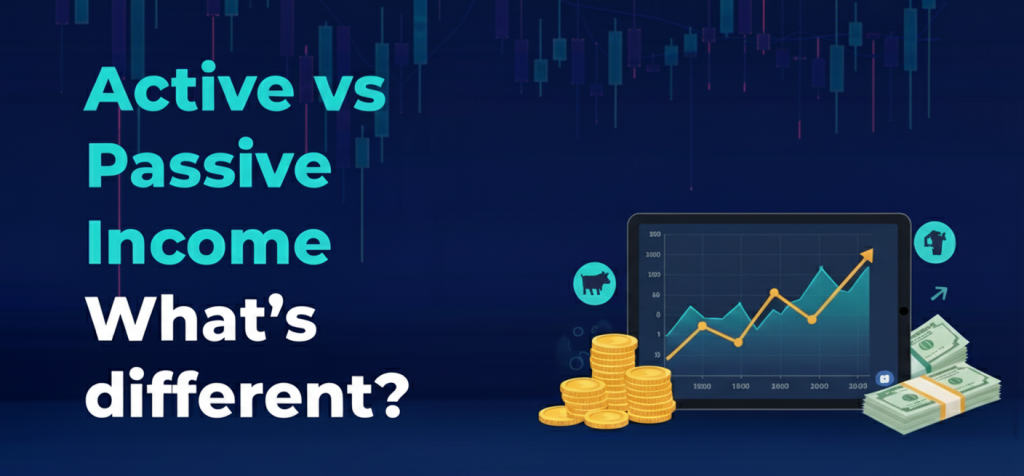
Picture this: you work hard every day, but the moment you stop, your paycheck also stops. That’s the reality of active income. Now imagine another scenario where money comes in even when you sleep. That’s the power of passive income.
Knowing the difference between active and passive income is one of the most important steps toward financial freedom, a concept supported by research from leading financial planners.
Active income is the money you earn directly from your job or business, and the moment you stop working? Income stops. Passive income, however, comes from assets like investments or property, and can continue to generate cash flow with lesser effort after the initial investment.
Here, we shall discuss these two types of income and how essential they are in financial planning. We will provide examples of active and passive income, explaining why having multiple sources of income, especially passive income, is an effective way to become wealthy and gain freedom over time.
What Is Active Income?
Active income is money you earn by working directly, like at a job, freelancing, or running a business. You only get paid when you put in the work. However, if you quit your job, your income will stop. This is the dominant income stream for the majority of the world.
One of the most important aspects of active income is that it is dependent upon your involvement. This may be an income from full-time employment or an hourly payment from part-time employment.
As an illustration, the active income of a freelance writer is obtained by the fulfillment of assignments for a client.
Active income strategies often involve options trading, which requires ongoing management and market research.
What Is Passive Income?
Passive income is money earned with little to no effort after some initial effort has been applied. The initial setup may require a significant investment of time or money, but once it’s complete, daily operations become a little easier.
Studies show that 43% of millennials in North America have at least one passive income stream.
The aim of creating passive income is to develop assets that yield cash flow automatically. For instance, a dividend-paying stock provides you with a share of the company’s profits simply because you own the stock. These income streams can be termed as passive since they do not necessarily rely on your incessant efforts.
Passive income can also be an essential element in becoming financially independent, as you can earn money without trading your time.
Difference Between Active and Passive Income
Four main areas — effort, control, taxation, and scalability — can be used to differentiate between active and passive income. These differences are the key to an effective financial strategy. Active income is the direct exchange of time for money. In contrast, passive income involves the direct exchange of time or money for investing in an asset that yields future benefits.
Active income demands active effort directly. You have to take an active part in doing work to gain a wage, commission, or even a fee. Passive income, on the other hand, requires a significant initial investment of time and effort to build an asset or a system that then generates revenue with minimal or no ongoing work.
Your level of control over your active income is high; your income directly depends on how productive and how hard you work. With passive income, there is less control over the flow of cash after already having an asset in place, because external market forces tend to affect the income.
Another significant difference is taxation. Active income, like income earned through a job, is usually subject to average income taxation. In some cases, passive earnings, such as qualified dividends and long-term capital gains, can be taxed at a reduced rate, which can significantly increase your after-tax income. Always check the local tax rules.
Finally, passive income is more scalable. You do not have a lot of time to invest in active income, and that limits your ability to earn. A passive-income asset, such as a lucrative app, real estate rental, or an investment portfolio, can continue to grow and generate extra income without requiring a proportional increase in commitment of your time.
Here’s a summary table to illustrate the core differences:
| Feature | Active Income | Passive Income |
| Source | Direct labor (job, service, trade) | Assets (investments, intellectual property) |
| Effort | Ongoing and continuous | Significant upfront effort, minimal ongoing effort |
| Example | Salary, hourly wages, consulting fees | Dividends, royalties, rental income, interest |
| Taxation | Generally taxed at higher income tax rates | Often taxed at lower rates (e.g., capital gains) |
| Scalability | Limited by time and effort | Highly scalable; not limited by time |
Active Income Examples
To gain a better understanding of active income, we can examine some of its components. These instances are where you personally sell your time, skills, and labor directly for money. Active income examples surround us, both with the most widespread jobs and with flexible side jobs.
- Salary and Wages: It is the most traditional kind of active income. The salary you earn is directly proportional to the amount of time and work you put in it. As soon as you stop working, you will not have a salary.
- Freelancing and Consulting Fee: Specialists such as graphic designers, freelance writers, and business consultants make active income selling their services on a fee basis. Their salary directly relies on the projects they undertake and the duration it takes them to accomplish the project.
- Commissions: The salespeople, real estate agents, and insurance brokers usually receive a commission based on the sales they make. The higher the number of products they sell, the higher the amount of money they will make. This is a direct result of their active selling efforts.
- Small Business Profits: For a small business owner who is a sole proprietor and carries out most of the business operations, their income is mostly active. Their profit is directly related to the number of hours they spend running their business.
Passive Income Examples
Everyone is familiar with active income, paying the bills. However, to be able to build wealth, you must avoid the time-to-money trap. That’s where passive income comes in. The following are some of the practical examples:
- Dividend-Paying Stocks: If you’re a shareholder of a company that pays dividends, you receive a portion of the company’s profits. It is among the easiest means of accumulating wealth without having to work hard all the time.
- Royalties: If you create something like a book or song, you’ll continue to get royalties anytime people use your invention.
- Rental Property Income: Buying a property and renting it out provides a steady income stream. Although it needs specific management, you are not compensated based on the hours of daily work.
- Savings or Loans Interest: High-interest savings deposits or peer-to-peer lending can help you achieve this goal. It’s a “set it and forget it” way to grow your money.
- Affiliate Marketing: By posting content online and using affiliate links, you can earn a commission every time someone purchases through your link. The money continues to flow so long as your content is active.
Key Differences in Points
The key differences between active and passive income are time requirement, stability, growth potential, and financial independence. It is possible to concisely and clearly compare these differences. However, when considering them, it is helpful to think of the long-term consequences of each.
- Time Requirement: Active income is an exchange of time and money. Passive income may require a significant amount of time to begin with, but it would liberate your time in the long term. Copy trading allows individuals to earn passive income without directly managing trades.
- Stability: Active income from a steady job can feel more stable in the near future. Passive income from diversified assets will be more resilient since the absence of one stream does not entail the loss of all your income.
- Growth Potential: The amount of active income you can earn is limited by the hours you can work and the earnings per hour. Passive income can be increased indefinitely. An investment portfolio can be multiplied several times, proving the power of compounding, and the same digital product can be sold multiple times, infinitely.
- Financial Independence: Active income allows you to pay your bills today. Passive income is what will get you out of the “rat race” by covering your bills.
Why Knowing the Difference Matters
The importance of knowing the difference between active and passive income is the secret to not just living but creating a balanced financial life.
Being able to distinguish between active and passive income is an essential part of any sound financial plan. It is necessary to recognize that this difference impacts your tax planning, wealth-building strategy, and long-term career decisions.
Passive income may be more tax-efficient in terms of tax planning. Say, long-term capital gains and dividends are frequently taxed at a lower rate than the income you make at your job. By properly restructuring your income streams, you can reduce your total tax load and increase your wealth accumulation rate.
In terms of wealth building, passive income provides the fuel for exponential growth. In active income, there is a restriction on the hours of the day. Passive income offers the opportunity to earn money even when you are asleep, on the move, or pursuing your interests.
The passively received money can be further invested in more assets, which will give rise to the compounding effect, thus making your wealth increase at a faster rate.
Finally, your career strategy will undergo a complete transformation after you understand this concept. Instead of just looking for a higher-paying job, you might start thinking about how your current skills can be used to create passive income assets.
Such a change of thinking enables you to have a financial background that is not entirely based on your active work, which leaves you with a lot of security and freedom.
FAQs
The primary distinction is the degree of continuous effort needed. Active income involves active, direct effort and continual exchange of time for money, whereas passive income involves little effort, as it continues after the initial investment.
No, a salary cannot be considered passive income. It is the classic example of active income because it is a direct result of your continuous work and effort at a job.
Dividends on stocks, rental income on real estate, royalties on intellectual property, and interest on investments are some of the best examples of passive income.
Passive income can be efficient for building long-term wealth. To cover short-term needs, you need an active income. However, passive income enables you to develop assets that increase and generate revenue without labor and time.
Generally, rental income can be regarded as passive income. Although it requires some management and repair, it does not demand your day-to-day work as in the case of a conventional job.
Final Thoughts
To sum it up, active and passive income are essential in developing a balanced financial life. Active income covers your daily expenses. But passive income builds wealth and establishes you in the long term, bringing you closer to financial independence.
It will not help you to favor one over the other; instead, you can maximize your active income to produce assets that will generate passive income.
Note that this is not investment advice, but rather informational. Investment decisions should always be made through sound research and consulting an expert.
Tags


Open Live Account
 Email Address
 Phone Number
Important Notice
STARTRADER does not accept any applications from Australian residents.
To comply with regulatory requirements, clicking the button will redirect you to the STARTRADER website operated by STARTRADER PRIME GLOBAL PTY LTD (ABN 65 156 005 668), an authorized Australian Financial Services Licence holder (AFSL no. 421210) regulated by the Australian Securities and Investments Commission.
Important Notice for Residents of the United Arab Emirates
In alignment with local regulatory requirements, individuals residing in the United Arab Emirates are requested to proceed via our dedicated regional platform at startrader.ae, which is operated by STARTRADER Global Financial Consultation & Financial Analysis L.L.C.. This entity is licensed by the UAE Capital Market Authority (CMA) under License No. 20200000241, and is authorised to introduce financial services and promote financial products in the UAE.
Please click the "Continue" button below to be redirected.


