








 Web Trader MT5









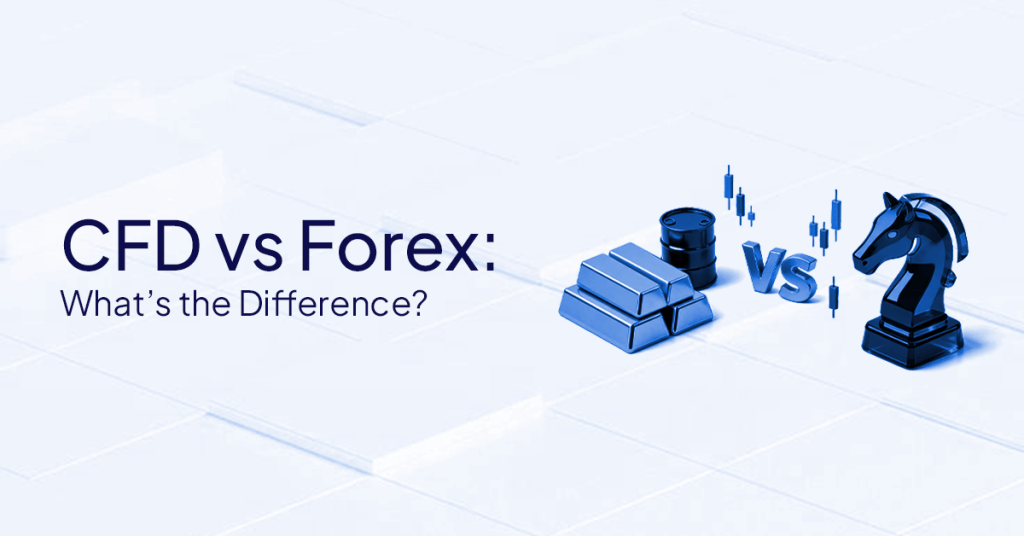
Forex refers to the international market in the buying and selling of currencies, whilst a CFD involves buying and selling the price changes of different assets, such as forex.
Have you ever wondered why a global marketplace and a financial contract are always compared to each other as though they were the same thing?
The misunderstanding is typically caused by the fact that both of the techniques permit you to speculate on the prices of currencies, which are usually on the same trading platforms.
The costs, risks, and background mechanics are, however, considerably different. This guide divides all that you have to know to distinguish between the CFD vs forex and then determine which one fits your objectives.
Quick Answer
Forex is the currency market (trade pairs such as EUR/USD). A CFD is an agreement which follows the price of an asset, with or without an investment in the underlying. Thus, CFs vs forex is really CFD forex vs spot forex. The main differences are in the structure of the product, leverage/margin, holding costs, and markets available.
Forex vs CFD: What Are You Actually Comparing?
The main distinction is that forex pertains to the asset class itself, and a CFD is a financial instrument that is employed to obtain exposure to different assets.
When individuals are posing questions about forex vs CFD, they are normally mixing up a market with a derivative product. To make a wise decision, you need to be aware of what each of these terms means in the first place.
Forex is the Market
The forex or foreign exchange market is the global, decentralized marketplace where individuals, banks, and institutions buy and sell currencies. You exchange one currency with another, in the hope of getting it right when it is going to go up or go down.
The global foreign exchange market is the most liquid in the world, with an overview of data (Bank for International Settlements (BIS) indicating that it trades over $7.5 trillion in volume daily.
What this implies on your part: In the case that you are trading in forex, then your primary concern is merely the international currency changes.
CFD is the Product
A contract for difference (CFD) is an agreement between a seller and a buyer to trade the difference between the asset’s current value and its value at expiry.
You can find out what a CFD exactly is in case you want to go deeper into the mechanics. CFDs enable one to speculate on price changes without necessarily owning the underlying asset.
The implication this has on you: A CFD is merely a product that allows you to trade the value of stocks, commodities, crypto, or even forex.
Table 1: When People Say ‘CFD vs Forex’
| Common Question | Correct Framing | What to Compare |
| “Should I trade CFDs or Forex?” | “Should I trade multi-asset CFDs or only currency pairs?” | Market access, asset volatility, and your personal knowledge base. |
| “Is a CFD better than Forex?” | “Is a forex CFD better than spot forex?” | Ownership, leverage limits, and overnight holding costs. |
What is Spot Forex?
Spot forex refers to a direct exchange of a given currency with another with immediate settlement at the prevailing market prices.
Traditional spot forex implies that you are doing a trade on the spot. Whereas the real-life performance of institutional traders may involve them physically receiving currency from international business, retail traders typically roll their positions over electronically.
How Currency Pairs Work
All of the currencies are always quoted in two, and they include the EUR/USD or GBP/JPY. The former is the base currency,y, and the latter is the quote currency.
Price indicates the quantity of the quoted currency that is required to buy a unit of the base currency.
What this means for you: To get into forex trading, you need to be able to analyze the economic health of two distinct regions at the same time.
What “Spot” Means in Practice
Spot in financial terms means the prevailing market rate at which one can purchase or sell a particular asset at that specific point in time and have it delivered in the present time.
In the retail trading arena, the true spot forex implies that you are trading the actual currency pair in the interbank market.
What is a Forex CFD?
A forex CFD is a derivative contract, which is used to replicate the actual price of the spot forex pair without the trader ever buying the actual currency.
This overlap is precisely why the two terms are often confused. You are comparing the same forex market, the same price charts, and trading the same currency pairs. But the working of your trade is another thing.
CFD on a Currency Pair
When you open a forex CFD, you agree with your broker, such as STARTRADER, to trade the difference between the price of the currency pair when you open the position to the time of closing it.
You have bought a contract that is denominated in EUR/USD, not in EUR/USD.
What this means for you: Your gains or losses will be based solely on the price movement of the contract, which will be a reflection of the live market.
No Ownership vs Price Exposure
The fact that a CFD is simply a price-tracking contract means that you never actually receive ownership of the underlying base currency.
The regulatory authorities, such as the European Securities and Markets Authority (ESMA), categorically rank CFDs as complex instruments due to the fact that they provide pure price exposure that is packaged in a leveraged contract.
Table 2: Forex (Spot) vs Forex CFD
| Feature | Spot Forex | Forex CFD |
| Market vs Product | The actual currency market. | A derivative contract tracking a market. |
| Asset Ownership | You are directly exchanging currencies. | No ownership; pure price speculation. |
| Leverage | Varies, often lower for direct spot accounts. | Typically higher leverage available. |
| Market Access | Limited to currency pairs only. | Can trade currencies, stocks, commodities. |
| Holding Costs | Rollover fees based on interest rates. | Overnight financing fees (swap rates). |
CFD Trading vs Forex Trading: Key Differences
The most notable differences are in the range of available markets, the structure of the margin requirements, and the risk profile in general.
The difference between CFD trading and forex trading requires a second look beyond the interface of the trading platform and into the provisions of the products.
The experience of clicking the purchase or sell button is the same, but the financial buying or selling is significantly different.
Product Scope
Traditional forex trading limits you to the foreign exchange market. You are dealing in fiat currencies, and nothing less. CFD trading, on the other hand, is a multi-asset vehicle.
From a single account, a CFD trader can easily alternate between trading in the Japanese Yen to taking gold, oil, or tech stocks.
Leverage and Margin Basics
Both of them use borrowed capital to enlarge their positions. This is best understood by knowing how leverage and margin work. Since CFDs are artificial contracts, brokers usually offer various margin levels beyond strict spot-market execution.
What this means to you: Leverage allows you to own a large position with a small deposit and both amplify potential gains and losses.
Risk Profile
The risk profile of leveraged derivative products is higher. Since CFDs enable one to trade in numerous volatile markets with high leverage effortlessly, it takes an inexperienced trader very little time to overexpose their account.
Risk management is not only advisable but a must for long-term success. ESMA data confirms 74–89% of retail CFD and forex accounts lose money, with average losses of €1,600–€29,000 per client.
CFD vs Spot Forex: Costs, Leverage, Holding
A comparison between CFDs vs spot forex will reveal differences in your trading expenses and holding costs, depending on the broker’s execution model and contract conditions.
Every financial transaction incurs a cost. The manner in which you pay a spot forex trade on your statement may seem to be different from how you pay a CFD trade, although the net effect may be similar.
Trading Costs
In spot forex, you normally pay the spread (difference between the buy and sell price) or a commission per lot that is traded, which is usually fixed.
CFD trading charges are the same, but because you are selling a contract the broker has issued, the spreads may carry different markups.
Holding Costs
When you have a spot forex position that you keep overnight, you pay or receive a tom-next (tomorrow-next) rollover rate, which is the difference in the interest rate of the two currencies.
When you keep a forex CFD overnight, you pay a daily financing fee. This swap fee will be the price of the leverage you borrow to keep the contract.
What this means for you: Having CFDs on a long-term basis will cannibalize your capital because of the compounding of overnight charges.
Execution and Liquidity
Spot forex usually connects you directly with a pool of big banks, with the aim of pure market execution. CFD deals are secured where the broker becomes the counterparty of your agreement.
The two techniques differ in the types of orders they use to handle both exits and entries effectively under fast-moving conditions.
Which Approach Fits Which Goal?
The decision between the two approaches should be determined by the holding time that you intend to have, the asset classes that you would wish to have, and the risk tolerance that you may have.
There is no better approach among these options. The correct decision will all be based on what you are attempting to accomplish in the markets.
Short-term Exposure vs Long-term Positioning
CFDs are typically used in speculative trading, which is a short-term strategy, and traders make bets depending on the sharp upward or downward trend in prices in the span of minutes, hours, or days.
They are not the best choice for long-term investments of more than a month due to the cost of overnight financing. Long-term buy-and-hold strategies are typically executed more effectively through traditional spot trading or the acquisition of actual assets.
Hedging vs Speculation
Since you can easily go short (when prices fall) with CFDs, they are good as hedging tools to use on physical portfolios against short-term market declines. If you are interested in protecting your capital, it is a good idea to learn the basics of hedging.
On the other hand, global businesses heavily use spot forex to hedge against real currency risk when conducting overseas trade.
Checklist: Before choosing CFDs or Spot Forex
- Determine your goal: Do you speculate on price, or must you have real money?
- Define your horizon: How long will you hold trades (CFDs): hours, or months (Spot)?
- Evaluate leverage knowledge: Does this give you a perfect understanding of how losing money through the use of margin is multiplied?
- Establish a maximum loss strategy: Have you worked out calculations of your risk per trade?
- Review fee awareness: Have you read the schedule of swap and commission of your broker?
- Check jurisdiction suitability: Do you have the option of CFDs in your home country?
FAQs
No, forex is not a CFD. Forex refers to the global market of exchange of fiat currencies. A CFD is a particular form of derivative contract, which may be employed to transfer the prices of the forex market and most other markets, such as stocks and commodities.
Forex trading is a trade that involves buying and selling currency pairs. CFD trading is the trading of derivative contracts that track the price of different assets in the world. You can conduct forex trading via CFDs, but you may also conduct trading in stocks, indices, and metals via CFDs.
The similarities are that they follow the same underlying price feed (e.g., the real-time price of EUR/USD). They are, however, different products at the very core. Spot forex is the real dealing of currencies, whereas a forex CFD is a mere price speculation contract without possession.
Both are highly risky because of market volatility. Nonetheless, CFDs are usually regarded as being more dangerous to retail novices due to the fact that they typically provide access to greater leverage and diversification of multi-and highly volatile asset classes in a single account.
Conclusion
The basic principle of becoming a resilient, long-term investor in the markets is to understand the mechanics of the traded assets. The difference between a global currency market and a derivative contract is very important for the safety of your capital.
Spot forex provides direct entry into currency trading, whereas CFDs offer the ability to enter into price exposure in a variety of asset types in a flexible and leveraged way. One is not better than the other, but their strategic purpose is different; they have timelines and risk tolerances.
When you understand how margin functions, how to recognize overnight charges, and what you hope to accomplish in the financial market, you will be able to maneuver these markets with a lot more precision.
To experience how these spreads, swap fees, and execution speeds really work in reality, you can have a look at a STARTRADER demo account to put your knowledge to the test free of charge.
Tags


Open Live Account
 Email Address
 Phone Number
Important Notice
STARTRADER does not accept any applications from Australian residents.
To comply with regulatory requirements, clicking the button will redirect you to the STARTRADER website operated by STARTRADER PRIME GLOBAL PTY LTD (ABN 65 156 005 668), an authorized Australian Financial Services Licence holder (AFSL no. 421210) regulated by the Australian Securities and Investments Commission.
Important Notice for Residents of the United Arab Emirates
In alignment with local regulatory requirements, individuals residing in the United Arab Emirates are requested to proceed via our dedicated regional platform at startrader.ae, which is operated by STARTRADER Global Financial Consultation & Financial Analysis L.L.C.. This entity is licensed by the UAE Capital Market Authority (CMA) under License No. 20200000241, and is authorised to introduce financial services and promote financial products in the UAE.
Please click the "Continue" button below to be redirected.


