








 Web Trader MT5







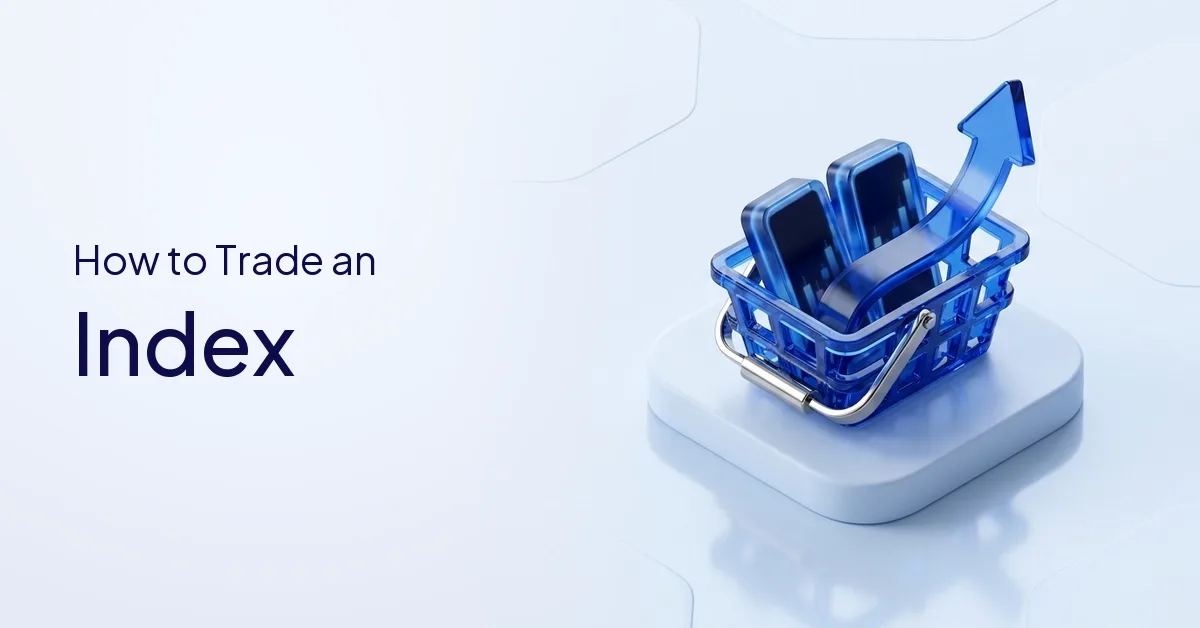
When you trade an index, you are speculating on the price movement of a stock market index, such as the NASDAQ 100 or the S&P 500, usually using CFDs or futures, instead of buying each individual stock.
But did you know that trading one index gives you exposure to a whole basket of companies at once, rather than selecting individual stocks? To understand how to trade index products you need to understand that an index tracks a basket of stocks or a specific segment of the market.
Index traders do not buy all the companies in the index. Instead, CFDs and futures are common trading routes that allow for long or short exposure, although they carry leverage risk. This guide covers index meanings, tradable examples, steps, options vs. CFDs and important risk notes for beginners.
Quick Answer
When you trade on indices you are not buying shares but you are speculating on the change in price of a stock market index. Indices are usually traded by beginners using CFDs or futures. First, they choose an index instrument, open up the chart, determine if they want to buy or sell, determine trade size, risk controls and then monitor the position. Index CFDs are leveraged products and carry a high risk of loss.
What Is Index Trading?
Index trading is about taking a position on the movement of a basket of stocks that represent a market, sector, country or theme. A stock index is a measure that tracks how a group of stocks is performing.
For example, an index might follow large U.S. companies, tech-heavy stocks, blue-chip companies, or a specific national market. This gives us a snapshot of how the broader equity markets are performing.
Trading The Index As One Instrument
Traders do not buy every stock in the index. Instead, they buy or sell an index-linked product that tracks the overall index price, such as a CFD or futures contract.
If you expect the market to go up you can open a long position and if you expect it to go down you can open a short position.
Index Trading Vs Index Investing
- Index Trading: Short-term price exposure, generally through CFDs, futures or options.
- Index Investing: Typically long-term exposure via ETFs, mutual funds, or index funds.
Which Indices Can You Trade?
Traders can access major global stock indices as market instruments, though these examples should never be treated as recommendations to trade any of them.
Major Global Index Examples
| Index | Market Focus | Beginner Note |
|---|---|---|
| S&P 500 | Large U.S. companies | Broad U.S. market reference |
| NASDAQ 100 | Large non-financial Nasdaq companies | Often technology-heavy |
| Dow Jones Industrial Average | 30 large U.S. blue-chip companies | Price-weighted U.S. index |
| FTSE 100 | Large UK-listed companies | UK market reference |
| DAX | Major German companies | German equity market reference |
| Nikkei 225 | Major Japanese companies | Japan market reference |
| VIX | Expected U.S. equity volatility | Volatility index, not a stock basket |
How To Trade The NASDAQ Index
Traders who are interested in trading the NASDAQ index will generally look for a CFD or futures instrument on the platform that is tied to the NASDAQ 100. On your platform it might be displayed as US100, NAS100, NASDAQ 100 or with some other provider-specific symbol.
How to Trade the Dow Jones Index
If you are learning to trade Dow Jones index movements, you will look for a Dow-related index CFD or futures instrument. Depending on your provider it might be US30, DJ30 or Wall Street 30.
How To Trade Volatility Index
If you are interested in trading volatility index products, remember the VIX is not a stock index. It tracks volatility instead of a basket of company shares. The complexity of volatility products means that beginners need to get to grips with the product specification before trading. Retail volatility products are usually based on VIX futures rather than the spot VIX index. Because the futures curve is often upward-sloping, a long position can lose value over time even when spot volatility is unchanged. These products are not designed to be held for extended periods.
Note: Index symbols are different for each platform. Always check the exact instrument name, underlying index, contract size, trading hours, spread, margin requirement, overnight financing and any expiry rules. Index CFD positions held through a constituent stock’s ex-dividend date are normally subject to a dividend adjustment.
How To Trade Index CFDs Step By Step
Index CFD trading usually involves opening an account, finding the index, opening the chart, choosing a direction, deciding on trade size, and managing risk.
Step 1: Open A CFD Trading Account
To trade index CFDs you need a supported CFD or multi-asset account that offers index instruments.
Step 2: Complete Verification And Fund The Account
To start live trading, you need to identify yourself and fund your account. Demo accounts are a safe way to practice before you trade live.
Step 3: Search For The Index
The name varies depending on your provider. For Dow Jones, check US30, for NASDAQ 100 check US100, for S&P 500 check SPX500, for DAX check GER40 or for FTSE 100 check UK100.
Step 4: Open The Index Chart
You can view historical price movement, change timeframes, and use basic technical tools on the chart.
Step 5: Decide Direction
This is a platform feature, rather than a recommendation:
- Buy / Long: This is used when you expect the index price to go up.
- Sell / Short: This is used when you expect the index price to go down.
Step 6: Choose Position Size
Your position size will affect the total market exposure, margin requirement and the overall risk.
Step 7: Add Stop Loss And Take Profit
Stop-loss and take-profit fields let you set exit levels in advance. A standard stop loss is not guaranteed: where an index gaps at the open, it may be executed at a materially worse level than the one selected. It limits exposure; it does not cap it.
Step 8: Review Costs And Margin
Review before trading, and check spread, commissions, margin requirements, overnight financing, trading hours and expiry rules before confirming a trade.
Step 9: Place And Monitor The Trade
Once you’ve entered the trade, track the price movement, account equity, margin level, market news and details of open positions.
| Step | Action | Beginner Note |
|---|---|---|
| 1 | Open account | Use a supported CFD or multi-asset setup |
| 2 | Verify and fund | Needed for live trading |
| 3 | Search index | Symbols vary by provider |
| 4 | Open chart | Review price movement |
| 5 | Choose buy or sell | Platform function, not advice |
| 6 | Set position size | Affects margin and risk |
| 7 | Add SL and TP | Do not use random levels |
| 8 | Review costs | Check spread, margin, and financing |
| 9 | Monitor trade | Watch price, news, equity, and margin |
How To Trade Index Options Vs CFDs
Index options gives you the rights to buy or sell at a fixed price by expiry whereas CFDs are simple contracts that track continuous price movement.
What Index Options Are
When learning how to trade index options it is important to understand that index options give the buyer the right, but not the obligation, to buy or sell exposure linked to an index at a given strike price before or at expiry.
What Index CFDs Are
Index CFDs are contracts whose value tracks the movement of an index. The CFD price will not be identical to the published index level: it includes a spread, is often derived from index futures rather than the cash index, and is affected by financing and dividend adjustments. A trader can normally buy or sell short, with the position value moving broadly in line with the underlying index.
Index Options Vs CFDs Table
| Feature | Index CFDs | Index Options |
|---|---|---|
| Structure | Contract tracking index price movement | Right, not obligation, linked to strike/expiry |
| Direction | Long or short exposure | Calls and puts |
| Expiry | May not have fixed expiry | Usually has expiry |
| Complexity | Simpler mechanics | More complex |
| Pricing Factors | Index price, spread, financing, margin | Index price, strike, expiry, volatility, time value |
| Mechanical Complexity | Easier to understand mechanically | Requires more options knowledge |
| Risk | Leverage, margin, spreads, financing | Premium loss, Greeks, expiry, volatility risk |
Retail traders may find CFDs accessible, depending on their experience and understanding of the risks involved. Options require more knowledge of the strike price, premium, volatility and time decay.
What Should Beginners Know Before Trading Indices?
Even though index trading might seem easier than individual stock picking, it still has leverage, gap, macro, liquidity, and execution risks.
Index Prices Move With Constituent Stocks
An index is based on the collective performance of the stocks that it is based on. CME Group’s education material indicates that large-cap stocks have a substantially larger influence on market-cap weighted index performance.
Macro Events Matter
Indices are highly sensitive to monetary policy, inflation data, employment numbers, earnings seasons and the global risk appetite.
Leverage Increases Risk
Index CFDs are leveraged products. Trading on margin amplifies both potential profits and potential losses, because both are calculated on the full position value rather than the margin deposited. If available margin falls below the required level, positions may be closed automatically, and automatic closure does not guarantee a particular exit level. SEC Investor guidelines require strict margin management for leverage in your trades because leverage can magnify losses and trigger forced sales.
Overnight Financing Costs May Apply
Holding CFD positions overnight can incur financing or swap costs depending on your product and account setup.
Indices Can Gap At Market Open
Index prices can open sharply higher or lower relative to the previous close on overnight news, weekend developments or macro surprises.
Trading Hours Vary
Index CFD trading hours depend on the instrument and provider. Look at the product specification before you place a trade and keep a close eye on your account equity and margin so you are not caught out by sudden liquidations.
Index Trading Vs Stock Trading
When you trade indexes, you are exposed to a basket of stocks rather than one stock, and when you trade stocks, you are limited to the performance of one company.
Major Difference
Stock trading depends on company-specific factors like earnings, management and debt. Index trading is more reliant on the movement of a group of stocks as a whole and the macro market environment in general.
Comparison Table
| Feature | Index Trading | Stock Trading |
|---|---|---|
| Exposure | Basket of stocks | One company |
| Main Driver | Market or sector movement | Company performance |
| Company Risk | Lower than single-stock trading | Higher |
| Diversification | Built into the index | Depends on stock selection |
| Trading Product | CFD, futures, options, ETFs | Shares, CFDs, options |
| Risk | Market, leverage, gap, macro risk | Company, market, earnings, gap risk |
Note: Index trading can decrease risk to individual companies, but it does not eliminate exposure to broader market risk or the inherent risks of trading CFDs.
Common Mistakes Beginners Make When Trading Indices
Beginners tend to underestimate leverage, gap risk, index weightings and the specifications of individual products.
Mistakes Checklist
- Thinking index trading is risk-free because it tracks many stocks.
- Not checking which underlying index the CFD is tracking.
- Confusing symbols for US30, US100 and US500.
- Disregarding market open and close volatility.
- Holding overnight without looking at the financing cost.
- Using leverage without understanding the margin.
- Trading around major news without planning risk.
- Assuming all indices move equally.
- Ignoring large stock weightings within an index.
- Assuming the demo performance is indicative of live results.
FAQs
You can start when you open a supported trading account, find the index instrument and open a chart. You then select buy or sell and set position size and risk controls and review margin and costs, and then monitor the trade.
To trade the NASDAQ 100, search for the platform’s index instrument linked to the NASDAQ, such as US100, NAS100, or NASDAQ 100. Open the chart, check product specifications, choose order type and position size, and manage the trade carefully.
If you’re interested in trading the Dow Jones Industrial Average, find a Dow-linked instrument such as US30, DJ30, Wall Street 30 or whatever the symbol is for your provider. Before placing a trade, read the underlying index, margin, spread and trading hours.
Index options are calls and puts on an index with strike prices and expiration dates. They are more complicated than CFDs as their pricing is based on index movement, time value, volatility and option structure.
When you trade on an index you are gaining exposure to a basket of stocks, when you trade a stock you are gaining exposure to a single company. Trading indexes reduces single company risk but still involves market, leverage, gap and execution risks.
Conclusion
Traders can get exposure to a broad market basket with one instrument, but strict risk management is critical because CFDs and futures can move quickly.
Trading indices is a practical way to trade broad market movement without having to select individual stocks. Index CFDs and futures give traders direct price exposure but traders should remember that index names are factual examples instead of recommendations.
Check the specific instrument and the underlying index always. Leverage can magnify losses and indices can gap on market open and during major news events. If you are a beginner, you should practice on a demo before you go live. A demo account does not fully reflect live trading conditions, as execution conditions can differ and trading with real money changes how decisions are made, so demo results do not indicate live results.
Before you trade stock indices with real money, explore more beginner trading guides on STARTRADER. Get to know CFDs, equity markets, account equity, margin and risk.
CFDs are complex financial instruments and carry a high risk of losing money rapidly due to leverage. You should ensure you fully understand the risks involved and carefully consider whether you can afford to take the high risk of losing your money before trading.
An index CFD is an agreement between you and the provider. It gives you no ownership of the constituent shares and no shareholder rights, and you are exposed to the provider’s ability to meet its obligations. The CFD price will not be identical to the published index level. Positions held through a constituent’s ex-dividend date are subject to a dividend adjustment, and positions held overnight normally incur financing charges. Index prices can gap at the market open, so a stop-loss order may be executed at a materially worse level than the one selected.
This content is provided for educational and informational purposes only. It does not constitute investment advice, financial guidance, or a recommendation to trade any financial instrument.
Tags


Open Live Account
 Email Address
 Phone Number
Important Notice
STARTRADER does not accept any applications from Australian residents.
To comply with regulatory requirements, clicking the button will redirect you to the STARTRADER website operated by STARTRADER PRIME GLOBAL PTY LTD (ABN 65 156 005 668), an authorized Australian Financial Services Licence holder (AFSL no. 421210) regulated by the Australian Securities and Investments Commission.
Important Notice for Residents of the United Arab Emirates
In alignment with local regulatory requirements, individuals residing in the United Arab Emirates are requested to proceed via our dedicated regional platform at startrader.ae, which is operated by STARTRADER Global Financial Consultation & Financial Analysis L.L.C.. This entity is licensed by the UAE Capital Market Authority (CMA) under License No. 20200000241, and is authorised to introduce financial services and promote financial products in the UAE.
Please click the "Continue" button below to be redirected.


