








 Web Trader MT5









Whenever you enter a trade on XAUUSD, you are already behind the eight ball a little. It’s not because of some cost you can see on a receipt, but rather because of the spread — the built-in disparity between the price you can buy at and the price you can sell at. It’s built into the pricing just before you initiate any trade, and it applies to every single trade you make.
Trading gold with a clear eye means knowing what the XAUUSD spread is, what a normal range looks like, and what it really costs in dollar terms. This article includes it all, from what causes the spread to widen to how to check it on your platform before you trade.
Our other guide on how to trade gold online walks you through the entire trading procedure for the bigger picture.
What Is the Bid-Ask Spread in Gold Trading?
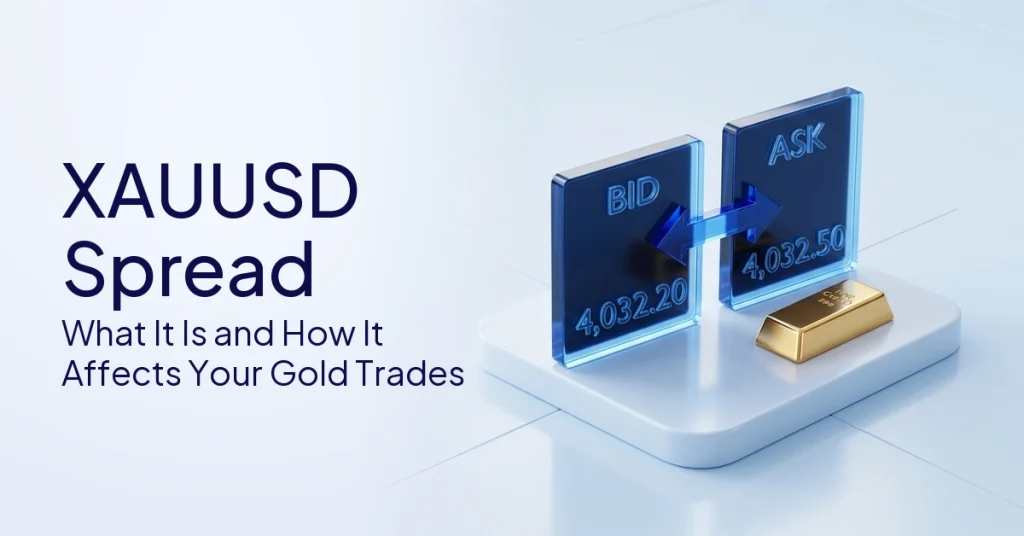
In gold trading, the difference between the ask price (the price at which you buy XAUUSD) and the bid price (the price at which you sell) is termed the bid-ask spread — the difference between these two values is what you pay to initiate any position.
If you seek up a quote for XAUUSD, you will see two rates at the same time. The bid is the lower one, and that is what you will be paid if you sell today. The ask is the bigger number — what you have to pay to buy now. The only difference between them is the spread.
For example, if XAUUSD is quoted with a bid of $2,300.00 and an ask of $2,300.30, then the spread is $0.30 per troy ounce – or 30 pips in XAUUSD terms (where 1 pip equals $0.01).
Brokers and market makers make money by providing a service that facilitates deals. That is why there is the spread. In many normal accounts, there is no separate commission – the cost of the transaction is built into the spread, the price you see before you click buy or sell.
What Is a Typical XAUUSD Spread?
XAUUSD spreads are not the same in all markets, times of day, and account types. No specific number, although knowing the overall spectrum is a good cost reference.
In a normally liquid market, XAUUSD spreads on retail platforms are typically between 10 and 50 pips – that’s $0.10 to $0.50 per troy ounce. Raw spread accounts are priced using interbank pricing and pay a separate commission, allowing for tighter spreads. A larger spread with no specific commission (regular spread-based case). The mark-up of the broker is part of a larger spread.
The tightest spreads are observed during the London-New York session overlap, the moment of highest liquidity in gold markets worldwide. They broaden out during the Asian session when fewer people are trading and spike following important news announcements when market makers widen out their quotes to cover themselves from quick changes in the market.
Why Does the Spread Matter?
The spread is a direct cost to every trade – your position opens with a loss equal to the spread, and the price has to move in your favor by at least that amount before you reach break-even.
When you open a buy position in XAUUSD, you buy at the ask price but can only sell immediately at the lower bid price. Before the market even moves at all, the difference is already working against you.
The dollar cost is scaled with lot size as follows:
- 30 pip spread ($0.30 per troy ounce)
- Standard lot (100 troy ounces) $0.30 x 100 equals $30 per trade.
- Mini lot (10 troy ounces) 0.30 x 10 = $3 per deal
- Micro lot (1 troy ounce): $0.30 x 1 = $0.30 per deal
For busy traders initiating many positions a day, spread charges can add up quickly. Ten standard-lot trades at a $30 spread each equals $300 in spread charges – before market movement has had a chance to affect the account either way. Understanding how spread costs relate to position size is closely tied to knowing the XAUUSD pip value; they go hand in hand in estimating the true cost of each trade.
Factors That Affect the XAUUSD Spread
There are several reasons why the gap widens or narrows – knowing them helps traders understand when costs are likely to be higher than usual.
- Market liquidity: The gold market is most liquid when trading occurs simultaneously in the major financial centers. London-New York is the window of maximum overlap. The spreads are wider in the Asian session due to reduced gold trading activity.
- Major news events: Market makers briefly widen spreads due to Federal Reserve rate decisions, US Non-Farm Payrolls, and unanticipated geopolitical developments. Trading around these occurrences includes assuming increased spread costs and more price volatility simultaneously. This interaction also occurs with position exposure — the XAUUSD margin requirements are essential for perspective on how rapidly markets influence your account during these times.
- Account type: Standard accounts usually have a greater floating spread and no commission. You can get tighter interbank spreads with Raw Spread or ECN accounts, but you will be charged a different commission per lot. It’s the same total but in a different fashion that it shows up on the terminal.
- Gold-specific volatility: XAUUSD responds to macroeconomic events. In periods of higher volatility – dollar moves, inflation surprises, geopolitical stress – spreads widen in accordance with greater fear in broader markets.
How to Check the XAUUSD Spread on a Trading Platform
The spread on XAUUSD is shown directly in the trading interface – the current bid and ask prices are always accessible before you place a trade.
The simplest way is to use the Market Watch window in MetaTrader 4 (MT4) or MetaTrader 5 (MT5). Right-click the column headers and enable the Spread column – this will show the live spread for each instrument in real time, in points (where 1 point represents 1 pip for XAUUSD).
When you open an XAUUSD trade ticket, you see the bid and ask prices. The difference between them is the spread at that particular instant. Spreads are dynamic and alter in real time. So the number you see when you open the ticket may differ slightly when you finalize the order – especially if markets are moving fast.
Frequently Asked Questions
The spread is the difference between the buy price (ask) and the sell price (bid) for XAUUSD. It depends on the broker, account type, and market conditions. Typically, retail spreads are about 10 to 50 pips under normal liquid conditions – check your broker’s instrument specs for the actual number that applies to your account.
Spreads tend to widen as liquidity dries up or uncertainty rises – during the Asian session, around key news events such as Fed decisions or NFP data, or geopolitical shocks. Market makers increase spreads when prices are moving fast to limit their risk exposure.
Every trade starts at a loss equal to the spread. Your position must move in your favor by at least the spread amount before reaching breakeven. On a standard lot, a 30-pip spread costs $30, but on a mini lot it’s $3, and on a micro lot it’s $0.30. The spread cost scales with your lot size.
Spreads tend to be tightest during the London-New York session overlap. By avoiding the Asian session and major scheduled news events, the spread cost on each trade is lower.
A fixed spread remains fixed regardless of market conditions – the broker absorbs liquidity changes. A variable spread adjusts with conditions, tightening in liquid times and expanding in times of volatility. Fixed spreads provide predictable prices, while variable spreads might be cheaper in normal conditions, but more expensive around big events.
To see the live spreads for all instruments, right-click the column headers in the Market Watch window in MT5 and select the Spread column. The spread is also apparent as the difference between bid and ask prices on the XAUUSD order ticket when initiating a new position.
Conclusion
XAUUSD spread is a clear and foreseeable cost that is charged on all trades. Knowing what it is, when it’s likely to be broader, and what it costs you in dollar terms at different lot sizes removes one variable out of your trading decisions and makes the full cost of each position evident before you get into it.
Want to go further? Study the XAUUSD pip value guide to understand how spread costs relate to position size or read the gold trading guide for broader market context.
CFDs are complex financial instruments and carry a high risk of losing money rapidly due to leverage. You should ensure you fully understand the risks involved and carefully consider whether you can afford to take the high risk of losing your money before trading.
This content is provided for educational and informational purposes only. It does not constitute investment advice, financial guidance, or a recommendation to trade any financial instrument.
Tags


Open Live Account
 Email Address
 Phone Number
Important Notice
STARTRADER does not accept any applications from Australian residents.
To comply with regulatory requirements, clicking the button will redirect you to the STARTRADER website operated by STARTRADER PRIME GLOBAL PTY LTD (ABN 65 156 005 668), an authorized Australian Financial Services Licence holder (AFSL no. 421210) regulated by the Australian Securities and Investments Commission.
Important Notice for Residents of the United Arab Emirates
In alignment with local regulatory requirements, individuals residing in the United Arab Emirates are requested to proceed via our dedicated regional platform at startrader.ae, which is operated by STARTRADER Global Financial Consultation & Financial Analysis L.L.C.. This entity is licensed by the UAE Capital Market Authority (CMA) under License No. 20200000241, and is authorised to introduce financial services and promote financial products in the UAE.
Please click the "Continue" button below to be redirected.


