








 Web Trader MT5





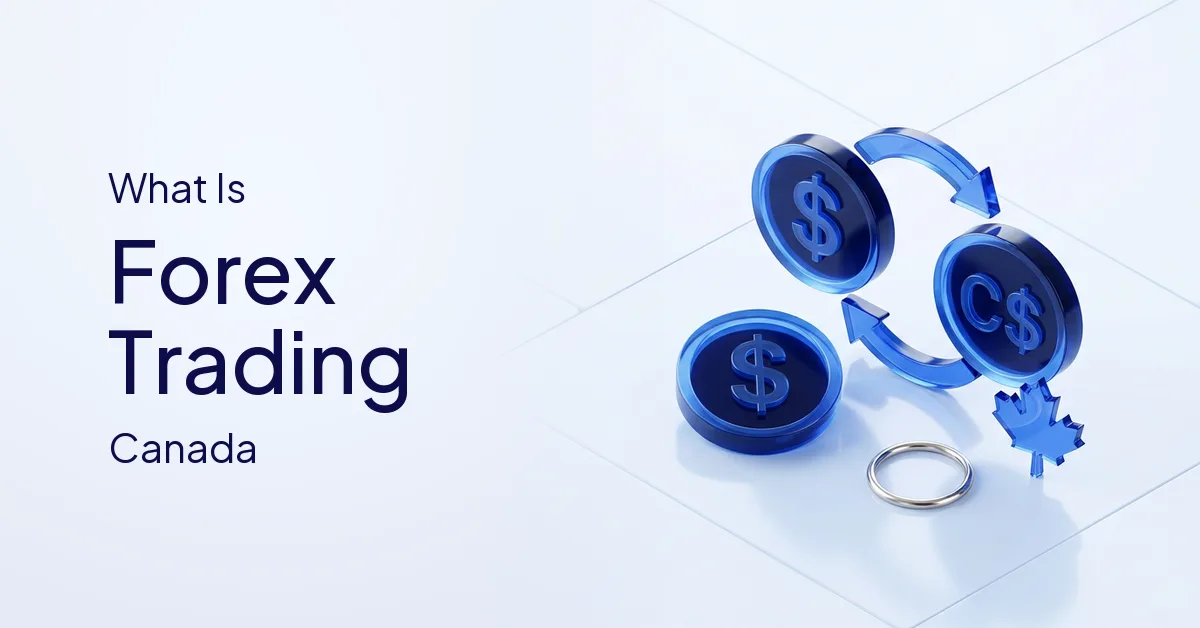
Forex trading means buying one currency while selling another. In Canada, this often means looking at pairs such as USD/CAD, which shows how the US dollar moves against the Canadian dollar.
At first, forex can look simple because it is based on exchange rates. But there are a few important ideas to understand before trading, including currency pairs, spreads, lot sizes, leverage, risk, and Canadian regulation.
This article explains those basics in a clear order, starting with what forex trading means and then moving into how it works for Canadian traders.
What is the First Thing to Understand About Forex
Most beginners enter forex through a price quote.
They see something like USD/CAD at 1.3500 and assume they are looking at one number. But that number is actually telling a small story: how much one currency is worth compared with another.
In this case, USD/CAD at 1.3500 means one US dollar is worth 1.35 Canadian dollars.
That is the starting point of forex. You are not looking at a company, a product, or a single asset moving on its own. You are looking at a relationship between two currencies.
This is why the same currency can behave differently depending on the pair. The Canadian dollar may weaken against the US dollar but hold up better against another currency. The question is always: compared with what?
For Canadian traders, this makes USD/CAD a useful pair to start with because the relationship already feels familiar. It connects to travel, imports, cross-border shopping, oil prices, Bank of Canada decisions, and US economic news.
Once that idea becomes clear, the rest of forex becomes easier to follow. The chart is not just moving up and down randomly. It is showing how the market is pricing one currency against another in real time.
How Forex Trading Works in Canada
A basic forex trade usually follows a simple path. A trader opens an account with a broker, deposits funds, chooses a currency pair, and decides whether to buy or sell. The result depends on whether the exchange rate moves in the direction the trader expected.
Consider a Canadian trader who believes the US dollar may strengthen against the Canadian dollar. They might look at the USD/CAD pair. If USD/CAD rises, one US dollar buys more Canadian dollars than before. If the trader positioned correctly, the trade may show a profit. If the exchange rate moves against them, the trade may show a loss.
This is where many beginners get confused: the order of the pair matters.
USD/CAD and CAD/USD are not just the same thing written differently. They express the same relationship from opposite directions.
| Pair | What it means |
| USD/CAD | How many Canadian dollars are needed to buy one US dollar |
| CAD/USD | How many US dollars are needed to buy one Canadian dollar |
If USD/CAD is 1.3500, that means one US dollar equals 1.35 Canadian dollars. The US dollar is the currency being measured, and the Canadian dollar is the currency used to express the price.
Once that is clear, the next step is understanding how forex prices are quoted by understanding currency pairs.
What Currency Pairs Are
A currency pair is the price relationship between two currencies. The first currency is called the base currency. The second currency is called the quote currency. The exchange rate tells you how much of the quote currency is needed to buy one unit of the base currency.
| Pair | Base currency | Quote currency | What the quote means |
| USD/CAD | US dollar | Canadian dollar | How many CAD are needed to buy 1 USD |
| CAD/USD | Canadian dollar | US dollar | How many USD are needed to buy 1 CAD |
| EUR/USD | Euro | US dollar | How many USD are needed to buy 1 EUR |
| GBP/CAD | British pound | Canadian dollar | How many CAD are needed to buy 1 GBP |
This is why forex can feel confusing at first. You are not simply asking whether a currency is strong. You are asking which currency it is strong or weak against.
For example, the Canadian dollar may strengthen against one currency while weakening against another. Its value always depends on the comparison being made.
Major, Minor, and Exotic Currency Pairs
After understanding the structure of a currency pair, it becomes easier to understand how pairs are commonly grouped.
Major currency pairs include the US dollar and are usually among the most actively traded pairs in the world.
| Major pair | Currencies involved |
| EUR/USD | Euro and US dollar |
| USD/JPY | US dollar and Japanese yen |
| GBP/USD | British pound and US dollar |
| USD/CAD | US dollar and Canadian dollar |
| AUD/USD | Australian dollar and US dollar |
| USD/CHF | US dollar and Swiss franc |
Major pairs often have high liquidity, meaning there are many buyers and sellers active in the market. Higher liquidity can help keep spreads tighter, although costs still vary by broker and market conditions.
Minor currency pairs include major global currencies but do not include the US dollar.
| Minor pair | Currencies involved |
| EUR/GBP | Euro and British pound |
| EUR/CAD | Euro and Canadian dollar |
| GBP/CAD | British pound and Canadian dollar |
| AUD/JPY | Australian dollar and Japanese yen |
Minor pairs can still be active, but they may have wider spreads than the most heavily traded major pairs.
Exotic currency pairs usually combine a major currency with a currency from an emerging or smaller economy, such as the Mexican peso, South African rand, or Turkish lira. These pairs can move sharply and may have wider spreads and lower liquidity. For beginners, they can be more difficult to understand and more expensive to trade.
Why USD/CAD Matters for Canadian Traders
For Canadian beginners, USD/CAD is one of the most useful pairs to understand because it connects directly to everyday life.
When USD/CAD rises, the US dollar is generally strengthening against the Canadian dollar. Canadians may need more Canadian dollars to buy the same amount of US dollars. This can affect travel costs, cross-border shopping, imports, and other expenses linked to US pricing.
When USD/CAD falls, the Canadian dollar is generally gaining ground against the US dollar. Canadians may need fewer Canadian dollars to buy the same amount of US dollars.
| USD/CAD rate | What it means |
| 1.3000 | 1 USD = 1.30 CAD |
| 1.3500 | 1 USD = 1.35 CAD |
| 1.4000 | 1 USD = 1.40 CAD |
If USD/CAD moves from 1.3500 to 1.4000, the US dollar has strengthened against the Canadian dollar. If it moves from 1.3500 to 1.3000, the Canadian dollar has strengthened against the US dollar.
This pair is also useful because it prepares beginners to understand how profits and losses are calculated.
How Profits and Losses Are Measured
Forex profits and losses come from changes in exchange rates. To understand those changes, beginners need to know three basic terms: pips, spreads, and lot sizes.
A pip is a small unit of price movement in a currency pair. For many major currency pairs, a pip is measured at the fourth decimal place. If EUR/USD moves from 1.0800 to 1.0810, that is a movement of 10 pips.
A pip may look small, but its financial effect depends on the size of the trade. That is why the next term matters.
A lot size is the size of a forex position.
| Lot type | Units of base currency |
| Standard lot | 100,000 units |
| Mini lot | 10,000 units |
| Micro lot | 1,000 units |
The larger the position, the more each pip movement can affect the account. A small exchange-rate movement can create a meaningful gain or loss if the position size is large.
The third term is the spread. The spread is the difference between the bid price and the ask price.
| Price type | Example price |
| Bid | 1.3500 |
| Ask | 1.3502 |
| Spread | 2 pips |
The bid price is the price at which a trader can sell. The ask price is the price at which a trader can buy. The spread is a trading cost because the trade begins with a small gap that must be overcome before it becomes profitable.
This cost may seem minor on one trade, but it matters over time, especially for traders who trade frequently or use larger position sizes.
What Leverage Means in Forex Trading
Once position size is understood, leverage becomes easier to explain.
Leverage allows a trader to control a larger position with a smaller amount of money. Instead of depositing the full value of the trade, the trader deposits a portion called margin, and the broker provides access to a larger position.
This can increase potential gains, but it also increases potential losses. Leverage does not only magnify winning trades. It magnifies both directions equally.
For example, if a trader uses leverage and the market moves in their favour, the gain may be larger than it would have been without leverage. But if the market moves against them, the loss can also grow quickly.
Leverage is one of the main reasons forex can be risky for beginners. To understand that risk more fully, it helps to look at what makes currency prices move in the first place.
What Makes Currency Prices Move
Currencies move because economic expectations change. Traders, banks, institutions, businesses, and investors are constantly responding to new information about economies and financial conditions.
Several factors can affect currency prices.
| Factor | Why it matters |
| Interest rates | Higher or lower rates can affect demand for a currency |
| Inflation | High inflation can weaken purchasing power |
| Employment data | Strong or weak job figures can influence economic expectations |
| Economic growth | A stronger economy may support its currency |
| Central bank policy | Decisions from the Bank of Canada or the US Federal Reserve can shift expectations |
| Commodity prices | Especially relevant for Canada because of its commodity-linked economy |
| Market sentiment | Investors may move toward or away from currencies during uncertainty |
| Political and global events | Elections, trade tensions, and crises can affect currency demand |
For Canada, commodity prices are especially relevant because the Canadian economy has strong links to natural resources. Oil prices and global demand can influence how investors view the Canadian dollar.
Still, knowing what affects currencies is not the same as being able to predict them. A market may react differently from what beginners expect. Good economic news does not always lead to a stronger currency, and bad news does not always lead to an immediate decline. Prices often reflect expectations, positioning, and broader market sentiment, not just the headline itself.
Why Forex Trading Is Risky
Because currency prices can move quickly, forex trading involves significant risk. That risk becomes greater when leverage is used.
A trader can lose money because the exchange rate moves against the trade. But that is only one part of the risk. Costs, liquidity, leverage, emotions, and broker selection can all affect the outcome.
| Risk | What it means |
| Market risk | The exchange rate moves against the trade |
| Leverage risk | Losses are magnified by borrowed exposure |
| Liquidity risk | Some pairs may be harder or more expensive to trade |
| Spread cost | Every trade begins with a cost built into the bid-ask difference |
| Emotional risk | Fear, greed, or FOMO can lead to poor decisions |
| Broker and regulatory risk | An unregistered or offshore broker may reduce investor protection |
Beginners should not trade with money they cannot afford to lose. They should also understand that reading about forex is different from experiencing a leveraged trade moving against them in real time.
This is also why forex should not be treated as a quick way to make money. It is a complex, risky market where small price changes can have large effects, depending on position size and leverage.
What Canadian Beginners Should Learn Next
A beginner does not need to learn everything at once. In fact, trying to absorb every detail immediately can create more confusion.
The better starting point is the foundation: understand what a currency pair is, why USD/CAD and CAD/USD are not the same quote, and what pips, spreads, lot sizes, margin, and leverage mean.
After that, beginners can move into more specific topics, such as how forex market hours work in Canada, how to evaluate brokers, how demo accounts work, and what rules apply to margin and leverage.
The goal is not to rush from curiosity into a live trade. The goal is to understand the market well enough that the basic terms, risks, and structures become clear before money is at risk.
Forex is a market built on exchange rates. But for beginners, the first exchange is not between Canadian dollars and US dollars. It is between confusion and clarity.
Frequently Asked Questions About Forex Trading in Canada
The forex market is one of the largest financial markets in the world. The Bank for International Settlements reported that global over-the-counter foreign exchange turnover reached US$9.6 trillion per day in April 2025.
This fact helps show how active the market is, but beginners should not focus too much on the size alone. A large market does not make trading easy or low-risk.
Yes. Forex and related trading services in Canada are subject to regulation.
The Canadian Investment Regulatory Organization, or CIRO, is the main national self-regulatory organization connected to investment dealers, mutual fund dealers, and trading activity on Canada’s debt and equity marketplaces. CIRO replaced the older structure that included IIROC, so older articles may still use the IIROC name.
Canadian securities regulation also involves provincial and territorial securities regulators. Before using a forex or CFD broker, Canadian traders should check whether the firm is properly registered to operate in Canada.
No. The Canadian Investor Protection Fund, or CIPF, does not protect traders from market losses.
CIPF provides limited protection for eligible client property if a member firm becomes insolvent. It does not reverse bad trades, cover losses from leverage, or guarantee the value of an investment.
This distinction matters because investor protection is not the same thing as protection from trading risk.
Forex trading and stock trading both involve financial markets, but they are not the same.
| Forex trading | Stock trading | |
| What is traded | Currency pairs | Company shares |
| Market structure | Global, over-the-counter, decentralized | Usually exchange-based |
| Trading hours | Active 24 hours during weekdays | Usually follows exchange hours |
| Price reflects | One currency relative to another | The market value of a company |
| Leverage | Common in retail forex | Depends on account type and rules |
| Ownership | Usually no company ownership | Shares may represent ownership in a company |
When someone buys a stock, they may own part of a company. When someone trades forex through most retail platforms, they are usually speculating on price movement between two currencies.
Are forex profits taxable in Canada?
Forex profits may be taxable in Canada, but the treatment depends on the trader’s situation.
The tax treatment may depend on factors such as how often the person trades, whether the activity looks like investing or business activity, what type of account is used, and whether gains are treated as capital gains or business income.
This article does not provide tax advice. Canadian traders should review current Canada Revenue Agency guidance or speak with a qualified tax professional.
Should beginners start with exotic currency pairs?
Exotic pairs are usually more difficult for beginners because they may have wider spreads, lower liquidity, and sharper price movements.
A beginner may find it easier to first understand major pairs such as USD/CAD, EUR/USD, or GBP/USD before studying less liquid or more volatile currency pairs.
Do Canadian traders need to use Canadian brokers?
Canadian traders should check whether any broker they consider is properly registered to operate in Canada.
Some offshore brokers may advertise higher leverage or easier access, but that may come with weaker investor protection. For beginners, broker registration and regulatory status are part of risk management.
Educational Disclaimer
This article is for informational and educational purposes only and does not constitute financial, investment, tax, or trading advice. Forex and CFD trading involve significant risk and may not be suitable for all investors. Leverage can magnify both profits and losses, and traders may lose more than their initial investment depending on the product and account terms. Always do your own research and consider speaking with a qualified financial advisor or tax professional before making investment, tax, or trading decisions.
Tags


Open Live Account
 Email Address
 Phone Number
Important Notice
STARTRADER does not accept any applications from Australian residents.
To comply with regulatory requirements, clicking the button will redirect you to the STARTRADER website operated by STARTRADER PRIME GLOBAL PTY LTD (ABN 65 156 005 668), an authorized Australian Financial Services Licence holder (AFSL no. 421210) regulated by the Australian Securities and Investments Commission.
Important Notice for Residents of the United Arab Emirates
In alignment with local regulatory requirements, individuals residing in the United Arab Emirates are requested to proceed via our dedicated regional platform at startrader.ae, which is operated by STARTRADER Global Financial Consultation & Financial Analysis L.L.C.. This entity is licensed by the UAE Capital Market Authority (CMA) under License No. 20200000241, and is authorised to introduce financial services and promote financial products in the UAE.
Please click the "Continue" button below to be redirected.


